
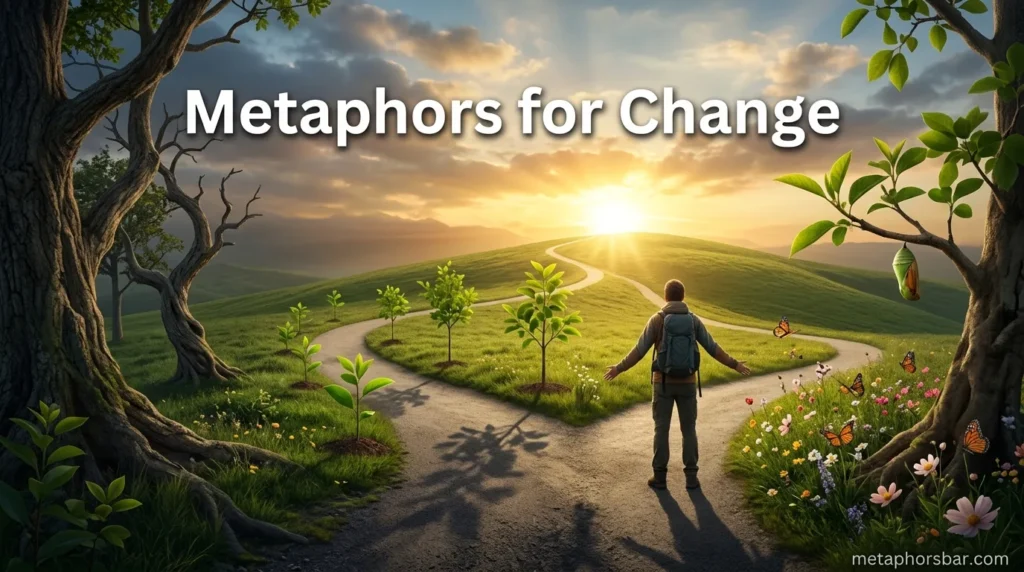
Change rarely arrives with a neat announcement. It slips in like weather shifting at dusk, like a door left open, like a road that bends just when you thought you knew the way. One day everything feels familiar; the next, the air is different, and even your own thoughts seem to move in new directions. Change can be unsettling, but it can also be the very force that carries us forward.
That is where metaphors for change become so useful. They help us describe transformation in a way that feels human, vivid, and memorable. Instead of saying only that something changed, metaphors let us show how it changed—whether it felt like breaking, blooming, sailing, or waking up.
In writing, speaking, journaling, social media captions, speeches, and storytelling, metaphors for change can bring emotion and clarity to ideas that are often hard to explain directly. They help readers see growth, loss, renewal, and reinvention with fresh eyes.
Why Metaphors for Change Matter in Writing and Daily Life
Change is one of the most universal experiences we have. People change careers, homes, habits, beliefs, relationships, and dreams. Seasons change. Cities change. We change, often in ways we do not notice until much later.
Metaphors make those experiences easier to understand and more powerful to express. They can:
- give emotional weight to transformation
- make abstract ideas feel concrete
- help readers connect with your message
- add beauty, depth, and rhythm to your language
A good metaphor for change does more than describe movement. It reveals meaning.
1. Change as a River
Meaning and Explanation
This is one of the most timeless metaphors for change. A river is never still, yet it remains itself. It flows, bends, deepens, and shifts around obstacles. That makes it a beautiful symbol of transformation, progress, and continuity.
Change as a river suggests that life moves forward whether we resist it or not. It also suggests that change is natural, even necessary. A river does not apologize for moving; it simply follows its course.
Example Sentence or Scenario
Life moved like a river after the move—sometimes calm, sometimes rushing, but always heading somewhere new.
In a real-life story, imagine someone beginning college in a new city. At first, everything feels strange and uncertain. Then routines form, friendships grow, and the days begin to carry the person forward, like water finding its way downstream.
Alternative Ways to Express It
- change flows like water
- life is a moving stream
- transformation follows the current
- growth is a river winding through time
Sensory or Emotional Details
A river metaphor often brings sound and motion to mind: the hush of current, the shimmer of sunlight on water, the pull of movement. Emotionally, it can feel peaceful, inevitable, or even a little sad, because a river cannot be held still.
Mini Storytelling Touch
An old fisherman once told his grandson that “the river is never the same twice.” The boy looked at the water and saw only the surface. Years later, after heartbreak, after leaving home, after beginning again in a new country, he understood. The river had been teaching him all along: change is not the enemy of life. It is the shape life takes.
2. Change as a Butterfly Emerging from a Cocoon
Meaning and Explanation
This metaphor captures change as transformation after a period of waiting, stillness, or vulnerability. A cocoon symbolizes limitation, but also protection and preparation. The butterfly represents emergence, beauty, and a completely new stage of being.
This metaphor is especially powerful when describing personal growth, healing, recovery, or reinvention. It reminds readers that visible change often begins in hidden places.
Example Sentence or Scenario
After months of silence and self-doubt, she emerged from the cocoon of grief with a steadier voice and a stronger heart.
In a real-life context, this could describe someone returning to creativity after burnout, or someone rebuilding confidence after a difficult breakup. The change is not instant. It is slow, inward, and deeply earned.
Alternative Ways to Express It
- change as emerging into the light
- transformation as unfolding wings
- growth as becoming something new
- rebirth after stillness
Sensory or Emotional Details
This metaphor carries a feeling of tension followed by release. There is the weight of the cocoon, the fragility of the wings, the first trembling flight. It can feel hopeful, delicate, and triumphant all at once.
Literary or Cultural Reference
The butterfly has long been a symbol of transformation in literature and culture. Across many traditions, it represents the soul, renewal, and the beauty that can come after confinement. Its power lies in the fact that the butterfly does not simply appear—it is made through change.
3. Change as Renovation or Rebuilding a House
Meaning and Explanation
This metaphor presents change as something practical, layered, and intentional. A house being renovated is still standing, but parts of it are being repaired, redesigned, or replaced. This works well for describing identity, habits, relationships, organizations, or even entire communities.
It suggests that change does not always mean starting from scratch. Sometimes it means strengthening what already exists, removing what no longer works, and making space for something better.
Example Sentence or Scenario
He was not becoming someone else; he was renovating the house of himself, room by room, wall by wall.
This metaphor can be especially meaningful in real life for someone recovering from a period of hardship. A person might keep their core values while changing routines, boundaries, or goals.
Alternative Ways to Express It
- rebuilding from the inside out
- remodeling the self
- restoring what time has worn down
- redesigning the foundation
Sensory or Emotional Details
Renovation brings in imagery of dust, tools, open walls, hammering, fresh paint, and scaffolding. Emotionally, it may feel messy before it feels beautiful. That messiness is part of the process. Not all change is graceful, and this metaphor honors that truth.
Real-Life Example
Think of someone after a difficult year. They may begin therapy, change jobs, reconnect with family, or develop healthier habits. The transformation may not look dramatic from the outside, but internally, the architecture of life is being reworked.
How to Choose the Right Metaphor for Change
The best metaphor depends on the kind of change you want to describe.
Use a river when you want to show movement, flow, inevitability, or adaptation, Use a butterfly emerging from a cocoon when you want to show growth, rebirth, and hidden transformation, Use renovation or rebuilding a house when you want to show intentional, layered, and sometimes messy change.
A strong metaphor should fit the emotion of the moment. Change can be gentle or disruptive, joyful or painful, visible or invisible. The language should match that truth.
Interactive Exercises: Practice Creating Your Own Metaphors for Change
Exercise 1: Compare Your Own Change
Think of a change you have experienced—a new job, a move, a relationship ending, a habit you built, a fear you overcame.
Complete this sentence: “This change feels like ______ because ______.”
Example: “This change feels like a forest path because I cannot see the whole road yet, but I know I am moving forward.”
Exercise 2: Sensory Transformation
Write five words connected to change:
- one sound
- one texture
- one color
- one movement
- one emotion
Then turn them into a metaphor.
Example: Change sounds like branches creaking in the wind, feels like wet earth underfoot, and looks like dawn reaching over a hill.
Exercise 3: Story Starter
Write a short paragraph beginning with: “Change arrived like…”
Let the metaphor guide the mood of the paragraph. You can make it hopeful, uneasy, surprising, or tender.
Exercise 4: Social Media Caption Practice
Turn a metaphor into a short caption or post.
Examples:
- “Becoming is a river, not a lightning strike.”
- “Some changes begin in quiet rooms.”
- “I am renovating my life, one wall at a time.”
Bonus Tips for Using Metaphors for Change in Writing, Social Media, and Daily Life
In writing
Use metaphors for change to deepen themes in essays, poems, memoirs, and fiction. They help readers feel the emotional shape of transformation.
In speeches or presentations
A metaphor can make a big idea easier to remember. Saying “our team is rebuilding the foundation” is often more powerful than saying “we are improving our process.”
On social media
Metaphors give captions personality and atmosphere. A single line can turn a simple photo or post into something reflective and shareable.
In journaling
Writing about change metaphorically can help you process emotions without forcing them into plain language too soon. It creates distance, clarity, and sometimes healing.
Avoid overcomplicating it
The best metaphors are vivid but clear. Too many layers can blur the message. Keep the image strong and the feeling honest.
SEO-Friendly Subheading Ideas for Related Content
If you are building content around this topic, these related keyword phrases can also help:
- metaphors for change in life
- change metaphors in writing
- symbolic ways to describe transformation
- creative metaphors for personal growth
- examples of metaphors for change and growth
These phrases naturally connect with topics like self-improvement, resilience, storytelling, and inspirational writing.
FAQs
1. What is a metaphor for change?
A metaphor for change is a figure of speech that describes transformation by comparing it to something else, like a river, butterfly, or rebuilding project.
2. Why are metaphors for change useful?
They make abstract ideas like growth, transition, and transformation easier to understand and more emotionally powerful.
3. Can metaphors for change be positive and negative?
Yes. Change can feel hopeful, painful, uncertain, or freeing, and the metaphor should match that mood.
4. What is a simple metaphor for change?
A simple example is: Change is a river. It is easy to imagine and carries a strong sense of motion.
5. How do I make my own metaphor for change?
Think about how the change feels, then compare it to something with a similar motion, texture, or emotional shape.
6. Are metaphors for change only for creative writing?
No. They are useful in essays, speeches, journal entries, captions, and everyday conversations.
7. What makes a good metaphor for change?
A good metaphor is clear, emotionally fitting, and vivid enough to help the audience picture or feel the transformation.
Conclusion
Change is one of life’s most constant visitors, yet it is also one of the hardest things to describe. It can feel like drifting, breaking, blooming, rebuilding, or beginning again. Metaphors give us language for all of it.
Whether change is a river carrying you forward, a butterfly opening its wings, or a house being renovated from the inside out, the right metaphor can reveal the deeper truth beneath the transition. It can turn uncertainty into image, emotion into language, and experience into something others can truly see.