
Have you ever felt a hollow ache in your chest, a longing for something you cannot quite touch, a dream just beyond reach? Maybe it was for a person, a place, or a moment that slipped by. That feeling is called yearning—an emotion so universal it has echoed in poems, songs, and stories across cultures for centuries.
Yearning is more than just wanting; it’s a deep pull, a stretch of the soul toward something it craves. And one of the most beautiful ways to express yearning is through metaphors. Metaphors take feelings that are hard to describe and paint them into images our minds can see and feel. They help us communicate longing in ways words alone sometimes cannot.
In this article, we’ll explore vivid metaphors for yearning, give examples and exercises, and even share tips for using them in writing, social media, and daily life. By the end, you’ll not only understand yearning more deeply, but you’ll also be able to express it in a way that touches hearts.
What Does “Yearning” Really Mean?
Yearning is that deep, almost ache-like longing. It’s different from a simple want or wish. It’s like your soul stretching toward something it senses but cannot fully reach. It might be missing someone far away, wishing for a new adventure, or dreaming of a life that feels just out of grasp.
Understanding this feeling helps us connect with ourselves and with others. Writers, poets, and storytellers often use metaphors for yearning to make emotions visible, tangible, and relatable.
“Yearning is a Flame in the Heart”
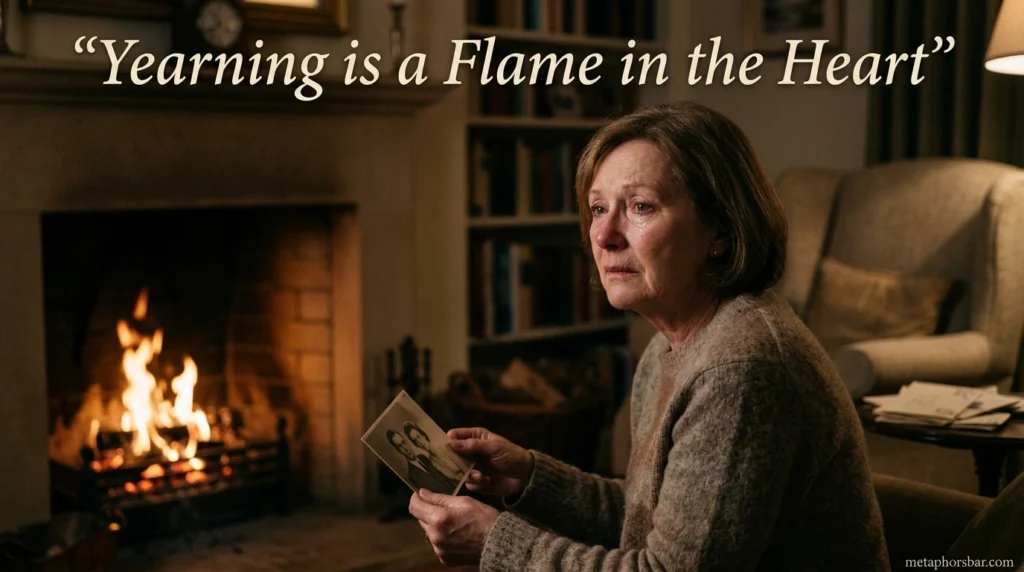
Meaning/Explanation: This metaphor compares longing to a fire burning inside you—warm, persistent, sometimes painful. Just like a flame, yearning can be bright, small, or dangerously strong.
Example Sentence: “Her yearning for home was a flame in her heart, flickering with every memory of the garden she had left behind.”
Alternative Expressions: “A spark of desire,” “a smoldering fire,” “an ember of hope.”
Mini Story: Imagine a sailor far from shore, watching the horizon. Each sunset reminds him of the village he misses. His heart burns quietly but constantly, never forgetting what it wants.
Exercise for Readers: Write a short paragraph describing your deepest longing as a fire. Is it gentle, fierce, or consuming? What color is the flame? What does it light up inside you?
“Yearning is a River Running to the Sea”
Meaning/Explanation: A river flows tirelessly, bending and turning, always seeking the ocean. This metaphor shows how yearning is a natural, ongoing force, pulling us toward something greater.
Example Sentence: “His yearning for adventure ran like a river to the sea, unstoppable, carving paths through every obstacle in his life.”
Alternative Expressions: “A tide of longing,” “currents of desire,” “a stream of hope.”
Cultural Reference: Many cultures use rivers to symbolize life, journeys, and longing—like the Ganges in India or the Mississippi in America, representing constant movement toward fulfillment.
Exercise for Readers: Draw a river on paper, labeling its twists and turns with your dreams and desires. Where does it flow? What blocks it? How does it find its way?
“Yearning is a Bird with Unbroken Wings”
Meaning/Explanation: This metaphor gives yearning a sense of freedom, restlessness, and hope. Like a bird longing to fly, yearning cannot be contained; it wants to explore, soar, and reach new heights.
Example Sentence: “Her yearning for freedom was a bird with unbroken wings, ready to leave the cage of her doubts.”
Alternative Expressions: “A restless spirit,” “a heart in flight,” “wings of longing.”
Mini Story: Think of Icarus in Greek mythology. He yearned to fly higher than anyone else. His wings were his dreams, carrying him toward the sun, testing the limits of longing.
Exercise for Readers: Write a short scene where you describe your yearning as a bird. Where does it fly? What does it see from above? What stops it, if anything?
Using Nature to Capture Longing
Nature is full of metaphors that mirror our inner desires. From deserts thirsting for rain to stars calling to the night sky, we can use these images to express yearning in subtle, poetic ways.
Example: “Her soul was a desert, thirsting for love as the sun burns the sand.”
Tip for Writers: Observe nature. Every plant, sky, or season can reflect emotions. Writing your yearning as part of the natural world makes it vivid and relatable.
Emotional Bridges: Connecting Yearning with Senses
Metaphors become stronger when combined with sensory detail. Instead of saying “I miss you,” you might say:
- “His absence tasted bitter, like coffee left cold.”
- “Her longing hummed in her ears, like a melody she couldn’t forget.”
These images bring the emotion to life, making readers feel the ache of yearning.
Exercise: Close your eyes and think of your strongest longing. Now, describe it as a taste, sound, or smell.
Yearning in Everyday Life
Yearning isn’t only for romance or distant dreams. It appears in small, everyday moments:
- A child longing for a lost toy.
- A student dreaming of graduation.
- An artist waiting for inspiration.
Example Sentence: “His yearning for a quiet morning was like a soft whisper, barely audible over the city’s chaos.”
Tip: Recognizing small yearnings helps you connect with yourself and write authentically.
Literary Metaphors for Yearning
Writers have long used metaphors to show longing:
- In The Great Gatsby, Gatsby’s yearning for Daisy is like a green light across the water, unreachable yet shining.
- In poetry, longing often appears as a night sky or an endless journey.
Exercise: Pick a book or poem you love. Identify a metaphor of longing. How does it make the emotion feel alive?
Social Media and Expressing Yearning Creatively
You can use metaphors to express longing on social media. Short, poetic lines grab attention and evoke emotion.
Example: “My heart is a compass, pointing to places I’ve never been.”
Tip for Creators: Pair metaphors with images—like sunsets, open roads, or birds in flight—for posts that feel personal and relatable.
Exercise: Write one metaphor about something you’re longing for today. Pair it with a photo or doodle.
Yearning as a Tool for Self-Reflection
Using metaphors to explore your longing helps you understand yourself. When you describe your desire in poetic terms, you uncover hidden feelings, dreams, and fears.
Exercise: Take five minutes to write a list of ten metaphors for something you want. Don’t overthink; let images come naturally. Review them. What patterns appear?
Bonus Tips for Using Metaphors for Yearning
- Be Specific: The more detailed the image, the stronger the emotion.
- Mix Senses: Combine sight, sound, and touch for depth.
- Use Everyday Life: Your longing can be ordinary, but your metaphors make it extraordinary.
- Keep it Short for Social Media: Short metaphors with punchy images work well online.
- Experiment: Try turning your yearning into a poem, sketch, or short story.
Interactive Prompt: Take a small longing—a cup of tea, a walk in the park, a phone call to a friend—and turn it into one vivid metaphor. Share it with a friend or write it in a journal.
FAQs About Metaphors for Yearning
What are metaphors for yearning?
Metaphors for yearning are creative comparisons that express deep desire, longing, or emotional craving in vivid ways.
Why are metaphors for yearning important in writing?
They help writers convey emotions more powerfully, making feelings of longing more relatable and memorable for readers.
What is an example of a metaphor for yearning?
“My heart was a compass always pointing toward you” is a metaphor showing emotional longing and desire.
Are yearning metaphors only romantic?
No. They can describe longing for success, home, freedom, peace, memories, or personal goals.
Where are metaphors for yearning commonly used?
They appear in poetry, novels, songs, speeches, and emotional storytelling to deepen emotional impact.
How can I create a metaphor for yearning?
Think about images linked to desire or distance, such as oceans, stars, empty spaces, fire, or endless roads.
What emotions do yearning metaphors usually express?
They often express hope, sadness, love, nostalgia, loneliness, ambition, or emotional connection.
Do metaphors for yearning improve creative writing?
Yes. They add emotional depth, improve imagery, and help readers connect more strongly with the message.
Conclusion
Metaphors for yearning transform deep emotions into vivid imagery that readers can instantly feel and understand. Whether describing love, ambition, nostalgia, or personal dreams, these metaphors make writing more emotional, memorable, and engaging. Using creative comparisons helps bring longing to life and strengthens the emotional connection between the writer and the audience.