

Truth is not always loud. Sometimes it arrives like morning light slipping under a closed door—quiet, steady, impossible to ignore. Sometimes it cuts through confusion like a clear bell in a foggy street. And sometimes it sits beside us patiently, waiting to be noticed, even when we have spent a long time looking elsewhere.
That is what makes metaphors for truth so valuable. Truth can be hard to define in plain language because it lives in so many forms: honesty, clarity, reality, revelation, proof, and the courage to see things as they are. Metaphors help us give truth shape. They let us describe not only what is true, but what truth feels like—sharp, shining, grounding, or even uncomfortable.
In writing, conversation, journaling, speeches, and storytelling, metaphors for truth bring depth and resonance. They can make an idea more memorable, a lesson more vivid, and a message more human.
Why Metaphors for Truth Matter in Writing and Everyday Life
Truth is one of the most important ideas we encounter, yet it is often difficult to hold in a single definition. Is truth a fact? A feeling? A moral standard? A hidden thing waiting to be uncovered? Often, it is all of these at once.
Metaphors help us explain truth in ways that readers can see, hear, and feel. They can:
- make abstract ideas more concrete
- add emotional depth to writing
- help readers connect with honesty and reality
- create memorable language for essays, stories, and daily speech
A direct sentence says, “The truth was revealed.” A metaphor says, “The truth rose like the sun, and there was no arguing with its light.” That second line lingers.
Truth as a Mirror

Meaning and Explanation
This is one of the most classic metaphors for truth. A mirror reflects things as they are, not as we wish them to be. In that sense, truth can be seen as something that shows reality back to us without distortion.
This metaphor works especially well when describing self-awareness, honesty, or the need to face reality. A mirror can be flattering or unforgiving, but it does not invent what is there.
Example Sentence or Scenario
Truth is a mirror, and sometimes the hardest part is not what it shows, but our own unwillingness to look.
In a real-life situation, this might describe receiving honest feedback at work, recognizing a mistake in a relationship, or admitting a habit that no longer serves us.
Alternative Ways to Express It
- truth is a clear reflection
- honesty is a mirror held up to life
- reality is a glass surface with no disguise
- truth shows us our own face
Sensory or Emotional Details
This metaphor brings in the cool shine of glass, the stillness of a reflected face, and the unsettling clarity of being seen. Emotionally, it can feel truthful, vulnerable, and even a little painful.
Mini Storytelling Touch
A young painter once kept correcting her self-portrait, adding softness to her jawline and lightening the shadows under her eyes. Her teacher finally said, “You are painting your hope, not your face.” That sentence struck her like a bell. The mirror of truth had not asked her to be harsh—only honest. She painted it again, and this time it looked alive.
Literary or Cultural Reference
Mirrors often appear in literature as symbols of self-knowledge, illusion, and revelation. In many stories, a character must confront their reflection before they can move forward. Truth, like a mirror, asks for courage.
Truth as a Light in the Darkness
Meaning and Explanation
This metaphor presents truth as illumination. Darkness can symbolize confusion, ignorance, fear, or secrecy, while light reveals what was hidden. Truth, then, becomes the force that makes things visible.
This is a powerful metaphor when you want to show that truth brings clarity, hope, or understanding. It can also suggest that truth does not need to shout; it simply shines.
Example Sentence or Scenario
The confession was a light in the darkness, revealing a path they had not been able to see before.
This might apply to a difficult conversation, a long-hidden fact, or a sudden realization that changes everything. Truth can feel like a doorway opening in a dark room.
Alternative Ways to Express It
- truth is a lantern in the night
- honesty is a beam of light
- reality shines through the fog
- truth is dawn breaking open the sky
Sensory or Emotional Details
This metaphor adds brightness, warmth, and direction. You can almost feel the relief of seeing where you are going after wandering in uncertainty. Emotionally, it may suggest comfort, clarity, or even awakening.
Real-Life Example
Imagine someone struggling with confusion in a friendship. The situation feels cloudy until a direct, honest conversation finally explains everything. The truth does not erase the hurt, but it reveals the shape of it. Once seen clearly, the person can decide what to do next.
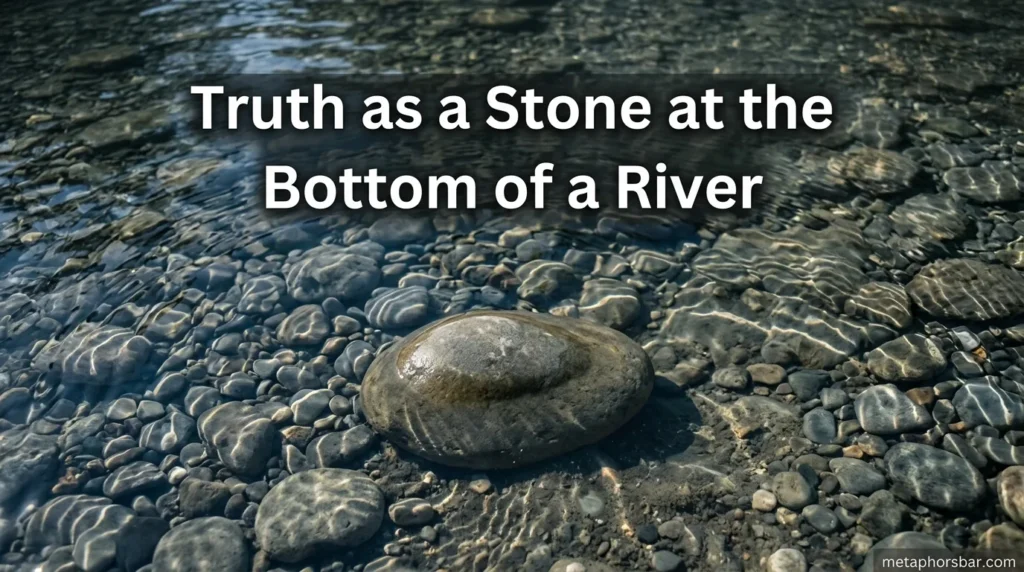
Truth as a Stone at the Bottom of a River
Meaning and Explanation
This metaphor suggests that truth is solid, enduring, and always there even when the surface is moving. Water may swirl, stories may change, and emotions may cloud the view, but the stone remains.
This is a beautiful metaphor for deep truth—the kind that does not depend on appearances or convenience. It is especially useful when describing facts, integrity, or moral certainty.
Example Sentence or Scenario
Beneath every rumor and every excuse, the truth sat like a stone at the bottom of the river, steady and untouched by the current above.
This could describe a family secret, a historical fact, or a personal realization that remains true no matter how much noise surrounds it.
Alternative Ways to Express It
- truth is an anchor in deep water
- honesty is bedrock beneath shifting ground
- reality is a stone that never drifts
- truth rests where the current cannot move it
Sensory or Emotional Details
This image gives us weight, depth, cool water, and stillness. It feels ancient and unmoving. Emotionally, it can suggest stability, certainty, or quiet strength.
Mini Storytelling Touch
An elder in a coastal village once told a child that the sea hides many things, but it never changes what lies beneath. The child remembered that years later, when facing a lie that had spread through the town. The rumors moved fast, but the truth remained where it always was—solid, patient, waiting to be found.
Cultural Reference
Many traditions treat truth as something enduring beneath appearances. Rivers, stones, and deep water often symbolize what cannot easily be shaken. It is a reminder that not all truth is obvious at first glance.
How to Choose the Right Metaphor for Truth
The best metaphor depends on what you want truth to do in your writing.
Use a mirror when you want truth to reflect reality or self-knowledge. Use a light in the darkness when you want truth to reveal, guide, or awaken, Use a stone at the bottom of a river when you want truth to feel stable, deep, and unchanging.
Truth can feel gentle or severe, comforting or confronting. The metaphor should match the tone of the moment.
Interactive Exercises: Practice Creating Your Own Metaphors for Truth
Exercise 1: Personal Reflection
Think of a time when a truth became clear to you.
Complete this sentence: “Truth felt like ______ because ______.”
Example: “Truth felt like fresh air after a closed room because it was uncomfortable at first, but then it made everything easier to breathe.”
Exercise 2: Sensory Mapping
Write five words connected to truth:
- one sound
- one color
- one texture
- one object
- one emotion
Turn them into a metaphor.
Example: Truth sounded like a bell, looked like white light, felt like cold water, and carried the weight of stone.
Exercise 3: Story Starter
Write a short paragraph that begins with:
“Truth arrived like…”
Let the image shape the mood. It can be dramatic, peaceful, painful, or hopeful.
Exercise 4: Caption Practice
Try turning a truth metaphor into a short social media caption or quote.
Examples:
- “Truth is the light that does not ask permission.”
- “Some truths are stones under moving water.”
- “The mirror never lies, even when we do.”
Bonus Tips for Using Metaphors for Truth in Writing, Social Media, and Daily Life
In writing
Use truth metaphors to strengthen essays, fiction, poetry, or reflective writing. They can add emotional texture to themes about honesty, memory, justice, or self-discovery.
In speeches or presentations
A strong metaphor can make a serious point more memorable. Saying “truth is a light that reveals the room” often lands better than saying “truth makes things clearer.”
On social media
Short, striking lines work especially well in captions, reels, and quote posts. A line like “Truth is a mirror, not a mask” can feel polished and shareable.
In conversations
Metaphors can soften or strengthen a difficult message. They help people hear meaning without feeling lectured.
Keep it precise
The best metaphors for truth should feel clear rather than vague. Truth is already a strong idea; the metaphor should sharpen it, not blur it.
SEO-Friendly Subheadings and Related Keyword Ideas
If you are writing content around this topic, these related phrases can help:
- metaphors for truth in writing
- creative ways to describe truth
- truth metaphors and examples
- figurative language for honesty
- poetic metaphors for reality
These phrases work naturally for blogs, essays, reflective pieces, and creative writing on honesty and clarity.
FAQs
1. What is a metaphor for truth?
A metaphor for truth is a figurative comparison that describes truth through another image, such as a mirror, light, or stone.
2. Why are metaphors for truth useful?
They help make abstract ideas like honesty, reality, and revelation more vivid and emotionally powerful.
3. Can truth metaphors be positive and negative?
Yes. Truth can feel comforting, freeing, painful, or confronting, and the metaphor should fit the tone.
4. What is a simple metaphor for truth?
A simple example is: Truth is a mirror. It clearly suggests reflection and honesty.
5. How do I create my own metaphor for truth?
Think about how truth feels, then compare it to something with a similar quality, movement, or emotional effect.
6. Are metaphors for truth only used in poetry?
No. They work in essays, speeches, storytelling, journaling, and everyday conversation.
7. What makes a strong metaphor for truth?
A strong metaphor is clear, meaningful, and emotionally accurate. It should help people feel the weight or clarity of truth.
Conclusion
Truth can be plain, but it is rarely simple. It reflects, reveals, grounds, and sometimes unsettles. That is why metaphors matter—they help us give truth a shape the heart can understand.
Whether truth is a mirror, a light in the darkness, or a stone beneath moving water, each image offers a different way to see what is real. And perhaps that is the quiet power of metaphor: it does not replace truth. It helps it be seen.
So when you need to speak of honesty, reality, or revelation, do not settle for flat language. Choose an image with depth. Choose words that feel as clear and enduring as truth itself.