
Transformation rarely announces itself with fanfare. More often, it begins in silence: a crack in the old shell, a slow shift in the light, a small stirring beneath the surface. One day the world looks exactly as it did before, and yet something essential has already begun to change. A person outgrows an old fear. A season turns. A heart softens. A life takes on a new shape.
That is the magic of metaphors for transformation. They help us describe change not as a flat event, but as a living, moving process. Transformation is never just about ending one thing and starting another. It is about shedding, unfolding, crossing thresholds, and becoming someone or something new.
In writing, speech, journaling, and storytelling, metaphors for transformation give shape to experiences that are often hard to name. They help readers feel the beauty, tension, and possibility of becoming.
Why Metaphors for Transformation Matter in Writing and Everyday Life
Transformation is one of the most powerful human experiences. It can be joyful, painful, frightening, healing, or all of these at once. Because it is so layered, plain language often feels too small for it.
Metaphors make transformation easier to grasp by turning it into something visible and vivid. They can:
- express growth in a more emotional way
- make abstract change feel concrete
- deepen essays, poems, stories, and reflections
- help people understand their own journey
A simple sentence says, “I changed.” A metaphor says, “I stepped out of one skin and into the morning light.” That difference gives the idea weight, beauty, and memory.
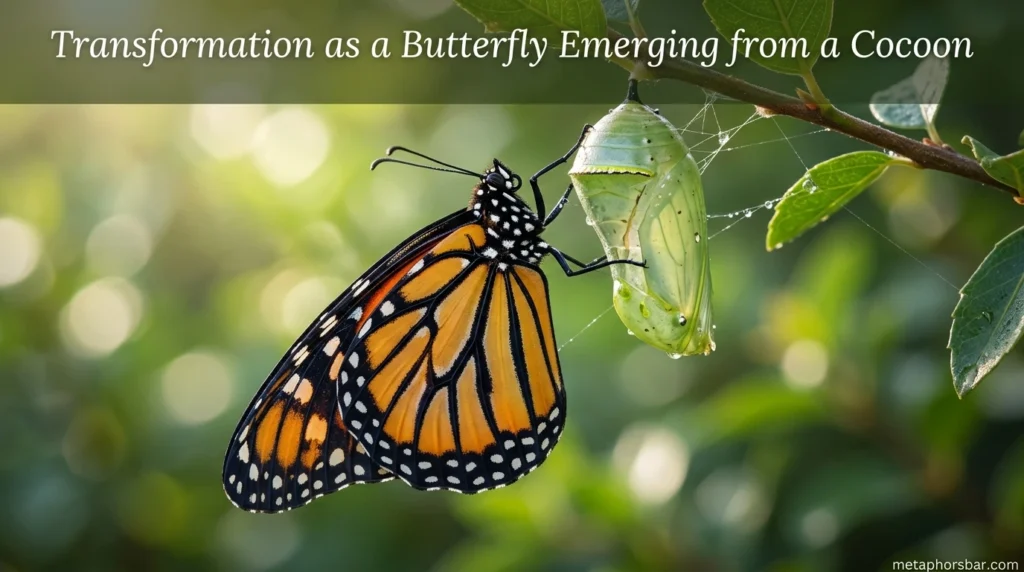
Transformation as a Butterfly Emerging from a Cocoon
Meaning and Explanation
This is one of the most classic and beloved metaphors for transformation. A cocoon represents a hidden, protected stage of development, while the butterfly represents emergence, freedom, and beauty after struggle.
This metaphor is especially powerful when describing personal growth, healing, reinvention, or a long season of change. It reminds us that transformation often begins in quiet isolation before it becomes visible to the world.
Example Sentence or Scenario
After months of grief and reflection, she emerged like a butterfly from a cocoon, fragile at first, then unmistakably alive.
This could describe someone recovering from heartbreak, rebuilding confidence, or discovering a new identity after a difficult period.
Alternative Ways to Express It
- unfolding like wings in sunlight
- breaking free from an old shell
- becoming something new in the light
- rising after a season of stillness
Sensory or Emotional Details
This metaphor brings in the feel of tightness giving way, the shimmer of wings, the first lift into open air. Emotionally, it carries tenderness, courage, and hope. There is vulnerability in the emergence, but also grace.
Mini Storytelling Touch
A woman once spent years putting everyone else first, until burnout forced her to stop. For a long while, she felt as though her life had gone still. But in that stillness, she began to heal, to write, to choose herself again. By the time she returned to the things she loved, she was not the same person who had entered that quiet season. She had become, in every sense, a butterfly leaving the cocoon.
Literary and Cultural Reference
The butterfly is a universal symbol in literature and culture, often representing rebirth, soul, and metamorphosis. It appears in poems, myths, and spiritual traditions because its change is so visible and so complete. It does not merely improve—it transforms.
Transformation as a Phoenix Rising from Ashes
Meaning and Explanation
The phoenix is a legendary creature that is reborn from fire and ashes. This metaphor is ideal for transformation after destruction, loss, or failure. It suggests that what seemed to be an ending can become the beginning of a new and stronger self.
This metaphor carries dramatic power. It is often used when someone rebuilds after hardship, recovers after collapse, or returns with new strength after being broken down.
Example Sentence or Scenario
Out of the ashes of disappointment, he rose like a phoenix, carrying wisdom where he once carried pain.
This could describe someone starting over after losing a business, leaving an unhealthy relationship, or recovering from a deep personal crisis.
Alternative Ways to Express It
- rising from the fire
- rebuilding from the remains
- reborn after ruin
- standing again from the ashes
Sensory or Emotional Details
This image glows with heat, smoke, and the sharp scent of smoke after a fire. Emotionally, it feels fierce, triumphant, and unforgettable. It is transformation with edges, with power, with scars that do not hide the past but prove survival.
Mini Storytelling Touch
A musician lost nearly everything—his home, his instruments, his confidence—after a flood destroyed his studio. For weeks, he could not imagine playing again. But slowly, neighbors brought him a keyboard, a notebook, a place to sit. What emerged from that loss was not just a comeback. It was a new voice, deeper and more human than before. A phoenix does not return untouched. It returns changed.
Cultural Reference
The phoenix has appeared in ancient myths across cultures, from Greek and Egyptian traditions to modern literature and film. Its enduring appeal comes from the idea that destruction does not always mean the end. Sometimes it clears the way for rebirth.
Transformation as a River Changing Course

Meaning and Explanation
A river is always moving, always becoming, always shaped by the land it crosses. But it also reshapes the land in return. This metaphor beautifully captures transformation as a natural, ongoing process rather than a sudden event.
It works especially well when describing life transitions, emotional growth, or shifts in identity. It suggests movement, adaptability, and the quiet power of time.
Example Sentence or Scenario
Her life changed course like a river after the storm, finding a new path through land she had never expected to cross.
This could describe someone changing careers, moving to a new country, or discovering a new purpose after years of uncertainty.
Alternative Ways to Express It
- flowing into a new path
- turning toward a different current
- carving a new way through the landscape
- following the bend in the river
Sensory or Emotional Details
This metaphor is full of motion: the sound of water, the press of current, the glint of sunlight on the surface, the feeling of being carried forward. Emotionally, it can feel peaceful, inevitable, or quietly brave.
Mini Storytelling Touch
An old mapmaker once said that no river ever apologizes for changing its course. It simply follows what the land asks of it. That idea stayed with a young teacher who had planned one life but found another. She had expected to follow a straight road, but life bent like a river, leading her into a vocation she had never considered. She later said the detour was not a mistake. It was transformation in motion.
How to Choose the Right Metaphor for Transformation
Different forms of transformation call for different images.
Use a butterfly emerging from a cocoon when the change is personal, delicate, and beautiful after a period of hidden growth. Use a phoenix rising from ashes when the change follows destruction, loss, or deep struggle, Use a river changing course when the change is gradual, natural, and shaped by time and experience.
The best metaphor should match the emotional truth of the transformation. Some changes are soft. Some are fierce, Some are steady and almost invisible until one day the whole landscape looks different.
Interactive Exercises: Practice Creating Your Own Metaphors for Transformation
Exercise 1: Map Your Own Change
Think of a transformation you have experienced or are experiencing now.
Complete this sentence: “My transformation feels like ______ because ______.”
Example: “My transformation feels like a tree stretching toward sunlight because it has taken time, patience, and a lot of unseen effort.”
Exercise 2: Sensory Expansion
Write down five words connected to your transformation:
- one sound
- one color
- one texture
- one movement
- one emotion
Then turn them into a metaphor.
Example: Transformation sounded like rain on a roof, looked like dawn breaking through fog, felt like wind opening a window, and moved like roots spreading underground.
Exercise 3: Story Starter
Begin a short paragraph with: “Transformation came like…”
Let the image shape the mood. It can be hopeful, dramatic, quiet, or uncertain.
Exercise 4: Caption Practice
Try turning your metaphor into a short quote, caption, or journal line.
Examples:
- “Becoming is not always loud.”
- “Some transformations begin in ashes, others in silence.”
- “I am not who I was, and that is the point.”
Bonus Tips for Using Metaphors for Transformation in Writing, Social Media, and Daily Life
In writing
Use transformation metaphors in essays, fiction, memoir, and poetry to deepen your theme. They make emotional change feel more layered and memorable.
On social media
A concise metaphor can turn an ordinary post into something reflective and shareable. For example: “Still becoming” or “Rising from my own ashes” can carry a lot of meaning in very few words.
In journaling
If you are in the middle of a life shift, metaphors can help you understand it. Writing “I feel like a river finding a new bend” may reveal more than simply saying “I am changing.”
In conversation
Metaphors can help describe growth without sounding overly formal. They make your reflections feel more alive and personal.
Use only as much as you need
One strong metaphor is often enough. Too many images can blur the message. Let the metaphor breathe.
SEO-Friendly Subheadings and Related Keyword Ideas
If you are building content around this topic, these related phrases may help:
- metaphors for transformation in writing
- creative ways to describe transformation
- transformation metaphors and examples
- figurative language for change and growth
- poetic metaphors for becoming
These terms work well for articles, speeches, essays, self-reflection pieces, and creative writing topics.
FAQs
1. What is a metaphor for transformation?
A metaphor for transformation is a figurative comparison that describes change through another image, such as a butterfly, phoenix, or river.
2. Why are metaphors for transformation useful?
They make change feel more vivid, emotional, and understandable, especially when the process is hard to explain directly.
3. Can transformation metaphors be positive and painful at the same time?
Yes. Real transformation often includes both struggle and hope, loss and renewal.
4. What is a simple metaphor for transformation?
A simple example is: Transformation is a butterfly leaving its cocoon.
5. How do I create my own metaphor for transformation?
Think about how the change feels, then compare it to something with a similar movement, texture, or emotional energy.
6. Are transformation metaphors only for poetry?
No. They are useful in storytelling, essays, speeches, captions, journaling, and everyday language.
7. What makes a strong metaphor for transformation?
A strong metaphor is clear, emotionally fitting, and rich enough to help the reader see and feel the change.
Conclusion
Transformation is never only about leaving one form behind. It is about crossing into something newly alive. It can happen slowly or all at once, in fire or in silence, through endings, beginnings, or both at once, It changes not only what we are, but how we see ourselves.
That is why metaphors matter. A butterfly, a phoenix, a river—each one gives transformation a different voice. One shows emergence, one shows rebirth, one shows flow. Together, they remind us that becoming is rarely simple, but it is always meaningful.
So when you need to write about change, do not settle for plain description alone. Choose an image that carries the truth of the journey. Let your words move, burn, unfold, and rise. That is where transformation becomes unforgettable.