

There are moments in life when everything feels just a little too heavy—like carrying a bag that keeps filling with unseen weight. And then, quietly, someone reaches out. A word, a gesture, a presence. Suddenly, the burden doesn’t vanish, but it becomes lighter, steadier, more manageable. That is support—not loud, not always visible, but deeply felt.
Yet describing support can be difficult. It’s not always something you can point to or measure. That’s where metaphors for support become powerful. They give form to something emotional and often invisible, helping us express care, strength, and connection in ways that resonate.
Whether you’re writing a heartfelt message, crafting a story, or simply trying to explain what someone means to you, metaphors can turn support into something vivid and unforgettable.
Why Metaphors for Support Matter in Writing and Communication
Support is one of the most essential human experiences. It appears in friendships, families, workplaces, and communities. But simply saying “I support you” doesn’t always capture the depth of that feeling.
Metaphors help by:
- making emotional support easier to understand and feel
- adding warmth and imagery to writing and speech
- strengthening connections through expressive language
- helping people articulate gratitude and encouragement
Instead of saying, “She helped me,” you might say, “She was my anchor in a storm.” That image carries weight, emotion, and meaning.
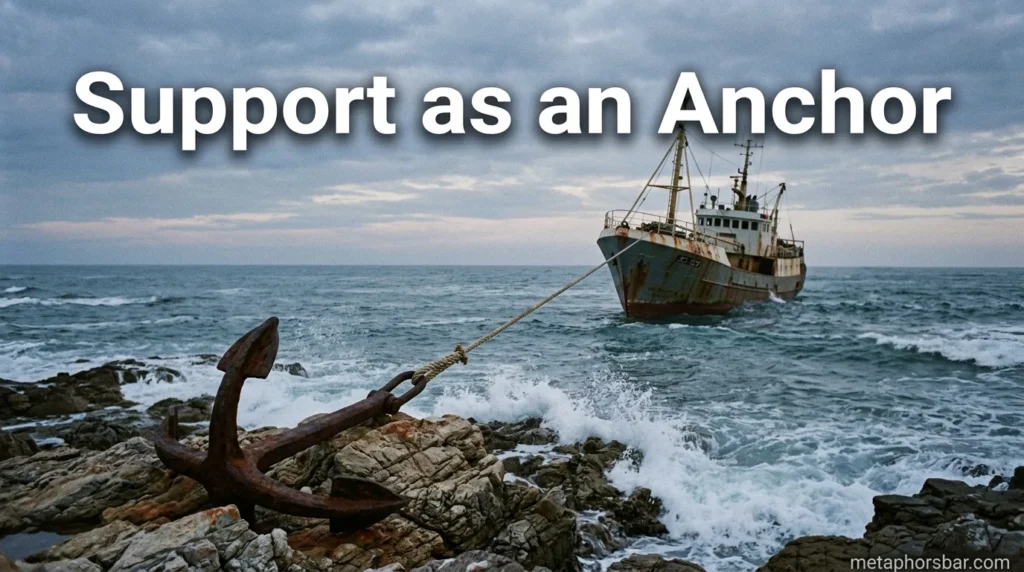
Support as an Anchor
Meaning and Explanation
This metaphor compares support to an anchor—something that holds steady when everything else is moving. It suggests stability, grounding, and reliability, especially during difficult or uncertain times.
It’s perfect for describing emotional support, loyalty, or someone who keeps you grounded.
Example Sentence or Scenario
During the hardest moments of his life, his sister was his anchor, keeping him steady when everything else felt like it was drifting.
This could apply to a friend helping through stress, a mentor guiding someone, or a loved one offering reassurance during chaos.
Alternative Ways to Express It
- a steady foundation
- a grounding force
- a pillar of strength
- a rock in rough waters
Sensory or Emotional Details
You can imagine a ship in a storm, waves crashing, wind howling—but the anchor holds firm beneath the surface. Emotionally, it feels safe, secure, and dependable.
Mini Storytelling Touch
A young student once moved to a new city, overwhelmed and uncertain. Everything felt unfamiliar until a teacher took the time to guide and encourage her. Years later, she said, “I didn’t realize it then, but you were my anchor.” Support doesn’t always stop the storm—but it keeps you from being lost in it.
Support as a Bridge
Meaning and Explanation
This metaphor sees support as something that helps you move from one place to another—emotionally, mentally, or even physically. A bridge connects two points, making progress possible.
This is especially useful when describing guidance, opportunity, or encouragement that helps someone grow or move forward.
Example Sentence or Scenario
Her encouragement became a bridge, helping him cross from doubt to confidence.
This might describe a mentor helping someone start a career, a friend encouraging a big decision, or a community offering opportunities.
Alternative Ways to Express It
- a path forward
- a link between struggle and success
- a connection across distance
- a stepping stone to growth
Sensory or Emotional Details
You can imagine crossing a wide gap, feeling the solid structure beneath your feet, seeing the destination come closer. Emotionally, it feels hopeful, empowering, and forward-moving.
Real-Life Example
Think about someone who helped you take a first step—apply for something, try something new, or believe in yourself. That person didn’t walk the journey for you, but they made it possible to begin.
Mini Storytelling Touch
A small business owner once credited her success to a single conversation. Someone believed in her idea before she did. “They didn’t build my path,” she said, “but they built the bridge that helped me cross it.”
Support as a Safety Net

Meaning and Explanation
This metaphor compares support to a safety net—something that catches you if you fall. It doesn’t prevent risk, but it reduces fear and allows you to try, knowing you won’t fall alone.
This works well when describing emotional reassurance, encouragement, or systems that provide backup.
Example Sentence or Scenario
Knowing his family was there gave him a safety net, allowing him to take risks he once feared.
This might describe someone starting a new career, pursuing a dream, or facing uncertainty with confidence.
Alternative Ways to Express It
- a cushion in hard times
- a backup when things go wrong
- a protective layer
- a net beneath the fall
Sensory or Emotional Details
You can imagine falling and being caught, the sudden relief, the softness beneath impact. Emotionally, it feels reassuring, freeing, and empowering.
Mini Storytelling Touch
An aspiring artist hesitated to leave a stable job. What gave her courage wasn’t certainty—it was knowing her family supported her decision. “I knew if I fell,” she said, “I wouldn’t hit the ground.” That belief became her safety net.
How to Choose the Right Metaphor for Support
Different types of support call for different images:
- Use an anchor for stability and emotional grounding
- Use a bridge for growth and progress
- Use a safety net for reassurance and risk-taking
Choose based on the feeling you want to express.
Interactive Exercises: Create Your Own Metaphors for Support
Exercise 1: Personal Reflection
Complete this sentence: “Support feels like ______ because ______.”
Example: “Support feels like a warm blanket because it comforts me when things feel cold and uncertain.”
Exercise 2: Sensory Mapping
Describe support using:
- one object
- one texture
- one emotion
Turn it into a metaphor.
Exercise 3: Story Starter
Begin a paragraph with: “Support was like…”
Let your metaphor shape the story.
Exercise 4: Social Media Caption Practice
Try short, meaningful lines:
- “Grateful for the anchors in my life.”
- “Some people build bridges you didn’t know you needed.”
- “Strong enough to try because I have a safety net.”
Bonus Tips for Using Metaphors for Support
In Writing
Use them to deepen emotional scenes and relationships.
In Social Media
Short metaphors can express gratitude and connection.
In Daily Life
They help you articulate appreciation and feelings.
In Conversations
Metaphors can make encouragement more powerful and memorable.
Be Genuine
Choose metaphors that reflect real experiences and emotions.
FAQs About Metaphors for Support
1. What is a metaphor for support?
A metaphor for support is a figurative comparison that describes help or encouragement using imagery, like an anchor or a bridge.
2. Why use metaphors for support?
They make emotional ideas more vivid and easier to understand.
3. Can support metaphors be used in daily conversation?
Yes. They make communication more expressive and meaningful.
4. What is a simple metaphor for support?
Support is an anchor in a storm.
5. How do I create my own support metaphor?
Think about how support feels, then compare it to something with similar qualities.
6. Are support metaphors useful in writing?
Yes. They add emotional depth and clarity.
7. What makes a strong support metaphor?
Clarity, relatability, and emotional accuracy.
Conclusion
Support is one of the quiet forces that shape our lives. It doesn’t always stand in the spotlight, but it holds us steady, moves us forward, and catches us when we fall.
Through metaphors, support becomes something we can see and feel—an anchor, a bridge, a safety net. These images remind us that we are not alone, even when life feels uncertain.
So the next time you think about support, try to describe it. Give it a shape, a story, a voice. Because sometimes, the strongest connections are the ones we learn to express.