
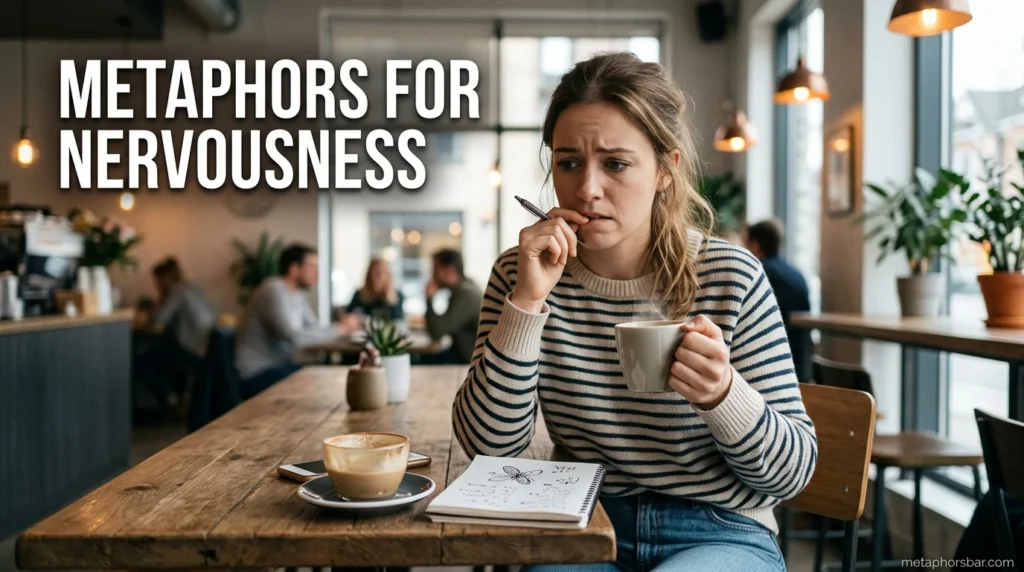
The hallway outside the interview room felt too quiet.
A clock ticked somewhere overhead, each second stretching longer than the last. The palms of her hands were damp, though the room wasn’t warm. She rehearsed her answer again under her breath, but the words tangled before they could settle. It felt as if her thoughts were pacing inside her chest, bumping into each other, refusing to line up properly.
That is nervousness.
It is not always loud. Sometimes it is a quiet storm inside the body—a flutter in the stomach, a tightening in the throat, a mind that suddenly forgets everything it once knew. Nervousness is universal, yet difficult to describe with simple words. That is why metaphors are so powerful: they turn invisible tension into vivid, relatable imagery.
A nervous moment may become a racing engine, a trembling leaf, a hive of buzzing bees, or a tightrope suspended over silence. These images help readers feel what nervousness truly is—not just understand it.
Whether you are writing fiction, poetry, speeches, captions, or personal reflections, metaphors for nervousness can bring emotional authenticity and depth to your words.
Metaphors for Nervousness: Why Anxiety Imagery Matters in Writing
The emotional meaning behind nervousness
Nervousness is a layered emotion. It often includes:
- anticipation
- fear of judgment
- excitement mixed with worry
- physical tension
- mental overthinking
- uncertainty
- vulnerability
Metaphors help translate these invisible feelings into something readers can imagine and emotionally connect with.
Why readers relate to nervousness metaphors
Everyone has felt nervous:
- before speaking publicly
- during exams or interviews
- before important decisions
- while waiting for news
- in unfamiliar situations
Because of this, nervousness metaphors are instantly relatable.
Compare:
- “She was nervous.”
- “Her nerves buzzed like electricity trapped under her skin.”
The second sentence makes the feeling physically imaginable.
Powerful Metaphors for Nervousness With Meanings and Examples
1. Nervousness is a swarm of bees inside the mind
Meaning and explanation
This metaphor represents restless thoughts, mental noise, and chaotic energy. Bees move quickly, unpredictably, and constantly, just like anxious thoughts that refuse to settle.
It is especially effective for overthinking, panic, or mental overload.
Example sentence or scenario
“As she waited for her name to be called, nervousness buzzed through her mind like a swarm of bees refusing to rest.”
Alternative ways to express it
- thoughts buzzed uncontrollably
- anxiety filled his head like noise
- her mind was a hive of restless ideas
- worry moved in chaotic patterns
Optional sensory or emotional details
Readers may imagine humming sounds, fast movement, vibration in the chest, heat rising in the face, and the feeling of being mentally crowded.
Mini storytelling touch
Many people describe exam stress or performance anxiety this way—the mind becomes too full, too loud, too fast. Like bees in a hive disturbed, thoughts keep circling without landing anywhere.
2. Nervousness is a tightrope stretched across silence
Meaning and explanation
This metaphor emphasizes balance, pressure, and fear of falling. A tightrope walker must stay perfectly steady or risk losing control. Similarly, nervousness often feels like carefully maintaining composure under scrutiny.
It is ideal for public speaking, interviews, or high-pressure situations.
Example sentence or scenario
“Standing on stage, he felt like he was walking a tightrope stretched across silence.”
Alternative ways to express it
- every word felt carefully balanced
- she walked emotionally on a thin line
- his confidence felt suspended
- tension stretched beneath every step
Optional sensory or emotional details
This metaphor evokes height, stillness, suspended breath, focused attention, and the fear of making even a small mistake.
Real-life example
Speakers often describe stage fright as a physical balancing act—one wrong move feels magnified. The tightrope metaphor captures that fragile emotional state perfectly.
3. Nervousness is a racing engine with no destination
Meaning and explanation
This metaphor describes physical and mental restlessness. Like an engine revving too fast, nervous energy builds without direction or release.
It is especially useful for physical symptoms of anxiety—restless hands, fast heartbeat, shaky breathing.
Example sentence or scenario
“Before the interview, her heartbeat felt like a racing engine that couldn’t find the brakes.”
Alternative ways to express it
- adrenaline surged uncontrollably
- his body ran on overdrive
- anxiety accelerated inside her chest
- nerves moved faster than thought
Optional sensory or emotional details
Readers may imagine pounding heartbeats, vibrating muscles, shallow breathing, heat in the chest, and constant internal motion.
Literary or cultural reference
Many psychological descriptions of anxiety compare it to “fight or flight” energy—an internal system revving up for action even when no action is needed. The engine metaphor captures that modern interpretation of nervousness well.
Creative Ways to Use Metaphors for Nervousness in Writing
In poetry and emotional writing
Nervousness metaphors help create vivid emotional landscapes.
Examples:
- “Her silence trembled like glass under pressure.”
- “Anxiety flickered through him like broken static.”
- “His thoughts ran barefoot across sharp edges.”
These lines turn internal tension into sensory experience.
In storytelling and fiction
Writers use nervousness metaphors to deepen character emotion.
Examples:
- “The room felt too small for her heartbeat.”
- “His confidence unraveled like thread under tension.”
- “She stood frozen while her thoughts sprinted ahead.”
These comparisons make internal states visible and relatable.
In social media captions and personal writing
Metaphors for nervousness can make short reflections feel powerful and authentic.
Examples:
- “All calm on the outside, storm inside.”
- “Butterflies turned into thunderstorms.”
- “Learning to breathe through the noise.”
These captions feel honest and emotionally expressive.
Interactive Exercises for Practicing Nervousness Metaphors
Exercise 1: Compare nervousness to movement or nature
Choose one:
- storm
- bees
- fire
- wind
- water
- electricity
Now create a metaphor.
Example: “Nervousness moved through him like wind shaking loose leaves from branches.”
Exercise 2: Rewrite simple sentences metaphorically
Take basic lines:
- “She was nervous.”
- “He felt anxious.”
- “They were waiting nervously.”
Rewrite them:
- “Her nerves fluttered like trapped birds.”
- “Anxiety tightened its grip around him.”
- “Waiting felt like standing on shifting ground.”
Exercise 3: Recall a nervous moment and describe it creatively
Think about:
- an interview
- exam
- performance
- first meeting
- difficult conversation
Now describe it using metaphor.
Example: “Waiting for my turn felt like balancing on a thread above silence, afraid even breathing might break it.”
Bonus Tips for Using Metaphors for Nervousness Effectively
Match the metaphor to the intensity of emotion
Different images express different levels of nervousness:
- bees → mental overthinking
- tightrope → pressure and control
- engine → physical anxiety
- storm → emotional overwhelm
Choose carefully based on tone.
Include physical sensations
Nervousness feels real in the body. Add:
- heartbeat
- trembling hands
- dry mouth
- heat or cold sensations
- shallow breathing
This makes metaphors more immersive.
Avoid overloading imagery
Too many metaphors can confuse meaning. One strong image is usually enough.
Instead of: “Nervousness was a storm, fire, and engine inside her.”
Try: “Nervousness was a storm building quietly inside her chest.”
Balance fear with relatability
Nervousness is universal, not just negative. It often signals care, importance, or excitement.
Example: “Nervousness buzzed inside her like proof that this moment mattered.”
More Metaphors for Nervousness You Can Use
Nervousness is a glass of water trembling in your hands
Perfect for visible tension.
Nervousness is a storm cloud hovering too low
Ideal for emotional pressure.
Nervousness is a violin string pulled too tight
A beautiful metaphor for emotional strain.
Nervousness is footsteps echoing in an empty hall
Great for anticipation and silence.
Nervousness is a flickering light under wind
Symbolic of unstable calm.
FAQs About Metaphors for Nervousness
1. What is a metaphor for nervousness?
A metaphor for nervousness is a symbolic comparison used to describe anxiety, tension, or uneasy feelings in a vivid way.
2. Why are nervousness metaphors useful?
They make internal emotional experiences easier to visualize and understand.
3. What are common metaphors for nervousness?
Popular examples include:
- buzzing bees
- racing engines
- tightropes
- storm clouds
- trembling glass
4. Can nervousness metaphors describe physical symptoms?
Yes. They are often used to describe heartbeat, shaking, breathlessness, and tension.
5. Are metaphors for nervousness useful in fiction?
Absolutely. They help readers connect emotionally with characters’ inner states.
6. How do I create original nervousness metaphors?
Think about how anxiety feels physically or mentally, then compare it to movement, pressure, sound, or instability.
7. Can nervousness metaphors include positive emotion?
Yes. Nervousness can also reflect excitement or anticipation, not just fear.
Conclusion
Nervousness is one of the most human emotions we experience. It appears in quiet waiting rooms, crowded stages, important conversations, and moments of change. It can feel like buzzing bees in the mind, a tightrope stretched over silence, or an engine running too fast inside the chest.
That is why metaphors for nervousness are so powerful. They give shape to something invisible, turning internal tension into vivid imagery that readers can feel and recognize.
Whether you are writing poetry, fiction, speeches, captions, or personal reflections, these metaphors help you capture the pulse of uncertainty and the fragile beauty of being human in high-stakes moments. And in that shared experience, nervousness becomes not just something to endure—but something to understand, express, and ultimately connect through.