
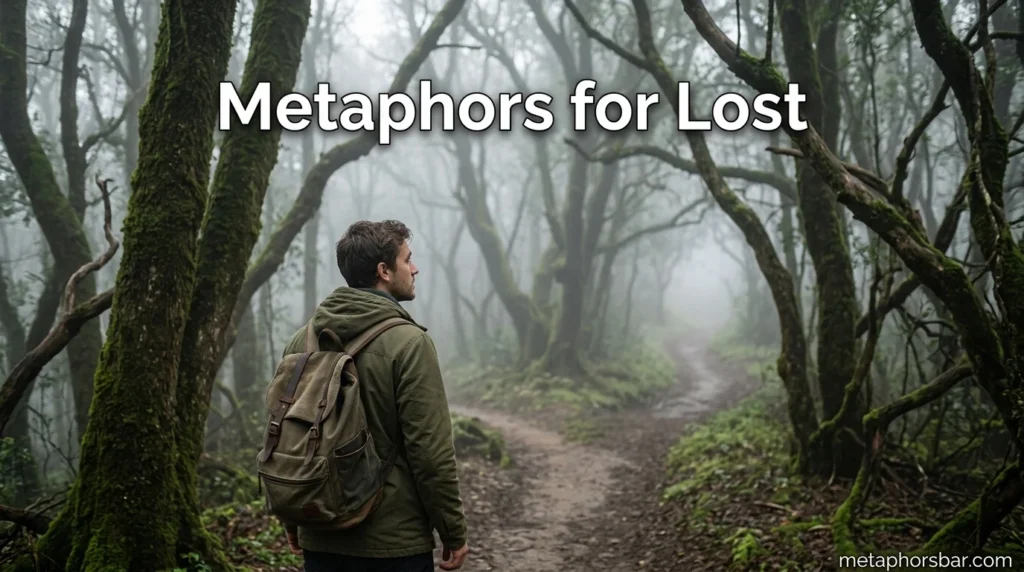
The fog rolled in so quietly that no one noticed at first. One moment, the path ahead was clear; the next, familiar landmarks had vanished behind a gray curtain. Every direction looked the same. Every step felt uncertain. It’s a feeling many of us recognize—not just when we’re physically lost, but when life itself seems to lose its map.
Being lost is more than not knowing where you are. It can mean feeling disconnected, confused, uncertain about the future, or grieving something that can never be fully recovered. Because the experience is so emotional and complex, writers often turn to metaphors to express it.
Metaphors for lost transform a difficult feeling into vivid imagery. They help readers understand confusion, loneliness, change, and uncertainty in ways that are memorable and deeply human. Whether you’re writing poetry, fiction, personal essays, speeches, or social media captions, these metaphors can add depth and emotional resonance to your words.
Why Metaphors for Lost Matter in Writing
They Give Shape to Invisible Feelings
Feeling lost is often hard to describe. Metaphors turn abstract emotions into images readers can picture and understand.
They Create Emotional Connection
Many people have experienced moments of uncertainty. Metaphors help readers connect their own experiences with your writing.
They Add Beauty and Depth
Instead of simply saying someone feels lost, a metaphor can paint a vivid picture that lingers in the reader’s imagination.
Three Powerful Metaphors for Lost
A Ship Without a Compass
Meaning and Explanation
A ship crossing a vast ocean depends on navigation. Without a compass, it drifts aimlessly, unsure where to go or how to return.
This metaphor perfectly captures feeling directionless in life. It suggests uncertainty, confusion, and a lack of guidance.
Example Sentence or Scenario
After graduating, he felt like a ship without a compass, floating between possibilities but unsure which direction to follow.
This metaphor works well for life transitions, career uncertainty, personal growth, and major decisions.
Alternative Ways to Express It
- drifting at sea
- sailing without a map
- wandering through open waters
- caught in unknown currents
- floating without direction
Sensory and Emotional Details
Imagine endless waves stretching toward every horizon. The sky blends into the sea, making direction impossible to determine. Emotionally, the image conveys uncertainty, vulnerability, and longing.
Mini Storytelling Example
A young traveler spent months exploring different cities after college. Although the adventure was exciting, she often described herself as “a ship without a compass.” She wasn’t lost geographically—she was searching for her place in the world.
Literary and Cultural Reference
The sea has long symbolized life’s uncertainty in literature. Countless stories use drifting ships to represent emotional and spiritual searching.
A Leaf Caught in the Wind
Meaning and Explanation
A leaf has little control over where the wind carries it. It twists, turns, rises, and falls according to forces beyond its control.
This metaphor emphasizes helplessness, unpredictability, and the feeling of being swept along by circumstances.
Example Sentence or Scenario
Following the sudden changes in her life, she felt like a leaf caught in the wind, moving wherever fate decided to take her.
This metaphor is especially effective for describing unexpected change, uncertainty, or emotional upheaval.
Alternative Ways to Express It
- drifting with the breeze
- carried by unseen currents
- floating through uncertainty
- tossed by changing winds
- swept along by circumstance
Sensory and Emotional Details
Picture a golden leaf spiraling through autumn air. It dances unpredictably, beautiful yet vulnerable. The emotion is bittersweet—part freedom, part helplessness.
Mini Storytelling Example
When a company downsized unexpectedly, many employees felt uprooted. One worker compared the experience to being a leaf in a storm, uncertain where he would land next.
Real-Life Connection
Major life events—moving, changing careers, ending relationships—often create the feeling of being carried by forces larger than ourselves.
A Star Hidden by Clouds
Meaning and Explanation
Stars don’t disappear when clouds cover them. They remain in the sky, temporarily concealed from view.
This metaphor represents being lost without being gone. It suggests that direction, purpose, or identity still exists, even if it cannot currently be seen.
Example Sentence or Scenario
During her difficult year, she felt like a star hidden by clouds, unsure of her own light but still shining somewhere beneath the darkness.
This metaphor is particularly useful for describing self-doubt, temporary setbacks, and periods of emotional struggle.
Alternative Ways to Express It
- hidden beneath the storm
- covered but not extinguished
- obscured by darkness
- waiting behind the clouds
- temporarily unseen
Sensory and Emotional Details
Imagine a cloudy night where stars remain invisible. Though hidden, they continue to exist. The image feels hopeful, gentle, and reassuring.
Mini Storytelling Example
An artist stopped creating after receiving harsh criticism. For months, she questioned her abilities. Looking back years later, she realized she had never lost her talent—she had only been a star hidden by clouds.
Literary and Cultural Reference
Stars often symbolize hope, guidance, and identity across cultures, making them powerful symbols for moments of feeling lost.
How to Choose the Best Metaphor for Lost

Use a Ship Without a Compass for Directionlessness
This metaphor works best when emphasizing uncertainty about the future or a lack of guidance.
Use a Leaf Caught in the Wind for Lack of Control
Choose this image when focusing on unexpected changes and external circumstances.
Use a Star Hidden by Clouds for Temporary Uncertainty
This metaphor is ideal when you want to balance struggle with hope and resilience.
The right metaphor depends on the emotional tone and message you wish to convey.
Interactive Exercises for Practicing Metaphors for Lost
Exercise 1: Finish the Sentence
Complete this phrase:
“I felt lost like…”
Try writing three different metaphors.
Examples:
- I felt lost like a ship without a compass.
- I felt lost like a bird separated from its flock.
- I felt lost like a lantern without a flame.
Exercise 2: Describe a Life Transition
Think about a major change you’ve experienced.
Write a paragraph using one metaphor to describe how you felt during that period.
Exercise 3: Create Your Own Metaphor
Ask yourself:
- What object loses direction?
- What part of nature becomes isolated?
- What image represents uncertainty to you?
Use your answers to create a unique metaphor.
Exercise 4: Story Starter
Begin a story with:
“The moment everything changed, I became…”
Let your metaphor guide the story.
Bonus Tips for Using Metaphors for Lost in Writing, Social Media, and Daily Life
In Creative Writing
Use metaphors to reveal emotional states without directly naming them. Readers often connect more deeply with imagery than explanations.
In Poetry
Images of oceans, forests, stars, fog, and drifting leaves work particularly well when exploring themes of loss and uncertainty.
In Social Media Captions
Short metaphorical lines can be powerful:
- “A ship searching for its compass.”
- “A leaf learning where the wind leads.”
- “A star waiting behind the clouds.”
In Personal Reflection
Metaphors can help clarify emotions and provide perspective during difficult times.
Balance Sadness with Hope
Many effective metaphors for lost include the possibility of finding one’s way again, creating emotional depth and optimism.
FAQs About Metaphors for Lost
1. What is a metaphor for lost?
A metaphor for lost is a figurative comparison that describes confusion, uncertainty, or absence through vivid imagery such as ships, stars, forests, or drifting leaves.
2. Why are metaphors for lost useful?
They help express complex emotions in a relatable and memorable way.
3. What is a simple metaphor for feeling lost?
A common example is: “I am a ship without a compass.”
4. Can metaphors for lost be positive?
Yes. Some metaphors, such as a star hidden by clouds, suggest hope and eventual rediscovery.
5. Are these metaphors useful in fiction?
Absolutely. Writers often use them to reveal character emotions and personal struggles.
6. What metaphor works best for uncertainty about the future?
A ship without a compass is particularly effective because it emphasizes direction and navigation.
7. How can I create my own metaphor for lost?
Think about situations where something lacks direction, guidance, connection, or visibility, then compare that image to your emotional experience.
Conclusion
Feeling lost is one of the most universal human experiences. It can arise during major life changes, moments of grief, periods of self-discovery, or times when the future feels uncertain. Because these emotions are complex, metaphors provide a powerful way to express them.
The ship without a compass symbolizes directionlessness and searching. The leaf caught in the wind captures uncertainty and lack of control. The star hidden by clouds reminds us that being lost does not mean being gone. Sometimes our purpose, strength, and identity remain present even when we cannot clearly see them.
Whether you’re writing stories, poetry, personal reflections, or social media content, metaphors for lost can transform simple descriptions into meaningful emotional journeys. They remind us that even when the path disappears into the fog, there is always the possibility of finding our way forward again.