
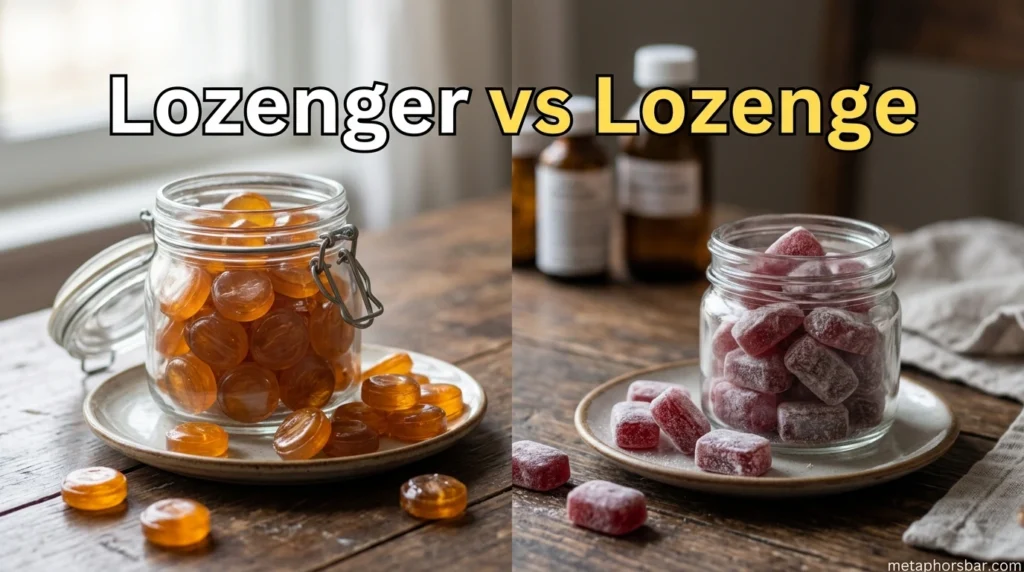
Learners often get confused by lozenger and lozenge because the two spellings look and sound similar, and many English words keep old forms or regional variants in speech. The confusion matters in everyday writing, speaking, exams, and professional communication because choosing the wrong spelling can make a sentence look careless or nonstandard. In modern standard English, lozenge is the normal spelling, while lozenger appears in historical or dialectal references, not as the usual contemporary form.
Meaning of “Lozenge” and “Lozenger”
The standard word lozenge has several related meanings. Dictionaries list it as a diamond-shaped figure, something shaped like that figure, and a small sweet or medicated tablet designed to dissolve slowly in the mouth. Cambridge defines it as a small flat sweet used for coughs or sore throats, while Merriam-Webster and Collins also include the shape meaning and the medicated tablet meaning.
Lozenger, by contrast, is not the form most modern learners should use. The Oxford English Dictionary records lozenger as a separate entry with at least one obsolete sense, and other reference sources describe it as archaic or dialectal. In practical modern English, that means most writers should prefer lozenge unless they are specifically quoting historical or dialect material.
Here is the simplest way to remember the difference:
| Word | Status in modern standard English | Common meaning |
| lozenge | standard | diamond shape; throat tablet; medicated sweet |
| lozenger | archaic or dialectal variant | historical/nonstandard form related to lozenge |
A quick learner-friendly memory trick is this: lozenge is the word you should use in normal writing; lozenger is mainly something you may see in older or regional references.
2) Correct Usage: When to Use “Lozenge”
Use lozenge when you are talking about a shape, a diamond-like design, or a throat lozenge. Merriam-Webster lists the shape meaning and the medicated-tablet meaning, and Collins similarly gives both the shape sense and the “sweets you can suck to make a cough or sore throat better” sense.
Common contexts for “lozenge”
- geometry and design
- heraldry and pattern descriptions
- medicine and pharmacy
- everyday speech about cough sweets or throat tablets
Example uses
- The wallpaper has a lozenge pattern.
- She bought a box of throat lozenges.
- The logo uses a simple lozenge shape.
Correct and incorrect examples
| Correct | Incorrect | Why |
| He took a throat lozenge for his cough. | He took a throat lozenger for his cough. | Lozenge is the standard form. |
| The pattern is a lozenge shape. | The pattern is a lozenger shape. | The shape word is lozenge. |
| She bought lozenges at the pharmacy. | She bought lozengers at the pharmacy. | Modern standard English prefers lozenges. |
In formal writing, exams, product descriptions, health information, and general communication, lozenge is the safe and correct choice.
3) Spelling Differences: Lozenger vs Lozenge
The key spelling point is very simple: lozenge is the standard spelling, and lozenger is a variant recorded in older or dialectal sources. Merriam-Webster lists lozenge as the main entry and separately indexes lozenger, while the OED marks lozenger as having obsolete usage.
Spelling comparison table
| Form | Standard today? | Notes |
| lozenge | Yes | normal modern spelling |
| lozenges | Yes | plural form |
| lozenger | Usually no | archaic or dialectal variant |
| lozengers | Usually no | nonstandard in modern writing |
Common misspellings
Learners often make spelling errors by adding, swapping, or omitting letters. The most common wrong forms are:
- lozenger in place of lozenge
- lazenge
- lozange
- lozange
- lozenj
Why the spelling is easy to mix up
The middle sound in speech can be soft and quick, so people sometimes write what they hear. That is especially likely when the final -ge sound is reduced in fast conversation. Dictionaries show the standard pronunciation as something like LAH-zinj or LŌ-zinj, which can make the last sound easy to mishear in casual speech.
Correct and incorrect examples
| Correct | Incorrect |
| lozenge | lozenger |
| throat lozenges | throat lozengers |
| diamond-shaped lozenge | diamond-shaped lozenger |
| lozenge pattern | lozenger pattern |
A useful rule for learners is this: if you are writing for school, work, publishing, or public communication, always choose lozenge. Leave lozenger to historical discussion, dialect notes, or quotations from older speech.
4) Grammar Rules and Word Forms
From a grammar point of view, lozenge is a countable noun. That means it can appear in singular and plural forms, and it can take articles such as a or the. Collins explicitly shows the plural form lozenges, and Merriam-Webster also treats it as a noun with standard countable uses.
Basic grammar forms
| Form | Example | Use |
| singular | a lozenge | one tablet or one shape |
| plural | lozenges | more than one |
| with article | the lozenge | a specific one |
| adjective + noun | throat lozenge | describes purpose |
How the grammar works
You can say:
- a lozenge
- the lozenge
- several lozenges
- a throat lozenge
- a diamond-shaped lozenge
Correct and incorrect examples
| Correct | Incorrect | Why |
| I bought a lozenge. | I bought lozenge. | singular countable nouns usually need an article |
| She carried two lozenges. | She carried two lozenge. | plural form needed |
| This is a throat lozenge. | This is a throat lozengees. | wrong plural ending |
| The lozenge is blue. | Lozenge is blue. | article improves standard grammatical form |
A note on adjective use
English often uses lozenge before another noun in descriptive phrases, such as lozenge pattern or lozenge shape. Merriam-Webster and Collins both support the shape meaning, and Merriam-Webster also records derived forms such as lozenge-shaped and lozengewise.
5) British vs American English
For modern standard English, British English and American English both use lozenge. Cambridge, Collins, and Merriam-Webster all list the standard word in the same spelling. That means learners do not need to memorize two different spellings for the two main varieties of English.
The interesting difference is not standard spelling but historical and regional variation. The Oxford English Dictionary records lozenger as a separate entry with an obsolete sense, and Grammarphobia summarizes OED and regional-dialect evidence showing that lozenger has appeared in some American and northern English usage. In other words, lozenger is a historical or dialectal variant, not the normal modern choice in either British or American standard English.
Regional usage table
| Variety | Standard spelling | Notes |
| British English | lozenge | standard modern form |
| American English | lozenge | standard modern form |
| Historical/dialect usage | lozenger | obsolete or regional variant |
Practical takeaway
If you are writing for an international audience, always use lozenge. That spelling is recognized across both varieties and is the one you will see in learner dictionaries and current reference works.
6) Pronunciation of “Lozenge”
Pronunciation is another reason people sometimes get confused. Merriam-Webster gives lozenge as ˈlä-zᵊnj or -sᵊnj, while Cambridge provides audio pronunciation guidance for the same word. Collins also gives a pronunciation that reflects the final -nge sound rather than a hard -ger ending.
Simple pronunciation guide
A learner-friendly way to say it is:
- LOH-zinj
- or LAH-zinj
The stress is on the first syllable.
Pronunciation comparison table
| Word | Approximate pronunciation | Stress |
| lozenge | LOH-zinj / LAH-zinj | first syllable |
| lozenger | not standard in modern general English | varies by dialect or historical usage |
Why pronunciation can lead to spelling mistakes
Because the final sound can be reduced in fast speech, some speakers may hear something closer to -j or -nj and mistakenly write lozenger. Standard dictionaries, however, still give lozenge as the modern spelling and pronunciation.
Speaking examples
- “Take one lozenge for your sore throat.”
- “The design uses a lozenge shape.”
- “The package contains ten lozenges.”
7) Sentence Examples in Real Life
Examples help learners see the correct word in natural contexts. Dictionary sources show lozenge used for both shape and medicinal tablets, so the examples below follow those established meanings.
Everyday examples
- I bought some lozenges for my cough.
- The tile pattern is arranged in a lozenge shape.
- She kept a mint lozenge in her bag.
- The logo features a blue lozenge.
- He popped a lozenge before his presentation.
School and exam examples
- A lozenge is a diamond-shaped figure.
- The medicine was packaged as lozenges.
- The artist used a repeated lozenge pattern in the border.
- Please circle the lozenge-shaped symbol.
Workplace examples
- We provided throat lozenges for employees.
- The brochure uses a clean lozenge design.
- The package includes individually wrapped lozenges.
- Please check the lozenge icon in the layout.
Correct and incorrect examples
| Correct | Incorrect | Why |
| I need a lozenge for my throat. | I need a lozenger for my throat. | standard spelling is lozenge |
| The pattern is lozenge-shaped. | The pattern is lozenger-shaped. | wrong form |
| She bought lozenges at the pharmacy. | She bought lozengeres at the pharmacy. | incorrect plural spelling |
| The diamond has a lozenge design. | The diamond has a lozenger design. | nonstandard spelling |
Natural usage note
In everyday English, lozenge may sound a little more formal than words like cough drop, but it is still the correct standard word in dictionaries and in professional writing. Merriam-Webster even lists cough drop as a related entry meaning a lozenge or troche used to relieve coughing.
8) Common Mistakes, FAQs, and Final Advice
The most common mistake is assuming lozenger is the modern spelling simply because it sounds familiar. Standard reference works list lozenge as the main form, while lozenger is historical, obsolete, or dialectal. That means the safest rule for learners is simple: use lozenge unless you are intentionally discussing older language or regional speech.
Common mistakes table
| Mistake | Incorrect example | Correct example |
| Using the wrong spelling | lozenger | lozenge |
| Wrong plural | lozengeres | lozenges |
| Wrong adjective form | lozenger-shaped | lozenge-shaped |
| Using dialect form in formal writing | a lozenger tablet | a lozenge tablet |
FAQs
1) Is “lozenger” a real word?
Yes, some historical and dialect sources record it, but it is not the normal modern standard form. The OED lists it with obsolete usage, and some language references describe it as archaic or dialectal.
2) Which spelling should I use in school or work?
Use lozenge. That is the standard form in modern learner dictionaries and general reference dictionaries.
3) What is the plural of lozenge?
The plural is lozenges. Collins shows this plural form clearly.
4) Is lozenge only a medicine word?
No. It can also mean a diamond-shaped figure or something shaped like that figure. Merriam-Webster and Cambridge both include the shape meaning.
5) How do I remember the difference?
Remember this short rule: lozenge is the modern standard spelling; lozenger is an older or regional variant.
Conclusion
For modern English, the correct and standard spelling is lozenge. Use it for the shape, the throat tablet, and any formal or academic writing. Lozenger may appear in historical or dialectal references, but it is not the form most learners should use in everyday communication. If you want your English to sound clear, correct, and professional, choose lozenge every time.