
The first sign of greed is often not a shout, but a reaching. A hand extends a little farther across the table. A cupboard is opened again, though it was already full. A person who has enough still looks around and thinks of what they do not have. Greed has a particular feeling to it: restless, hungry, endless. It can look like desire at first, but it rarely knows when to stop.
That is why metaphors for greed are so useful. Greed is one of those emotions that can be difficult to describe directly because it is not just about wanting something—it is about wanting more, and then more still. A strong metaphor helps reveal greed’s shape: a pit that never fills, a fire that keeps spreading, a machine that never turns off. These images make the emotion visible, memorable, and easier to understand in writing, speech, and reflection.
Whether you are writing fiction, poetry, essays, speeches, or social media captions, metaphors for greed can add depth, warning, and vividness to your words.
Why Metaphors for Greed Matter in Writing and Reflection
They turn an abstract vice into a visible image
Greed is often internal and hidden. A metaphor gives it a body, a landscape, or a movement so readers can picture its effects.
They reveal greed’s consequences
The best greed metaphors do not just describe wanting; they show how greed consumes, enlarges, or deforms a person’s life.
They make moral and emotional writing more memorable
A simple sentence like “He was greedy” states a fact. A metaphor like “his desire was a pit with no bottom” lingers much longer.
Greed as a Bottomless Pit
Meaning and explanation
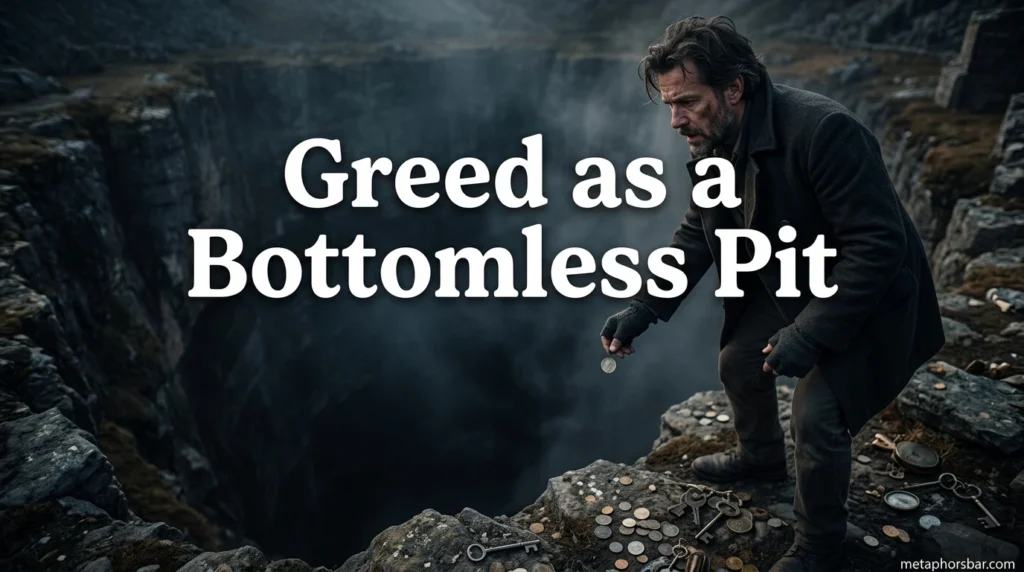
A bottomless pit is one of the most powerful metaphors for greed because it suggests endlessness. No matter how much is dropped into it, it never fills. That is greed in its purest form: a desire that is never satisfied.
This metaphor works especially well when a person keeps wanting more money, power, attention, possessions, or control, no matter how much they already have.
Example sentence or scenario
Her greed was a bottomless pit; every promotion, every reward, every compliment vanished into it without ever making her feel full.
This metaphor works beautifully in stories about ambition gone wrong, unchecked appetite, or characters who cannot recognize enough when it appears.
Alternative ways to express it
- an endless void of wanting
- a hunger with no floor
- a well that never fills
- a hunger hole
- an empty place that swallows everything
Sensory and emotional details
You can imagine darkness below your feet, the echo of something falling forever, the uneasy pull of space with no end. Emotionally, this metaphor feels unsettling, vast, and consuming. It suggests that greed is not a problem of lack, but of incompletion.
Mini storytelling touch
A businessman once said he thought the next contract would finally make him content. It did not. Then another deal came, and another, each one promising satisfaction that never arrived. Years later, he realized he had been living beside a pit that never stopped asking for more. That is why the bottomless pit metaphor is so effective—it captures the illusion that enough is just one more step away.
Literary or cultural reference
Bottomless pits often appear in myths and folklore as symbols of the insatiable and the unknowable. They are perfect for greed because they suggest something that devours without end.
2. Greed as a Wildfire
Meaning and explanation
A wildfire begins with a spark, but it spreads quickly through dry ground and destructive fuel. As a metaphor, greed as wildfire captures the way desire can grow rapidly when fed by envy, comparison, or unchecked appetite. It burns through reason, relationships, and restraint.
This metaphor is particularly effective when greed expands beyond one person and begins affecting a family, business, or community.
Example sentence or scenario
Once the first bonus arrived, greed spread like wildfire, and no one in the office wanted to stop at enough.
This image works well for stories where greed starts small and quickly grows into something dangerous and hard to contain.
Alternative ways to express it
- a blaze of wanting
- flames of excess
- a spreading hunger
- a fire that feeds on more
- a scorched hunger for gain
Sensory and emotional details
You can hear the crackle of dry brush, feel heat rising in the air, smell smoke before the flames are visible. Emotionally, this metaphor feels urgent, destructive, and contagious. It reminds us that greed often thrives where there is already fuel.
Mini storytelling touch
In a small neighborhood, one family’s sudden wealth created jealousy, then competition, then open hostility. What had started as admiration became resentment, and the social atmosphere turned smoky and tense. One resident later described it as “greed catching like fire in the dry season.” That image works because greed often spreads faster than people expect.
Real-life example
In consumer culture, greed can spread through trends, status symbols, and comparison. A desire that begins as “I want this” can become “I need more than everyone else.” The wildfire metaphor makes that escalation easy to see.
Literary or cultural reference
Fire is often used in literature to symbolize passion, destruction, and loss of control. With greed, the fire does not warm; it consumes.
3. Greed as Rust
Meaning and explanation
Rust is slow, corrosive, and quietly destructive. It eats away at metal over time, weakening what once seemed strong. As a metaphor, greed as rust suggests a gradual corruption of character, trust, and values. Greed does not always explode like fire; sometimes it erodes.
This metaphor is especially useful when describing long-term greed that damages relationships, institutions, or moral integrity.
Example sentence or scenario
Greed was rust on his soul, slowly corroding every generous instinct he once had.
This is a strong metaphor for stories where greed becomes a quiet habit, weakening a person from the inside out.
Alternative ways to express it
- corrosion of the conscience
- a slow decay of values
- a toxic erosion
- a stain on character
- the slow rot of wanting more
Sensory and emotional details
You can imagine metal turning orange-brown, flaking at the edges, losing strength without anyone noticing right away. Emotionally, this metaphor feels somber, patient, and grave. It suggests that greed may not always be dramatic, but it is deeply wearing.
Mini storytelling touch
A woman once watched her brother change after he became obsessed with money. He was not cruel overnight. He simply became less patient, less generous, less present. “It was rust,” she said later. “Not a crash, just corrosion.” That is what makes this metaphor so effective—it reveals greed as slow damage rather than sudden collapse.
Literary or cultural reference
Rust often symbolizes neglect and decay in literature. As a metaphor for greed, it suggests the quiet breakdown of what was once whole and healthy.
How to Choose the Right Metaphor for Greed
Use a bottomless pit when greed feels endless
Choose this image when the emphasis is on insatiability—when nothing ever seems enough.
Use wildfire when greed spreads fast
This metaphor works best when greed grows quickly, influences others, or becomes uncontrollable.
Use rust when greed corrodes slowly
Choose rust when you want to show a gradual weakening of character, trust, or values over time.
The best metaphor depends on the effect you want to emphasize. Greed can swallow, spread, or corrode—and sometimes it does all three.
Interactive Exercises for Practicing Metaphors for Greed
Exercise 1: Complete the sentence
Finish this prompt in three different ways:
“Greed felt like ______ because ______.”
Try one version that feels physical, one that feels social, and one that feels symbolic.
Example: Greed felt like a bottomless pit because no amount of success seemed to satisfy the need for more.
Exercise 2: Sensory mapping
Think of a character, memory, or real-world example involving greed. Write down:
- one sound
- one texture
- one color
- one smell
- one object
Then turn those details into a metaphor.
For example: Greed sounded like coins dropping into a deep well, felt like rough metal, looked like smoke on the horizon, smelled like burned paper, and moved like rust spreading across a gate.
Exercise 3: Story starter
Begin a short paragraph with:
“Greed grew like…”
Let the image guide the tone. Make it dramatic, restrained, reflective, or cautionary.
Exercise 4: Social media or journal prompt
Try writing a one-line reflection:
- “Greed is a pit that teaches nothing about fullness.”
- “Some desires spread like wildfire.”
- “What greed touches, rust eventually reaches.”
Bonus tips for using metaphors for greed in writing, social media, and daily life
In writing
Use greed metaphors in fiction, essays, poetry, and character studies to reveal the emotional and moral consequences of excess without directly lecturing the reader.
In social media
A metaphor can make a cautionary message feel more memorable. A line like “Greed is a fire that eats the house it lives in” can be striking and shareable.
In everyday reflection
If you are trying to understand your own motives or a situation around you, a metaphor can help you see whether the issue is a pit, a fire, or rust. That clarity can be powerful.
Keep the imagery balanced
Greed is a serious subject, so the best metaphors show its impact clearly without making it sound glamorous or abstract. Let the image carry consequence.
FAQs About Metaphors for Greed
1. What is a metaphor for greed?
A metaphor for greed is a figurative comparison that describes greed using another image, such as a pit, wildfire, or rust.
2. Why are metaphors for greed useful?
They make greed easier to picture and help reveal its emotional and moral consequences in writing.
3. What is a simple metaphor for greed?
A simple example is: Greed is a bottomless pit. It clearly suggests endless wanting and lack of satisfaction.
4. Can greed metaphors be used in fiction?
Yes. They are especially effective in fiction because they show character motivation, corruption, and conflict.
5. How do I make my own greed metaphor?
Think about how greed behaves—does it consume, spread, or wear away? Then compare it to something with similar qualities.
6. Are greed metaphors only for serious writing?
No. They can be used in essays, speeches, social commentary, and even subtle humor when appropriate.
7. What makes a strong metaphor for greed?
A strong metaphor is vivid, emotionally clear, and easy to picture. It should reveal greed’s effect, not just name it.
Conclusion
Greed is not simply wanting things. It is wanting without limit, without rest, without the moment where enough becomes enough. That is why metaphors matter so much: they help us show greed’s shape, its danger, and its slow pull on character and community.
A bottomless pit shows greed’s emptiness. A wildfire shows its speed and spread. Rust shows its quiet corrosion over time. Together, these images make greed visible in ways that plain words often cannot.
So when you write about greed, do not stop at the obvious. Let it swallow, burn, or corrode your language. A good metaphor can do more than describe greed—it can expose it, and sometimes that is the first step toward resisting it.