
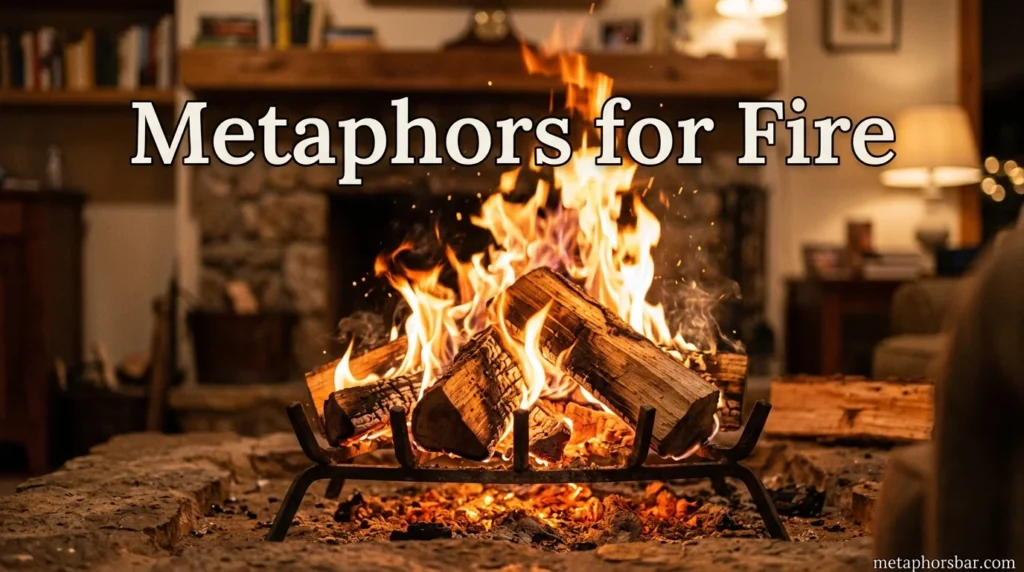
The first hint is usually the smell—smoke in the air, sharp and a little sweet, like the world has opened a hidden door. Then comes the crackle, small and alive, followed by the orange pulse that changes a dark room into something almost sacred. Fire has always held our attention because it is beautiful and dangerous at the same time. It warms, lights, destroys, transforms. It can be a comfort or a warning, a beginning or an ending.
That is why metaphors for fire are so useful. Fire is one of the richest images in language because it already carries so much meaning. We use it to describe passion, anger, courage, destruction, inspiration, desire, and renewal. A strong metaphor helps us turn that intense image into words that feel vivid, memorable, and emotionally true.
Whether you are writing poetry, fiction, a speech, a caption, or a reflective essay, metaphors for fire can make your language glow.
Why Metaphors for Fire Matter in Writing and Everyday Language
They make intense feelings easier to see
Fire is never bland. It is bright, moving, and impossible to ignore. Metaphors help translate that force into images readers can picture and feel.
They let you show different shades of heat
Fire can mean warmth, love, anger, danger, ambition, or transformation. A good metaphor helps you choose the exact kind of fire you mean.
They make writing more memorable
A line like “his anger burned” tells us the emotion. A line like “his anger was a wildfire racing through dry grass” gives the emotion a shape we can remember.
Three Powerful Metaphors for Fire
1. Fire as a Living Heartbeat
Fire is often compared to a heartbeat because both pulse with life, rhythm, and energy. A flame flickers, rises, and falls in a way that feels almost organic. This metaphor works especially well when fire feels intimate, alive, or deeply connected to emotion. It can suggest warmth, vitality, love, or the steady presence of something that keeps going inside a person or place.
Meaning and explanation: When fire is described like a heartbeat, it becomes less about destruction and more about life itself. It suggests a steady inner force—something that keeps a person moving, feeling, or hoping. It is a beautiful image for passion, courage, or the emotional warmth that stays alive even in hard times.
Example sentence or scenario: The campfire pulsed like a living heartbeat, its glow steady and warm in the dark circle of the woods.
This metaphor works well in scenes where fire is comforting, intimate, or quietly powerful. It can also describe love or inspiration, as in: Her passion burned like a heartbeat she refused to lose.
Alternative ways to express it:
- a pulse of flame
- a glowing rhythm
- a warm beat in the dark
- a fire that breathes
- a flicker of life
Sensory or emotional details: You can almost hear the crackle matching the rhythm of a chest rising and falling. You can feel the warmth on your face, see the ember glow, and sense a gentle energy that seems to move with purpose. Emotionally, this metaphor feels alive, intimate, and steady.
Mini storytelling touch: A child once sat beside a winter fireplace while her grandmother knitted and told stories. “The fire looks like it’s breathing,” she said. Her grandmother smiled and answered, “Everything that gives life has a rhythm.” That is what makes the heartbeat metaphor so lovely: it turns fire into something not only seen, but felt as part of life itself.
Literary or cultural reference: Many traditions use the hearth as the emotional center of the home. Fire as heartbeat fits that idea perfectly because both suggest a living center that holds warmth and continuity.
2. Fire as a Storm
A firestorm is fast, violent, and difficult to control. Comparing fire to a storm captures its power, movement, and unpredictability. This metaphor works especially well when fire represents anger, chaos, desire, or a situation that grows larger than expected. It is the right image when fire is not comforting but overwhelming.
Meaning and explanation: Storms gather, break, and sweep across landscapes, and fire can do the same. As a metaphor, fire as a storm emphasizes force and emotional turbulence. It is useful for describing emotions that spread quickly or events that become too intense to contain.
Example sentence or scenario: The argument became a firestorm, with sharp words flashing and tempers breaking loose in every direction.
This metaphor works well in writing about conflict, passion, political upheaval, or any scene where fire-like energy takes over. It is especially effective for anger and destruction.
Alternative ways to express it:
- a blaze of chaos
- a storm of flames
- a wildfire of emotion
- a roaring tempter
- a thunderous rush of heat
Sensory or emotional details: Imagine heat surging through dry air, sparks lifting into wind, and the feeling of something too strong to stand against. Emotionally, this metaphor feels urgent, unstable, and dramatic. It suggests that fire can arrive like weather—sudden, vast, and impossible to reason with once it starts.
Mini storytelling touch: A small rumor in a neighborhood once turned into a week of tension, arguments, and broken friendships. One resident later said, “It spread like a firestorm.” That image works because it captures the way certain emotions or events do not stay contained; they rush outward and change everything around them.
Real-life example: Anyone who has watched dry brush catch flame on a windy day knows how quickly a small spark can become something much larger. In emotional writing, the storm metaphor helps explain how one moment can escalate into overwhelming force.
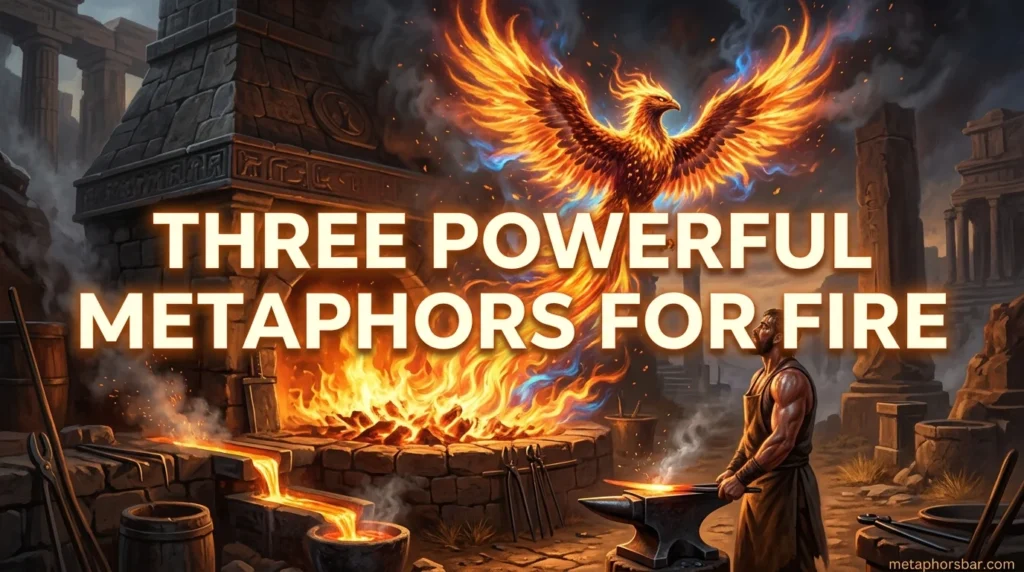
3. Fire as a Forge
A forge is where metal is heated and shaped into something stronger. Comparing fire to a forge emphasizes transformation, pressure, and creation. This metaphor is especially useful when fire represents change, strength, discipline, or the process of becoming something new. Unlike the storm, which highlights chaos, the forge highlights purpose.
Meaning and explanation: Fire in a forge does not simply destroy—it refines. It softens hard metal so it can be shaped. As a metaphor, this makes fire a symbol of endurance, growth, and the kind of pain that leads to strength. It is ideal for describing difficult experiences that change a person for the better.
Example sentence or scenario: Her resilience was forged in fire, tested and reshaped until it became stronger than before.
This metaphor works beautifully in stories about personal growth, training, recovery, and hard-won courage. It also works well when describing art, craft, or character development.
Alternative ways to express it:
- a shaping flame
- a crucible of change
- fire that tempers steel
- a furnace of becoming
- heat that creates strength
Sensory or emotional details: You can imagine the bright orange glow of hot metal, the ringing sound of a hammer on an anvil, and sparks flying in a dark room. Emotionally, this metaphor feels intense, hopeful, and purposeful. It suggests that hardship can create beauty and strength.
Mini storytelling touch: A musician once described years of practice, rejection, and self-doubt as “a forge I had to walk through.” It was not a pleasant image, but it was honest. In the end, the fire had not broken him. It had shaped him. That is what makes the forge metaphor so powerful—it gives pain a purpose without pretending the pain is easy.
Literary or cultural reference: Forging appears often in myths and legends, where heroes, swords, and identities are strengthened by flame. That tradition gives the metaphor a timeless feeling of becoming through heat.
How to Choose the Right Metaphor for Fire
Use the heartbeat when fire feels alive or loving
Choose this metaphor when you want fire to feel warm, intimate, or sustaining. It is especially good for passion, home, courage, or inspiration.
Use the storm when fire feels chaotic or destructive
This image works best when the fire represents anger, upheaval, conflict, or something that spreads too quickly to stop.
Use the forge when fire feels transformative
Choose this metaphor when fire is about shaping, strengthening, or refining something through pressure and change.
The best metaphor depends on the feeling you want to create. Fire can pulse, rage, or transform—and each image gives it a different emotional shape.
Interactive Exercises for Practicing Metaphors for Fire
Exercise 1: Complete the sentence
Finish this prompt in three different ways:
“Fire is like ______ because ______.”
Try one answer that feels comforting, one that feels destructive, and one that feels hopeful.
Example: Fire is like a forge because it can reshape what it touches into something stronger.
Exercise 2: Sensory mapping
Think about a fire you have seen—real or imagined. Write down:
- one sound
- one color
- one smell
- one movement
- one feeling
Then turn those details into a metaphor.
For example: The fire sounded like dry leaves cracking, looked like a living heartbeat, smelled like wood and smoke, moved like a storm across dry grass, and carried the feeling of both comfort and danger.
Exercise 3: Story starter
Begin a short paragraph with:
“The fire felt like…”
Let the image guide the tone. You can make it emotional, dramatic, quiet, or reflective.
Exercise 4: Social media or journal prompt
Try turning a fire metaphor into a short line:
- “My courage is a small flame that refuses to go out.”
- “Their argument became a firestorm.”
- “She was forged in fire and came out stronger.”
Bonus tips for using metaphors for fire in writing, social media, and daily life
In writing
Use fire metaphors in stories, poems, memoirs, and essays to bring emotion and atmosphere to the page. Fire is especially effective when you want to show intensity or transformation.
On social media
A short metaphor can make a caption or post feel more vivid and memorable. A line like “Still burning, still becoming” can carry a lot of emotional weight in very few words.
In everyday conversation
Metaphors can make your descriptions more expressive and natural. Instead of saying “I’m really passionate about this,” you might say “This is the fire that keeps me going.”
In character descriptions
If you are writing fiction, fire metaphors can reveal personality. A bold character may be “all flame and spark,” while a strong, tested character may be “forged in fire.”
Keep the image true to the moment
Not every fire is the same. A candle flame, a hearth fire, and a wildfire do very different things. The strongest metaphor is the one that matches the exact emotion or situation you want to describe.
FAQs
1. What is a metaphor for fire?
A metaphor for fire is a figurative comparison that describes fire using another image, such as a heartbeat, storm, or forge.
2. Why are metaphors for fire useful?
They help make fire more vivid and can also express emotions like passion, anger, transformation, and courage in a memorable way.
3. What is a simple metaphor for fire?
A simple example is: Fire is a living heartbeat. It suggests life, rhythm, and warmth.
4. Can fire metaphors describe emotions too?
Yes. Fire metaphors are often used for anger, love, ambition, courage, and change.
5. How do I create my own fire metaphor?
Think about what fire does—warm, burn, light, destroy, transform—and compare it to something with similar qualities.
6. Are fire metaphors only for dramatic writing?
No. They can also be used in reflective writing, speeches, captions, and everyday conversation.
7. What makes a strong fire metaphor?
A strong metaphor is sensory, emotionally accurate, and easy for the reader to picture and feel.
Conclusion
Fire is one of the most powerful images in human language because it carries so many meanings at once. It can comfort, consume, and create. It can warm a room, light a path, or reshape what it touches. That is why metaphors for fire are so rich—they help us turn heat into meaning.
A heartbeat makes fire feel alive and intimate. A storm makes it feel wild and uncontrollable. A forge makes it feel transformative and purposeful. Together, these images remind us that fire is never just flame. It is emotion, motion, and change.
So the next time you write about fire, do not stop at the obvious. Let it pulse, storm, or forge through your words. A strong metaphor can make even a single spark feel unforgettable.