
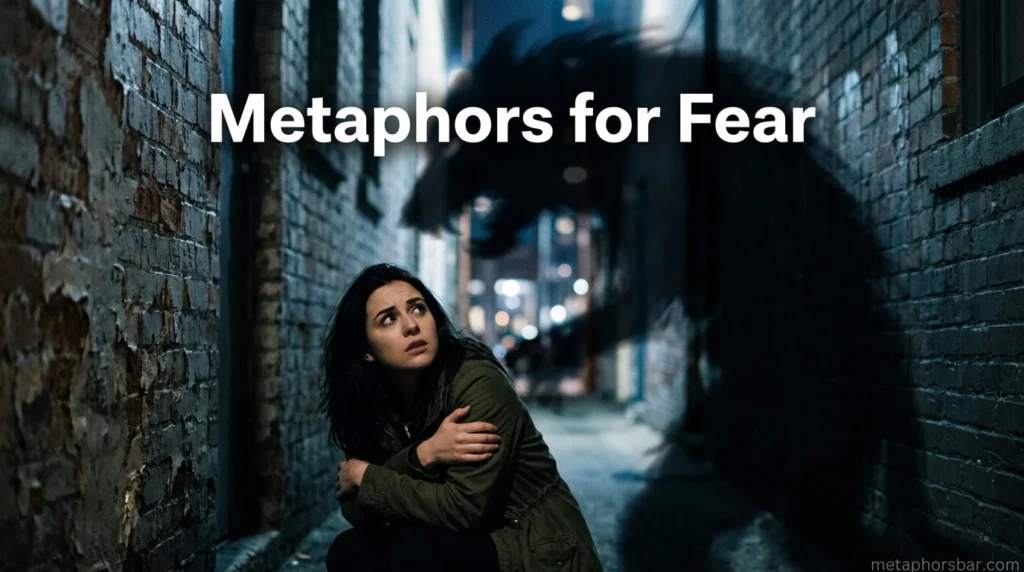
The first sign of fear is often not a scream, but a stillness. The breath shortens. The shoulders tighten. The room seems to change shape around you, as if the air itself has become aware of your unease. Fear can arrive like that—quietly at first, then all at once, wrapping itself around your thoughts until even ordinary things feel charged with danger. A hallway looks longer. A shadow looks deeper. A small noise suddenly has teeth.
That is why metaphors for fear are so useful. Fear is one of the most complex and primal emotions we experience, but plain language often feels too small for it. Metaphors help give fear a shape we can see, hear, and remember. They make the invisible feel real, and the internal world easier to describe.
Whether you are writing fiction, poetry, a personal essay, a speech, or even a social media caption, the right metaphor can turn fear from an abstract word into a vivid emotional experience.
Why Metaphors for Fear Matter in Writing and Reflection
They give shape to an invisible emotion
Fear often lives inside the body before it can be explained in words. A metaphor turns that private tension into something readers can picture.
They help reveal the kind of fear you mean
Fear can be sharp, lingering, dark, sudden, silent, physical, or emotional. The image you choose can show whether it feels like danger, anticipation, anxiety, or dread.
They make writing more memorable
A line like “I was scared” states a fact. A line like “fear sat on my chest like a stone” creates a lasting image that carries emotional weight.
Three Powerful Metaphors for Fear
1. Fear as a Shadow
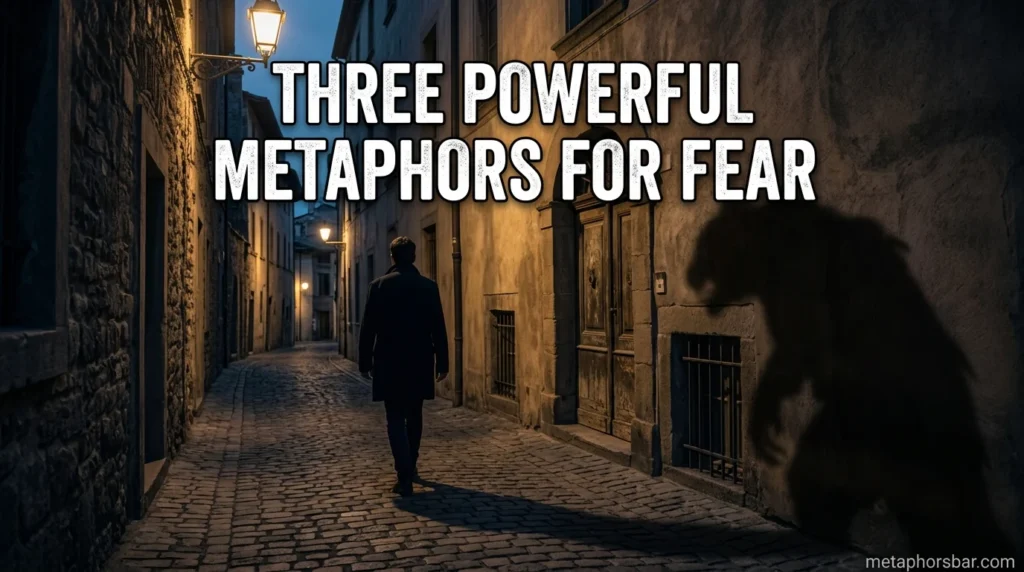
Fear is often compared to a shadow because shadows follow, distort, and darken what they touch. A shadow is not the object itself, but it is always connected to it. That makes it a powerful metaphor for fear that lingers in the background—present, silent, and difficult to ignore.
This metaphor is especially useful when fear is not a sudden panic, but a constant companion. It works well for anxiety, worry, suspicion, or the sense that danger may be nearby even when nothing obvious is happening.
Meaning and explanation: Fear as a shadow suggests that the emotion follows a person everywhere, especially when the light changes or when attention is elsewhere. It hints at something attached, close, and persistent. The shadow may not strike directly, but it changes how everything else appears.
Example sentence or scenario: Fear followed her like a shadow, long and silent, stretching behind every step she took.
This works well in stories where a character cannot quite escape a past experience, or where the tension is subtle rather than explosive.
Alternative ways to express it:
- a dark companion
- a trailing silhouette
- a lingering dusk
- an unseen presence
- a cloud that does not leave
Sensory and emotional details: You can imagine late afternoon light, long shapes on the ground, and the uneasy feeling of being watched by something just out of reach. Emotionally, this metaphor feels quiet, haunting, and steady. It suggests fear that does not shout, but stays.
Mini storytelling touch: A child once described walking home alone as feeling “like a shadow was walking one step behind me.” Nothing had happened, but the fear made every tree and corner look larger than life. That is the power of the shadow metaphor: it captures the way fear changes ordinary space into something charged and uncertain.
Literary or cultural reference: Shadows have long symbolized mystery, uncertainty, and the hidden self in literature. Fear naturally fits this image because it often grows where visibility weakens.
2. Fear as a Storm
A storm is sudden, loud, and difficult to control. As a metaphor, fear becomes something that gathers in the sky and moves in fast, unpredictable waves. This is especially effective when fear feels overwhelming—when it surges through the body or mind and seems to take over everything at once.
This metaphor works well for moments of panic, crisis, or emotional upheaval. It also suits fear that is tied to change, uncertainty, or the arrival of something unwanted.
Meaning and explanation: Fear as a storm suggests force and turbulence. It is not only the feeling of being afraid, but the feeling of being caught in an event bigger than yourself. A storm changes the landscape; fear can do the same to a person’s thoughts.
Example sentence or scenario: As the deadline approached, fear rose like a storm, darkening every thought and rattling her confidence.
This metaphor works beautifully in scenes of confrontation, high stakes, or sudden bad news.
Alternative ways to express it:
- a thundercloud of worry
- a hurricane of panic
- a squall of dread
- a tempest in the chest
- a weather front of anxiety
Sensory and emotional details: Imagine wind slamming against windows, rain hitting the roof, and thunder rolling across a dark sky. Emotionally, this metaphor feels urgent, chaotic, and difficult to stand against. It captures fear as something atmospheric and all-consuming.
Mini storytelling touch: A man waiting for a medical result described the silence before the phone rang as “the calm before a storm I could feel in my bones.” That sentence stays with you because fear often does feel like weather: a shift in the air before the first drop falls.
Real-life example: People often describe public speaking, exams, or life transitions as storm-like because the fear builds pressure before releasing it. The storm metaphor makes that buildup easy to picture.
3. Fear as a Locked Door
A locked door suggests barrier, limitation, and the unknown on the other side. As a metaphor for fear, it works beautifully when fear keeps a person from moving forward. It can represent hesitation, avoidance, paralysis, or the sense that something important is just out of reach.
This metaphor is especially effective when fear is internal—when it blocks confidence, opportunity, or emotional honesty.
Meaning and explanation: Fear as a locked door emphasizes restriction. It suggests that a person may want to move ahead but feels blocked by uncertainty or dread. The fear itself becomes a barrier, standing between the person and the next step.
Example sentence or scenario: Every new opportunity felt like a locked door, and fear was the key she had somehow lost.
This metaphor works well in stories about growth, healing, courage, or moments where someone must decide whether to step forward.
Alternative ways to express it:
- a gate that will not open
- a barrier of hesitation
- a closed threshold
- a door sealed by doubt
- a passage blocked by worry
Sensory or emotional details: You can picture cold metal, a heavy latch, and the tense stillness before trying the handle. Emotionally, this metaphor feels stuck, frustrating, and inward. It captures the frustration of wanting to move but feeling unable to.
Mini storytelling touch: A young woman once said the idea of applying for a job felt like “standing in front of a locked door with my own fear on the other side.” That image is so effective because it shows fear as an obstacle—but also as something the person may one day learn to open.
Literary or cultural reference: Doors often symbolize choices, transitions, and thresholds in literature. A locked door adds the emotional layer of fear, making the decision to proceed feel both necessary and difficult.
How to Choose the Right Metaphor for Fear
Use a shadow when fear is lingering or subtle
Choose this metaphor when fear feels quiet, persistent, or always nearby in the background.
Use a storm when fear feels overwhelming or sudden
This image is best when the emotion comes in waves, like panic, dread, or emotional crisis.
Use a locked door when fear feels like a barrier
Choose this metaphor when fear prevents action, blocks growth, or keeps someone from stepping into something new.
The best metaphor depends on the kind of fear you want to express. Fear can follow, surge, or block—and sometimes it does all three.
Interactive Exercises for Practicing Metaphors for Fear
Exercise 1: Complete the sentence
Finish this prompt three different ways:
“Fear felt like ______ because ______.”
Try one version that feels physical, one that feels emotional, and one that feels symbolic.
Example: Fear felt like a shadow because it stayed close and changed everything it touched.
Exercise 2: Sensory mapping
Think of a moment when fear appeared in a story, memory, or imagined scene. Write down:
Then turn those details into a metaphor.
For example: Fear sounded like wind under a door, felt like cold metal, looked like gray dusk, moved like a storm, and sat in the stomach like a locked key.
Exercise 3: Story starter
Begin a short paragraph with:
“Fear moved through the room like…”
Let the image guide the tone. Make it poetic, restrained, dramatic, or raw.
Exercise 4: Journal or caption prompt
Try writing a one-line reflection:
- “Fear is a shadow that learns your shape.”
- “Sometimes fear arrives like weather.”
- “I am learning how to stand at the door.”
Bonus tips for using metaphors for fear in writing, social media, and daily life
In writing
Use fear metaphors in fiction, poetry, essays, and memoir to make emotion more tangible. They are especially useful when you want to show how fear affects a character’s body, mind, or choices.
On social media
A short metaphor can give a reflective post more emotional depth. A line like “Fear was a storm I could hear before I could see” can feel honest and memorable.
In conversation
Metaphors can help people describe their fear without having to explain every detail. They create a little breathing room around the emotion.
In journaling
If you are trying to understand your own anxiety or dread, metaphor can help. Naming fear as a shadow, storm, or locked door can make it easier to see clearly.
Keep the image true to the feeling
The strongest fear metaphors are the ones that match the exact experience. Some fear creeps. Some fear crashes, Some fear blocks the path. Choose the image that feels honest.
FAQs
1. What is a metaphor for fear?
A metaphor for fear is a figurative comparison that describes fear using another image, such as a shadow, storm, or locked door.
2. Why are metaphors for fear useful?
They help make an invisible and complicated emotion easier to picture, understand, and express.
3. What is a simple metaphor for fear?
A simple example is: Fear is a shadow. It suggests something following, darkening, and lingering.
4. Can fear metaphors be used in poetry?
Yes. They are especially effective in poetry because they can hold emotional complexity in a small space.
5. How do I create my own metaphor for fear?
Think about how fear behaves—does it follow, storm, block, freeze, or tighten? Then compare it to something with similar qualities.
6. Are fear metaphors only for serious writing?
No. They can also be used in reflective captions, speeches, stories, and personal writing.
7. What makes a strong metaphor for fear?
A strong metaphor is vivid, emotionally accurate, and easy to imagine. It should help the reader feel the fear, not just label it.
Conclusion
Fear is one of the oldest human emotions, and one of the hardest to describe with simple words. It can hover like a shadow, crash like a storm, or block the way like a locked door. That is why metaphors matter: they help us see fear clearly enough to name it.
A shadow captures fear’s lingering presence. A storm captures its force and chaos. A locked door captures its power to hold us back. Together, these images make fear feel visible, and sometimes that visibility is the first step toward courage.
So when you write about fear, do not settle for the obvious. Let it creep, thunder, or lock itself into your language. A good metaphor can make fear easier to face—and that can change everything.