
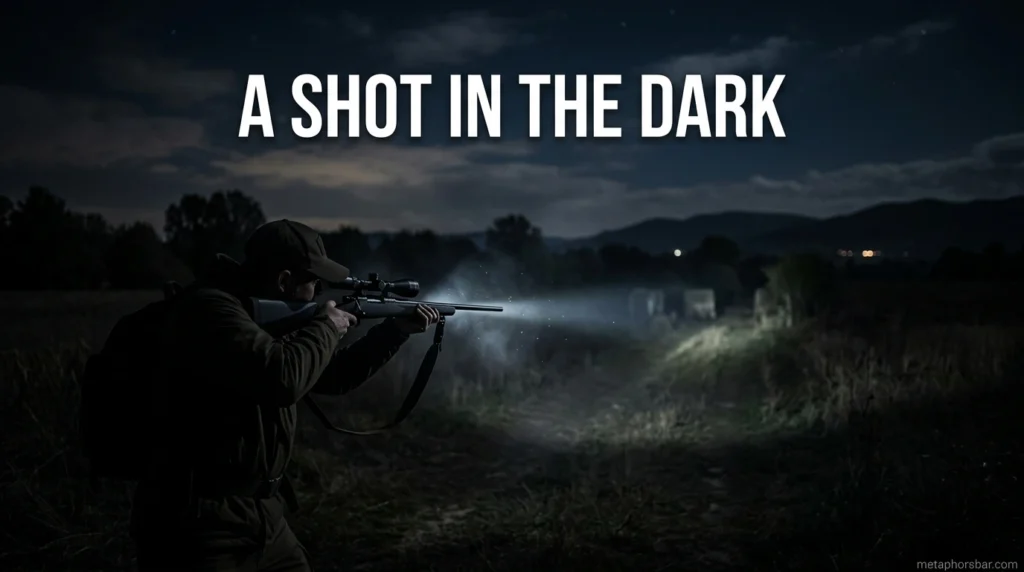
People often get confused by a shot in the dark because it sounds literal, but it is actually an idiom. If you hear it for the first time, you might imagine someone shooting in darkness, which is not the real meaning at all. In everyday writing, speaking, exams, and professional communication, idioms like this matter because they help you sound natural and understand what other speakers mean. If you use the phrase correctly, your English sounds more fluent and expressive. If you use it incorrectly, the sentence can feel awkward or unclear.
The good news is that a shot in the dark is easy to understand once you know the idea behind it. It usually means a guess, a risky attempt, or something done without much information or certainty. In this article, you will learn the meaning, correct usage, grammar rules, pronunciation, examples, common mistakes, and simple memory tips so you can use the phrase confidently.
What Does “A Shot in the Dark” Mean?
The phrase a shot in the dark means a guess made without enough information or a hopeful attempt with little chance of success.
Simple meaning
- a guess
- a blind attempt
- a risky try
- something uncertain
- a decision made without full facts
Examples
- I do not know the answer, so this is just a shot in the dark.
- He applied for the job as a shot in the dark.
- That was a shot in the dark, but it worked.
What the phrase suggests
It often implies:
- uncertainty
- lack of evidence
- guessing
- hoping for a lucky result
Comparison table: basic meaning
| Phrase | Meaning | Tone |
| a shot in the dark | a guess or risky attempt without enough information | informal, vivid |
| guess | an opinion without certainty | neutral |
| blind guess | a guess with no solid evidence | neutral to informal |
| long shot | something unlikely to succeed | informal |
A simple way to remember it
If something is a shot in the dark, you are trying something without seeing clearly or without enough facts. That is why the phrase is often used when people are unsure but still willing to try.
Where Does the Phrase Come From?
This idiom comes from the image of shooting in the dark, where you cannot clearly see your target. That image naturally suggests uncertainty and chance.
Why the phrase became popular
It is a strong visual metaphor:
- if you shoot in the dark, you may hit something
- but you are mostly guessing
- you do not know exactly where the target is
This is the same idea behind the figurative meaning of the phrase.
Origin summary table
| Element | Explanation |
| literal image | shooting without light |
| figurative meaning | guessing without enough information |
| modern use | a risky guess or attempt |
| tone | informal, expressive |
Why it matters
Knowing the image behind the idiom makes it easier to remember. When someone says a shot in the dark, they are usually not talking about a real gun or physical darkness. They are talking about uncertainty.
Read More: https://metaphorsbar.com/behavior-vs-behaviour/
Correct Usage in Real Life
This phrase is used when a person does not know something for sure and is taking a guess or trying something with little chance of success.
Common situations
- answering a difficult question
- making a guess in an exam
- trying an unlikely solution
- applying for something with low confidence
- making an uncertain prediction
Examples
- “What is the password?” “I do not know. It’s just a shot in the dark.”
- He called the company anyway; it was a shot in the dark, but he got an interview.
- My answer may be a shot in the dark, but I think the meeting is tomorrow.
Comparison table: common uses
| Situation | Example | Meaning |
| guess | That answer is a shot in the dark. | uncertain answer |
| job application | Applying was a shot in the dark. | low chance, but tried anyway |
| problem-solving | It was a shot in the dark, but we fixed it. | risky attempt |
| prediction | My guess is a shot in the dark. | not based on much evidence |
Tone and style
This phrase sounds:
- informal
- conversational
- expressive
- slightly dramatic
It is often used in:
- daily conversation
- storytelling
- friendly writing
- opinion pieces
- casual professional discussion
When it works best
Use it when you want to show:
- uncertainty
- a guess
- a risky attempt
- hope despite low confidence
Grammar Rules Behind the Phrase
Although a shot in the dark is an idiom, it still follows normal grammar rules.
Basic structure
The phrase works like a noun phrase:
a + shot + in + the + dark
Grammar breakdown
- a = article
- shot = noun
- in the dark = prepositional phrase describing the shot
Why the article matters
You normally say:
- a shot in the dark
Not:
- shot in the dark
- the shot in dark
- a shot of the dark
Grammar comparison table
| Form | Status | Example |
| a shot in the dark | correct | That was a shot in the dark. |
| shot in the dark | usually incomplete | That was shot in the dark. |
| a shot of the dark | incorrect | — |
| the shot in dark | incorrect | — |
Can the phrase be plural?
Not usually in fixed idiomatic use. If you talk about multiple guesses, you would normally say:
- several shots in the dark
- many blind guesses
- a few risky attempts
Example:
- They made several shots in the dark, but none worked.
Can it be used as part of a sentence?
Yes, very naturally:
- That was a shot in the dark, but it paid off.
- I think that answer is a shot in the dark.
- The proposal was a shot in the dark, yet it succeeded.
Important note
The phrase usually functions as a noun phrase, so it can be the subject, object, or complement of a sentence.
Sentence Examples: Correct and Incorrect Usage
Examples are the easiest way to understand this idiom.
Correct examples
- My guess is just a shot in the dark.
- Applying for the scholarship was a shot in the dark.
- It was a shot in the dark, but we tried anyway.
- His suggestion sounded like a shot in the dark.
- I made a shot in the dark and got the right answer.
More real-life examples
- She phoned the office as a shot in the dark and reached the manager.
- The repair was a shot in the dark, but it fixed the issue.
- We took a shot in the dark and asked the professor for help.
Incorrect examples
- That is shot in the dark.
- That is a shot of the dark.
- That was a dark in the shot.
- She made a shot from the dark.
- It was the shot in a dark.
Correct vs incorrect table
| Incorrect | Correct |
| That was shot in the dark. | That was a shot in the dark. |
| It was a shot of the dark. | It was a shot in the dark. |
| The answer was shot in dark. | The answer was a shot in the dark. |
| He took shot in the dark. | He took a shot in the dark. |
How it sounds in context
The phrase often appears with words like:
- guess
- try
- attempt
- chance
- hope
Examples:
- It was just a shot in the dark, but I had to try.
- We took a shot in the dark and asked again.
Common Mistakes Learners Make
Because this idiom is unusual, learners often make predictable mistakes.
Mistake 1: Taking it literally
Some learners think it always refers to an actual shot or gun. It does not. In modern English, it is usually figurative.
- Wrong: He took a real shot in the dark.
- Right: He made a shot in the dark when he guessed the answer.
Mistake 2: Forgetting the article “a”
- Wrong: That was shot in the dark.
- Right: That was a shot in the dark.
Mistake 3: Changing the structure
The phrase is fixed. Do not rearrange it.
- Wrong: dark in the shot
- Wrong: shot dark in the
- Right: a shot in the dark
Mistake 4: Using the wrong preposition
- Wrong: a shot of the dark
- Right: a shot in the dark
Mistake 5: Overusing it where a simpler word would do
Sometimes guess or attempt is enough.
- Less clear: That is a shot in the dark answer.
- Better: That is a guess.
- Better: That is an uncertain answer.
Common mistake table
| Wrong sentence | Correct sentence |
| It was shot in the dark. | It was a shot in the dark. |
| That is a shot of the dark. | That is a shot in the dark. |
| He made shot in dark. | He made a shot in the dark. |
| The dark shot was good. | The shot in the dark was good. |
Easy memory tip
Remember the full phrase:
- a shot in the dark
All four parts belong together.
Pronunciation, Style, and British vs American English
Pronunciation
The phrase is usually pronounced like:
- uh shot in thuh dark
The stress is usually on:
- shot
- dark
Spoken rhythm
- a SHOT in the DARK
It has a strong rhythm, which is one reason it is memorable.
Style
The phrase sounds:
- informal
- idiomatic
- descriptive
- slightly dramatic
It is commonly used in:
- conversation
- storytelling
- comments
- casual professional speech
Comparison table: style alternatives
| Phrase | Tone | Best use |
| a shot in the dark | vivid, informal | conversation, storytelling |
| a guess | neutral | everyday writing |
| a blind guess | casual | informal explanations |
| a risky attempt | clear and descriptive | formal or explanatory writing |
British vs American English
There is no major difference in meaning or grammar between British and American English for this phrase. Both use it in the same general way.
Comparison table
| Feature | British English | American English |
| meaning | same | same |
| spelling | same | same |
| usage | common and understood | common and understood |
| grammar | same | same |
Practical note
You do not need separate rules for British and American English here. The phrase is widely understood in both.
FAQs
Is “a shot in the dark” a real English idiom?
Yes. It is a common idiom meaning a guess or risky attempt made without enough information.
Is it formal or informal?
It is mostly informal or conversational, though it can appear in writing when the tone is expressive.
Can I use it in an exam?
Yes, if the question is about idioms or meaning. But in formal writing tasks, a simpler word like guess or attempt may be better.
Does it mean something bad?
Not always. It usually means uncertain or risky, but not necessarily negative. Sometimes a shot in the dark works out well.
Can it mean a lucky guess?
Yes. If the guess succeeds, you could say it was a shot in the dark that worked.
What is a simpler synonym?
Possible alternatives include:
- guess
- blind guess
- long shot
- risky attempt
Can I say “shots in the dark”?
Yes, in a literal plural sense or when speaking about several guesses.
Example:
- We made several shots in the dark before finding the answer.
Is it okay to use in business writing?
It can be used in business writing if the tone is informal or narrative, but more formal alternatives like risky attempt or uncertain guess may be better.
Conclusion
The phrase a shot in the dark is a useful English idiom that means a guess, a blind attempt, or something done without enough information. It often suggests uncertainty, risk, or hope. The structure is fixed, so it should usually be written exactly as a shot in the dark.
Here is the easiest way to remember it:
- a shot = a try or attempt
- in the dark = without enough information
- together = a guess made without seeing clearly
So write:
- That was a shot in the dark.
- His answer was a shot in the dark.
- Applying for the role was a shot in the dark, but it worked.
If you remember only one thing, remember this: a shot in the dark means a risky guess or attempt made without much certainty. That simple idea will help you understand the phrase, use it naturally, and recognize it when you read or hear it in English.