
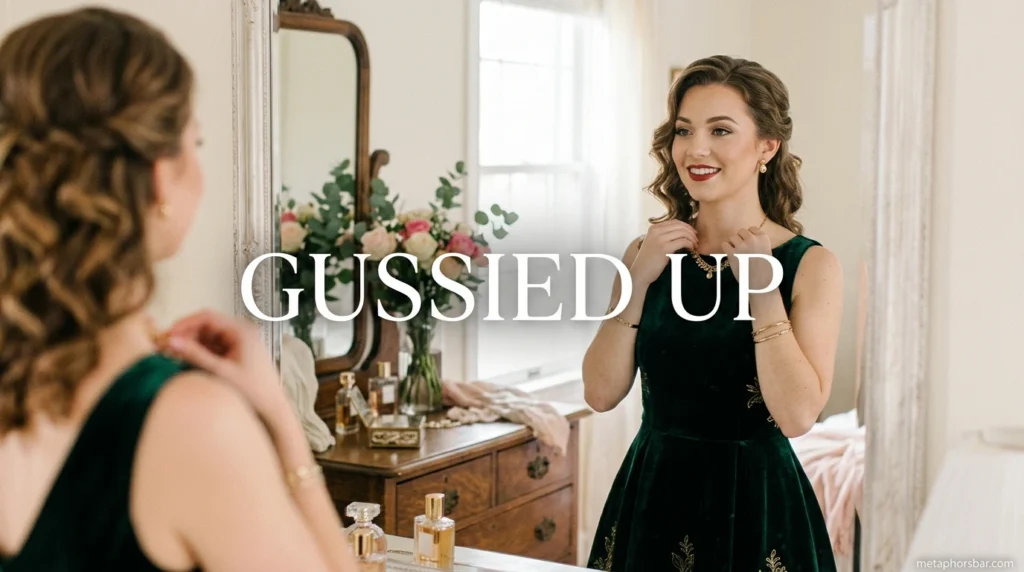
People often get confused by gussied up because it sounds playful, old-fashioned, and a little unusual. It is not a phrase most learners meet in a beginner grammar book, so they may wonder what it means, whether it is correct English, and whether it is formal or slang. That matters in everyday writing, speaking, exams, and professional communication because word choice affects tone. A phrase like gussied up can make your English sound vivid and natural, but only if you use it in the right context.
The good news is that this phrase is easy to understand once you know the meaning. Gussied up usually means dressed up neatly or attractively, often in a fancy, stylish, or exaggerated way. It can also mean improved, decorated, or made to look better than usual. In this article, you will learn the meaning, correct usage, grammar rules, pronunciation, sentence examples, common mistakes, and memory tips so you can use gussied up confidently.
What Does “Gussied Up” Mean?
The phrase gussied up means dressed in a fancy, neat, or attractive way. It is often used informally when someone looks more polished than usual. It can also describe objects, places, or things that have been decorated or improved to look better.
Simple meaning
- dressed up
- made to look nicer
- styled attractively
- decorated or improved
- wearing one’s best clothes
Examples
- She got gussied up for the party.
- The restaurant was all gussied up for the holidays.
- He gussied himself up before the interview.
What the phrase suggests
It often carries a feeling of:
- style
- effort
- celebration
- appearance
- informality
Comparison table: basic meaning
| Phrase | Meaning | Tone |
| gussied up | dressed up in a stylish or fancy way | informal, playful |
| dressed up | wearing nicer clothes | neutral |
| dolled up | made to look attractive, often with makeup or clothes | informal, playful |
| spruced up | improved in appearance | informal, positive |
A simple way to think about it
If someone is gussied up, they have made an effort to look more attractive, polished, or festive than usual. It is often a cheerful or lightly humorous phrase.
Where Did “Gussied Up” Come From?
The word gussy is old informal American English, and gussied up developed as a colorful way of saying “dressed up.” It is especially associated with casual, folksy, or old-fashioned speech.
Why the phrase sounds unusual
It sounds unusual because:
- it is not a modern formal expression
- it is more common in spoken English than in serious writing
- it has a playful, almost comic feeling
Origin summary table
| Element | Explanation |
| root form | gussy |
| main phrase | gussied up |
| style | informal, old-fashioned, playful |
| meaning | dressed up or improved in appearance |
Why it survived
Expressions like this survive because they are:
- memorable
- vivid
- expressive
- easy to imagine
When someone says gussied up, you can picture someone dressing neatly for an occasion, or a place being decorated to look special.
Practical note
You do not need to know the full historical origin to use the phrase correctly. What matters most is the current meaning and tone.
Correct Usage in Real Life
The phrase gussied up is best used in informal conversation, storytelling, and playful writing. It is not usually a formal or academic phrase.
Good situations for the phrase
- describing someone getting ready for a party
- describing a house, room, or restaurant that has been decorated
- writing dialogue in fiction
- talking casually about appearance
Examples
- She got gussied up before the wedding.
- The shop was gussied up for Christmas.
- He gussied himself up for the big meeting.
Comparison table: best uses
| Situation | Suitable? | Example |
| party or celebration | yes | She got gussied up for dinner. |
| casual conversation | yes | He looks all gussied up today. |
| formal business report | no | The office was gussied up for the event. |
| fiction or dialogue | yes | “We’d better get gussied up,” she said. |
Tone and style
The phrase sounds:
- informal
- cheerful
- a little old-fashioned
- descriptive
- sometimes humorous
When not to use it
Avoid gussied up in:
- academic essays
- formal letters
- business reports
- legal writing
- serious journalism
Instead, use:
- dressed up
- decorated
- improved
- made more attractive
- prepared formally
Practical rule
Use gussied up when you want to sound friendly, vivid, or a little playful.
Grammar Rules: How “Gussied Up” Works in a Sentence
The phrase gussied up behaves like a verb phrase with a past-tense or past-participle meaning.
Basic structure
- get gussied up
- gussied up
- gussy up (base form, more common in speech)
Examples
- She got gussied up for the dance.
- He gussied up the room with flowers.
- They were gussied up in their best clothes.
Grammar table: forms of the phrase
| Form | Example | Function |
| gussy up | They gussy up the room. | base form / present tense |
| gussied up | She gussied up for the party. | past tense |
| get gussied up | He got gussied up quickly. | common passive-like phrase |
| be gussied up | The hall was gussied up for the event. | passive-style use |
Object use
The phrase can describe:
- a person
- a place
- an event
- an object
Examples:
- She gussied up herself.
- The house was gussied up for the guests.
- The menu got gussied up with fancy fonts.
Comparison table: grammar patterns
| Pattern | Example | Meaning |
| get gussied up | She got gussied up. | dressed herself up |
| gussy up + object | They gussied up the hall. | decorated or improved something |
| be gussied up | The shop was gussied up. | had been made attractive |
Important note
The phrase is not usually used in a very formal grammatical setting. It is an idiomatic expression, so tone matters more than strict formality.
Sentence Examples: Correct and Incorrect Usage
Examples help the phrase become easier to remember.
Correct examples
- She got gussied up for the celebration.
- The garden was gussied up with lights.
- He gussied himself up before the date.
- The hotel got gussied up for the holiday season.
- We all got gussied up for the photo shoot.
More real-life examples
- The bride and groom were all gussied up.
- The office was gussied up for the company anniversary.
- He looked very gussied up in his suit.
- The old restaurant got gussied up for reopening day.
Incorrect examples
- She got gussy up for the party.
- He was gussied in the party.
- The room was gussied with beautiful.
- They gussied up to the event.
Correct vs incorrect table
| Incorrect | Correct |
| She got gussy up for the party. | She got gussied up for the party. |
| They gussied up to the event. | They got gussied up for the event. |
| The room was gussied with beautiful. | The room was gussied up beautifully. |
| He is gussied very. | He is very gussied up. / He looks gussied up. |
A helpful observation
You will often see gussied up in contexts about clothing, decorations, or style. It usually implies effort and improvement.
Examples:
- She gussied up in a red dress.
- The store was gussied up with ribbons.
- The invitation was gussied up with gold lettering.
Common Mistakes Learners Make
Because the phrase is informal and not very common in textbooks, learners often make a few mistakes.
1: Using the wrong form
- Wrong: gussy uped
- Right: gussied up
2: Changing the phrase too much
- Wrong: gussied in
- Right: gussied up
3: Using it in a serious formal setting
- Less suitable: The board meeting was gussied up for the investors.
- Better: The board meeting was decorated for the investors.
- Better: The presentation was made more polished for the investors.
4: Thinking it only applies to people
It can also describe places and things.
- Correct: The room was gussied up with flowers.
- Correct: The menu was gussied up with color.
5: Using it as a noun
It is usually not a noun.
- Wrong: She wore a gussied.
- Right: She was gussied up.
Comparison table: common mistakes and fixes
| Wrong | Correct |
| She got gussy up. | She got gussied up. |
| The room was gussied in flowers. | The room was gussied up with flowers. |
| He is a gussied. | He is gussied up. |
| The event was gussied very nice. | The event was gussied up very nicely. |
Easy memory tip
Think of gussied up as a fixed phrase meaning:
- made fancy
- dressed nicely
- decorated attractively
That will keep you from changing it into something unnatural.
Pronunciation, Style, and British vs American English
Pronunciation
The phrase is usually pronounced like:
- GUS-ee’d up
A natural sound version may be:
- GUS-eed up
Pronunciation table
| Word | Approximate pronunciation | Notes |
| gussy | GUS-ee | base form |
| gussied | GUS-eed | past tense |
| gussied up | GUS-eed up | full phrase |
Style
The phrase sounds:
- informal
- slightly old-fashioned
- playful
- descriptive
- friendly
It is often used in:
- conversation
- fiction
- storytelling
- casual articles
- humorous descriptions
Comparison table: style choices
| Phrase | Tone | Best use |
| gussied up | playful, old-fashioned | casual speech, stories |
| dressed up | neutral | general English |
| decorated | neutral | objects and places |
| made more attractive | clear and formal | business or academic writing |
British vs American English
The phrase is much more strongly associated with American English. British speakers will usually understand it, but they are more likely to use:
- dressed up
- smartened up
- spruced up
Comparison table: regional use
| Feature | American English | British English |
| commonness | more common | less common |
| tone | folksy, playful | understandable but less typical |
| better local alternatives | dressed up, spruced up | smartened up, dressed up |
Practical note
If you are writing for a broad audience, dressed up may be safer. If you want a more colorful, folksy tone, gussied up is a good choice.
FAQs
Is “gussied up” correct English?
Yes. It is correct, informal English.
Is it formal?
No. It is informal and often playful.
Can I use it for people?
Yes. It is often used for people who are dressed nicely.
Can I use it for places and objects?
Yes. It can describe a room, restaurant, house, invitation, or even a menu that has been made more attractive.
Is “gussied up” American English?
It is especially common in American English.
What is a more formal alternative?
You can say:
- dressed up
- decorated
- polished
- made more attractive
- improved in appearance
Is “gussied” a noun?
No, it is usually part of a verb phrase, not a noun.
Can I say “gussied herself up”?
Yes. That is a very natural pattern.
Example:
- She gussied herself up for the party.
Does it always mean clothing?
No. It can also mean making something look nicer in general.
Conclusion
The phrase gussied up is an informal, lively expression that means dressed up neatly or attractively, or more broadly made to look nicer or fancier. It is often used for people, but it can also describe places and things. The phrase is common in American English and has a playful, old-fashioned feel.
Here is the easiest way to remember it:
- gussy up = make something look nicer
- gussied up = dressed up or decorated attractively
- best for informal, friendly, or storytelling English
So write:
- She got gussied up for the wedding.
- The room was gussied up for the celebration.
- He gussied himself up before the interview.
If you remember only one thing, remember this: gussied up is a colorful informal phrase for dressing up or making something look more attractive, and it works best in casual, creative, or conversational English.