
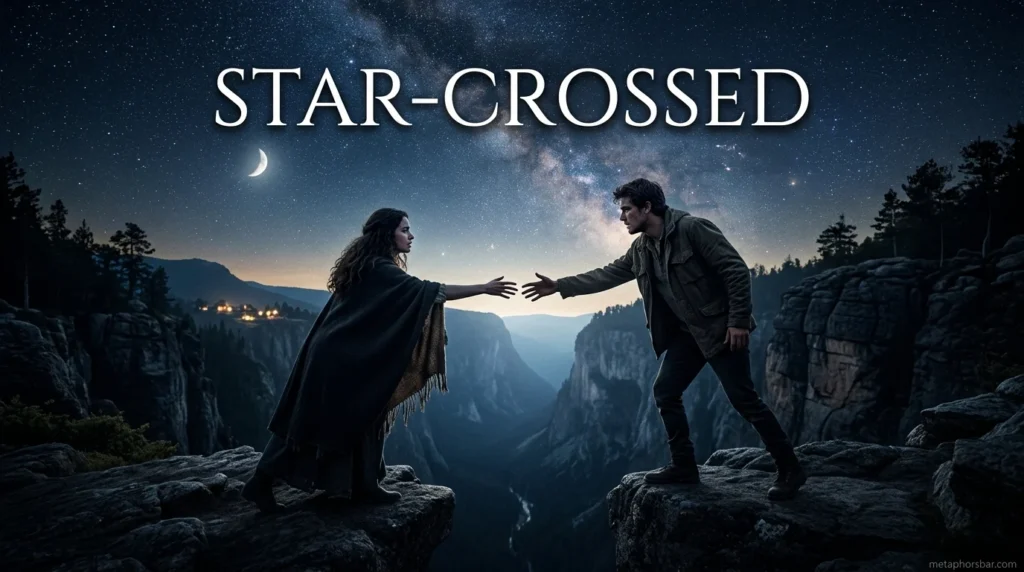
People often get confused by star-crossed because it sounds poetic, old-fashioned, and a little mysterious. Some learners hear it in literature, songs, or movie titles and wonder whether it is a noun, an adjective, or just a fancy phrase. That matters in everyday writing, speaking, exams, and professional communication because words like this carry both meaning and tone. If you use them correctly, your English sounds rich and natural. If you use them carelessly, the phrase can sound odd or unclear.
The good news is that star-crossed is not difficult once you understand it. It is usually an adjective that describes people, lovers, or situations that seem doomed by fate, bad luck, or forces outside their control. In this article, you will learn the meaning, correct usage, spelling, grammar rules, pronunciation, sentence examples, common mistakes, and memory tips so you can use star-crossed confidently.
What Does “Star-Crossed” Mean?
Star-crossed is an adjective that describes someone or something that seems destined to fail, especially because of bad luck, fate, or outside forces.
Simple meaning
- doomed by fate
- unlucky in love or life
- not meant to succeed
- blocked by outside circumstances
- affected by bad destiny
Examples
- They were star-crossed lovers.
- The project felt star-crossed from the beginning.
- Their friendship seemed star-crossed and tragic.
Why the phrase sounds poetic
The phrase suggests that the stars, which traditionally symbolize fate or destiny in literature, are working against the people involved. That is why it often appears in stories about:
- romance
- tragedy
- fate
- impossible relationships
- unfortunate circumstances
Comparison table: meaning of similar words and phrases
| Word/Phrase | Meaning | Tone |
| star-crossed | doomed, fate-challenged, tragically unlucky | poetic, literary |
| unlucky | not fortunate | everyday, neutral |
| doomed | destined to fail | serious, strong |
| ill-fated | unlucky from the start | formal/literary |
Key idea
If something is star-crossed, it usually means it seems like fate is against it. The phrase is especially common when talking about love stories or tragic situations.
Where Did “Star-Crossed” Come From?
The phrase has a long literary history. It is strongly associated with Shakespeare and older ideas about astrology, fate, and the influence of the stars.
Why stars?
In older thinking, people believed stars and planets could influence human life. If the stars were “crossed,” it suggested conflict, bad timing, or an unlucky fate.
Why the phrase became famous
It became especially well known through literature and later spread into:
- poetry
- novels
- plays
- songs
- film titles
- modern expressions of tragic romance
Origin summary table
| Element | Explanation |
| star | symbol of fate, destiny, or cosmic influence |
| crossed | in conflict, opposed, blocked |
| star-crossed | unlucky, fate-damaged, doomed |
Why the phrase survives today
People still use it because it sounds:
- romantic
- dramatic
- literary
- emotional
It gives a sentence a richer tone than simple words like “unlucky” or “badly timed.”
Practical note
You do not need to know the history to use the phrase correctly, but knowing the background helps you understand why it appears in tragic love stories and poetic writing.
Correct Usage in Real Life
The phrase star-crossed is usually used as an adjective before a noun or after a linking verb.
Common patterns
- star-crossed lovers
- star-crossed fate
- a star-crossed relationship
Examples
- It was a star-crossed romance.
- Their friendship seemed star-crossed.
- The play tells the story of star-crossed lovers.
When to use it
Use it when you want to describe:
- tragic romance
- doomed relationships
- bad luck that feels inevitable
- a situation that seems blocked by fate
Comparison table: best contexts
| Situation | Suitable? | Example |
| tragic romance | yes | star-crossed lovers |
| literary writing | yes | a star-crossed destiny |
| casual complaint | possible, but dramatic | a star-crossed day |
| formal business report | usually no | a star-crossed project |
Tone and style
The phrase is:
- poetic
- literary
- emotional
- dramatic
- slightly old-fashioned
It is not usually used in very formal business writing, but it is common in:
- stories
- essays
- book reviews
- film discussions
- song lyrics
- creative writing
Practical rule
If you want a phrase that sounds tragic, romantic, or fate-driven, star-crossed is a strong choice.
Grammar Rules and Word Forms
Star-crossed is usually used as an adjective. It can describe a noun directly or follow a linking verb.
As an adjective before a noun
Examples:
- star-crossed lovers
- star-crossed romance
- star-crossed fate
As a predicate adjective
Examples:
- Their love was star-crossed.
- The journey seemed star-crossed from the start.
- The relationship became star-crossed.
Grammar table: common structures
| Structure | Example | Function |
| adjective + noun | star-crossed lovers | describes the noun |
| be + adjective | Their love was star-crossed. | predicate adjective |
| seem + adjective | The plan seemed star-crossed. | describes a condition |
Hyphenation note
In modern English, star-crossed is usually written with a hyphen because it acts like a compound adjective.
Comparison table: grammar and punctuation
| Form | Correct? | Example |
| star-crossed | yes | star-crossed lovers |
| star crossed | sometimes seen, but less standard | star crossed lovers |
| starcrossed | not standard in careful writing | starcrossed lovers |
Why the hyphen matters
The hyphen helps show that the two words work together as one descriptive idea.
Can it be plural?
The phrase itself is not usually pluralized, but the noun it describes can be:
- star-crossed lovers
- star-crossed couples
- star-crossed friends
Practical note
Think of star-crossed as a ready-made adjective that helps describe a person or situation as tragically unlucky.
Sentence Examples: Correct and Incorrect Usage
Examples make the phrase much easier to understand.
Correct examples
- They were star-crossed lovers.
- The novel tells the story of a star-crossed romance.
- Their meeting felt star-crossed from the beginning.
- The two families shared a star-crossed history.
- The film portrays star-crossed characters separated by fate.
More real-life examples
- The couple seemed star-crossed, despite their love.
- The project had a star-crossed start because everything went wrong.
- She wrote about two star-crossed teenagers from different worlds.
Incorrect examples
- They were star crossed lovers.
- They were star-crossed love.
- Their love was a star-crossed.
- The project was star-crossedly unlucky.
Correct vs incorrect table
| Incorrect | Correct |
| star crossed lovers | star-crossed lovers |
| a star-crossed | a star-crossed romance |
| star-crossed love | star-crossed love story / star-crossed romance |
| star-crossedly unlucky | star-crossed / very unlucky |
A useful observation
The phrase is most naturally used with nouns related to:
- lovers
- romance
- relationship
- fate
- destiny
- tragedy
Examples:
- star-crossed lovers
- star-crossed romance
- star-crossed fate
Another practical example
Instead of:
- “Their relationship was unlucky.”
You could write:
- “Their relationship was star-crossed.”
That sounds more literary and expressive.
Common Mistakes Learners Make
Because the phrase is unusual, learners often make predictable errors.
1: Forgetting the hyphen
- Wrong: star crossed lovers
- Correct: star-crossed lovers
2: Using it like a noun
- Wrong: They were a star-crossed.
- Correct: They were star-crossed lovers.
3: Using it in a plain factual sentence when a simpler word is better
- Better: The meeting was badly timed.
- Better: The meeting was unlucky.
4: Adding an adverb ending
- Wrong: star-crossedly
- Better: star-crossed
5: Confusing it with “crossed stars”
The phrase does not mean stars literally crossing in the sky.
Common mistake table
| Wrong | Correct |
| star crossed | star-crossed |
| a star-crossed | star-crossed lovers / a star-crossed romance |
| star-crossedly unlucky | star-crossed or unlucky |
| crossed stars lovers | star-crossed lovers |
Easy memory tip
Remember:
- star-crossed = one fixed poetic adjective
- it usually describes love, fate, or tragedy
- use a hyphen
That will keep most mistakes away.
1.Pronunciation, Style, and British vs American English
Pronunciation
The phrase is usually pronounced like:
- STAR-krost or STAR-krôst
The exact vowel sound can vary by accent, but the phrase generally sounds smooth and literary.
Pronunciation table
| Word | Approximate pronunciation | Notes |
| star | star | simple |
| crossed | krawst / krost | depends on accent |
| star-crossed | STAR-krost | compound adjective |
Style
The phrase sounds:
- poetic
- tragic
- romantic
- literary
- slightly old-fashioned
Comparison table: style choices
| Phrase | Tone | Best use |
| star-crossed | poetic, dramatic | stories, essays, literature |
| unlucky | simple, neutral | everyday speech |
| ill-fated | formal, literary | reports, fiction |
| doomed | strong, serious | tragic contexts |
British vs American English
There is no major British vs American English difference in the spelling or meaning of star-crossed. Both varieties use the same form.
Practical note
You do not need separate UK and US rules here. The hyphenated form is standard in careful writing in both varieties.
FAQs
What does “star-crossed lovers” mean?
It means lovers whose relationship is doomed or troubled by fate, bad luck, or outside forces.
Is it formal?
It is more literary than conversational. It works well in essays, stories, and reviews.
Can I use it in everyday speech?
Yes, but it may sound dramatic or poetic.
Should I always use the hyphen?
Yes, in standard careful writing, star-crossed is the preferred form.
Can it describe things other than love?
Yes. It can describe:
- a star-crossed plan
- a star-crossed friendship
- a star-crossed journey
- a star-crossed destiny
Is there a British spelling difference?
No major spelling difference. The form is the same in British and American English.
Can I say “star crossed” without the hyphen?
You may see it sometimes, but star-crossed is the better standard form.
Conclusion
The word star-crossed is a poetic adjective that means doomed, fate-challenged, or unlucky in a tragic way. It is most often used to describe lovers, relationships, and dramatic situations. The correct standard spelling is star-crossed with a hyphen.
Here is the easiest way to remember it:
- star-crossed = tragic or fate-blocked
- usually describes love or relationships
- hyphenated compound adjective
- common in literary and creative English
So write:
- star-crossed lovers
- a star-crossed romance
- their star-crossed fate
- the star-crossed couple
If you remember only one thing, remember this: star-crossed is a poetic adjective for people or situations that seem doomed by fate, and the hyphen belongs in the standard spelling. That simple rule will help you use it naturally, correctly, and confidently in writing and reading.