

A feeling can arrive before words do. It may sit in the chest like a stone, flicker behind the eyes like a candle, or roll through the mind like weather changing over a field. Sometimes we know exactly what we feel, but not how to say it. Other times, the feeling is so tangled that plain language seems too small to hold it.
That is where metaphors for emotions become so useful. Emotions are invisible, moving, and often layered. A metaphor gives them shape. It turns sadness into rain, anger into fire, joy into sunlight, grief into a tide, and anxiety into fog. Good metaphors do not just decorate a sentence; they reveal the texture of what it means to be human.
Whether you are writing poetry, a journal entry, a speech, a story, or even a social media caption, metaphors for emotions can make your language feel more vivid, more honest, and more alive.
Why Metaphors for Emotions Matter in Writing and Communication
They make invisible feelings visible
Emotions cannot be seen directly, but they can be felt in the body and imagined through images. A metaphor gives shape to that invisible experience.
They help us name complex inner states
Many emotions are mixed. We can feel joy and fear at the same time, or anger and hurt together. Metaphors help capture that complexity without flattening it.
They make writing more memorable
A sentence like “I felt sad” is clear. A sentence like “sadness settled over me like evening rain” lingers longer in the mind.
They make emotional expression more human
Metaphors bridge the gap between what is felt and what is said. They help readers and listeners connect with experiences that may otherwise be hard to explain.
Three Powerful Metaphors for Emotions
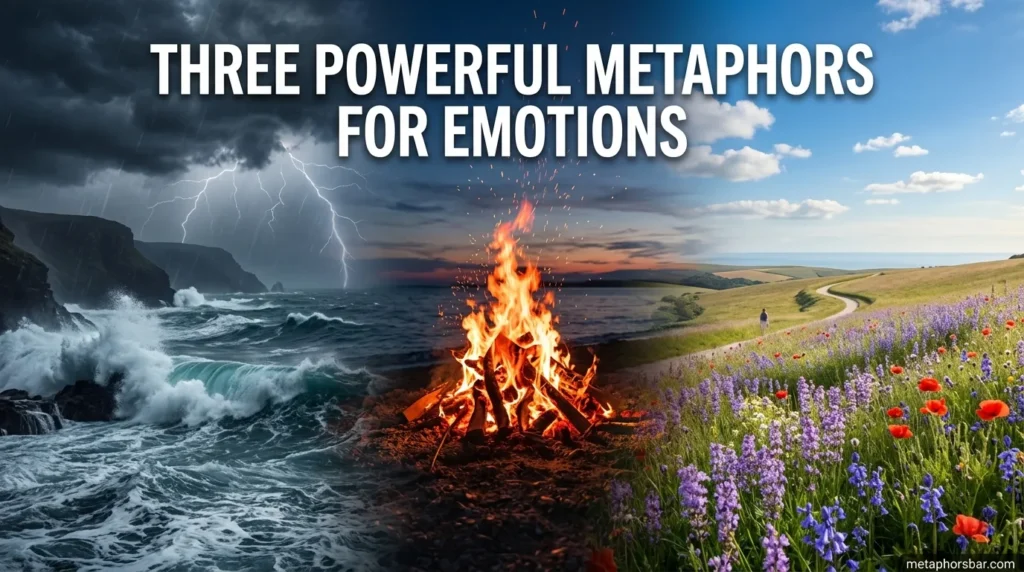
1. Emotions as Weather
Weather is one of the most natural and useful metaphors for emotions because it changes constantly, can be gentle or severe, and often arrives without warning. A mood may be sunny, cloudy, stormy, or foggy. This image works especially well when emotions feel shifting, temporary, or difficult to control.
Meaning and explanation
When emotions are compared to weather, the idea is that feelings can move through us the way weather moves through the sky. Joy can feel like sunshine. Sadness can feel like rain. Anger can feel like thunder. Anxiety can feel like fog. Calm can feel like a clear blue morning. This metaphor is powerful because it captures both motion and atmosphere.
It also reminds us that weather changes. A storm passes. Fog lifts. The sun returns. That makes this metaphor especially comforting when emotions feel intense or overwhelming.
Example sentence or scenario
Her mood was weather, shifting from bright sunshine in the morning to a sudden storm by afternoon.
This metaphor works beautifully in personal writing, fiction, and reflective essays, especially when you want to show emotional change over time.
Alternative ways to express it
- a sky of shifting feelings
- a storm inside the chest
- a cloud over the day
- sunlight in the heart
- fog in the mind
Sensory and emotional details
You can imagine the smell of rain on pavement, the weight of dark clouds, the sudden warmth of sunlight, or the hush that comes before a storm. Emotionally, this metaphor feels natural, changeable, and deeply relatable. It suggests that feelings are part of a larger climate inside us.
Mini storytelling touch
A teacher once told a nervous student, “Today your feelings may be stormy, but weather never stays forever.” That simple image can be a great comfort. It does not deny the storm, but it offers perspective. Weather metaphors help us understand that emotions are real without being permanent.
Literary or cultural reference
Writers across centuries have used weather to symbolize emotion. From stormy tragedy to bright renewal, the sky has long mirrored the human heart. In literature, weather often reveals what characters cannot say aloud.
2. Emotions as Fire
Fire is a powerful metaphor for emotions because it can warm, light, spread, consume, or glow softly beneath the surface. It works especially well for intense emotions such as anger, passion, desire, courage, or even grief that burns quietly over time.
Meaning and explanation
When emotions are compared to fire, the image suggests heat, intensity, and transformation. Joy can blaze. Anger can erupt. Love can burn warmly. Grief can smolder. Fire is useful because it captures the way emotions can start small and grow stronger if fed by thought or memory.
Unlike weather, which feels external and atmospheric, fire feels close to the body. It lives under the skin. That makes it especially effective when emotions feel deeply internal and difficult to ignore.
Example sentence or scenario
His anger was a fire that had been slowly building all week, waiting for one careless word to flare up again.
This metaphor is ideal for writing that wants emotional force, especially in fiction, poetry, or scenes of conflict and passion.
Alternative ways to express it
- a blaze of feeling
- an ember of memory
- a burning heart
- a flame that would not go out
- a quiet heat of longing
Sensory and emotional details
You can imagine the crackle of flames, the smell of smoke, the glow of embers, and the warmth that can comfort or scorch. Emotionally, this metaphor feels vivid, urgent, and alive. It suggests that emotions are not always gentle; sometimes they are fierce and transformative.
Mini storytelling touch
A woman once described the grief she felt after losing her mother as “a fire that did not roar but kept warmth in the ashes.” That line shows the flexibility of this metaphor. Fire is not only destruction. It can also be the lasting glow of something loved.
Literary or cultural reference
Fire appears everywhere in myth and literature as a symbol of passion, danger, purification, and life force. As a metaphor for emotions, it carries both beauty and risk, making it especially expressive for intense inner experiences.
3. Emotions as Waves
Waves are one of the most beautiful metaphors for emotions because they move in cycles, rise and fall, and can be calm or overwhelming. This image works especially well for feelings that return in patterns, such as grief, longing, hope, overwhelm, or relief.
Meaning and explanation
When emotions are compared to waves, the image suggests motion, rhythm, and recurrence. A feeling may come in a rush, crest, then retreat—only to return again. This metaphor is especially helpful for describing emotions that are not fixed, but moving. It can show how feelings can arrive softly or crash all at once.
The wave metaphor is especially rich because it reflects emotional life accurately. Few feelings arrive exactly once and disappear forever. They often return, shift, and change shape just like the sea.
Example sentence or scenario
Her grief came in waves, some small and gentle, others so heavy they knocked the breath out of her.
This metaphor works beautifully in memoir, poetry, and reflective writing about memory, love, and loss.
Alternative ways to express it
- a tide of feeling
- a swell of emotion
- a rolling sea inside
- a cresting memory
- a current of sorrow or joy
Sensory and emotional details
You can imagine the sound of surf, the pull of water at your ankles, the crash of a large wave, or the calm after the tide pulls back. Emotionally, this metaphor feels rhythmic, honest, and deeply human. It suggests that emotions can return without warning, but also that they can move through us and eventually ease.
Mini storytelling touch
A man once said that after a breakup, he expected his sadness to disappear like a broken object. Instead, it came and went like the ocean. “I had to learn,” he said, “that some feelings don’t vanish. They wash over you until you learn how to breathe with them.” That is the wisdom in the wave metaphor.
Literary or cultural reference
The sea has long symbolized the unconscious, emotion, and transformation in literature and art. Waves appear often in poetry because they capture the rise and fall of feeling so naturally.
How to Choose the Right Metaphor for Emotions
Use weather when emotions feel changeable or atmospheric
Choose this metaphor when the feeling is shifting, temporary, or spread across the whole day.
Use fire when emotions feel intense or consuming
This is the best choice for feelings that burn, glow, or threaten to overflow.
Use waves when emotions feel rhythmic or recurring
Choose this image when the feeling comes and goes in cycles or arrives in surges.
The best metaphor depends on the kind of emotion you want to describe. Some feelings move like weather, some burn like fire, and some return like the tide. Often, one person can feel all three in a single day.
Interactive Exercises for Practicing Metaphors for Emotions
Exercise 1: Complete the sentence
Finish this prompt in three different ways:
“My emotion felt like ______ because ______.”
Try one answer that feels gentle, one that feels intense, and one that feels repetitive.
Example: My emotion felt like a storm because it changed the atmosphere around me without warning.
Exercise 2: Sensory mapping
Think of a feeling you often experience. Write down:
- one color
- one sound
- one temperature
- one movement
- one object or place that comes to mind
Then turn those details into a metaphor.
For example: Sadness felt like gray rain, sounded like a slow dripping faucet, moved like a tide, felt cold as wind against the skin, and looked like an empty shoreline.
Exercise 3: Story starter
Begin a short paragraph with:
“This feeling was like…”
Let the image guide the tone. Make it poetic, honest, simple, or dramatic.
Exercise 4: Journal or caption prompt
Try writing a one-line reflection:
- “Joy felt like sunlight in a closed room.”
- “My anger was a fire that would not go quiet.”
- “My grief came in waves and left salt behind.”
Bonus Tips for Using Metaphors for Emotions in Writing, Social Media, and Daily Life
In writing
Use emotion metaphors in poems, fiction, memoirs, and essays to make feelings vivid and relatable. They help readers experience the emotion instead of just understanding the label.
On social media
A short metaphor can make a caption feel more thoughtful and original. “Feeling like fog today” or “My joy is sunlight” can be both expressive and simple.
In everyday conversation
Metaphors help you explain how you feel without needing long explanations. Saying “I’m in a storm right now” may communicate more than “I’m upset.”
In journaling
If you are reflecting on your emotional life, metaphor can help you notice patterns. Ask whether your feeling is weather, fire, or waves—and what that reveals.
Keep the image honest
The strongest emotional metaphor is the one that truly fits the feeling. Some emotions are quick and bright, some are heavy and slow, some rise in cycles. Let the image match the truth.
FAQs
1. What is a metaphor for emotions?
A metaphor for emotions is a figurative comparison that describes feelings using another image, such as weather, fire, or waves.
2. Why are metaphors for emotions useful?
They help make feelings easier to understand, express, and remember in writing or speech.
3. What is a simple metaphor for emotions?
A simple example is: Emotions are weather. It suggests change, mood, and atmosphere.
4. Can emotion metaphors be used in poetry?
Yes. They are especially effective in poetry because they capture inner life with imagery and rhythm.
5. How do I create my own metaphor for an emotion?
Think about what the feeling feels like in the body and mind, then compare it to something with similar qualities.
6. Are these metaphors only for serious writing?
No. They can also be used in captions, journals, conversation, and creative prompts when the tone is appropriate.
7. What makes a strong metaphor for emotion?
A strong metaphor is vivid, emotionally accurate, and easy to picture. It should help the reader feel the emotion, not just label it.
Conclusion
Emotions can be bright or heavy, sudden or slow, steady or stormy. They can burn, roll, and change like weather over a field. That is why metaphors matter—they help us turn invisible feelings into language that can be seen, heard, and felt.
Weather gives emotions movement and change. Fire gives them heat and intensity. Waves give them rhythm and return. Together, these images remind us that emotions are not static—they flow through us, shape us, and sometimes leave us changed.
So when you write about emotions, do not settle for the obvious. Let them storm, burn, and move through your words. A good metaphor can make the inner world feel unforgettable.