

A classroom can feel like many things at once: the soft scratch of pencils, the hush before a difficult question, the glow of a board lit by ideas, the quiet thrill when understanding finally clicks into place. Education is never only about facts and tests. It is also about becoming. It is the long, sometimes messy, often beautiful process of helping a person step into a larger version of themselves.
That is why metaphors for education matter so much. Education can be abstract, and abstract things are easier to understand when they are made vivid. A good metaphor can turn learning into a journey, a garden, a lantern, a bridge, a key, or a seed. It gives shape to the invisible work of growing knowledge, confidence, and curiosity.
Whether you are a teacher, student, parent, writer, or speaker, metaphors for education can make your language richer, more memorable, and more inspiring. They help explain the learning process in a way that feels human, relatable, and alive.
Why Metaphors for Education Matter in Teaching and Learning
They make learning easier to understand
Education includes many complex ideas: progress, memory, discipline, critical thinking, and curiosity. A metaphor turns those ideas into images people can immediately picture.
They help students feel the purpose of learning
When education is described as a journey, a garden, or a bridge, it becomes more than schoolwork. It becomes meaningful movement toward a future.
They make teaching more memorable
A teacher’s explanation can be forgotten, but a strong image often stays. Students remember what they can see in their minds.
They add warmth to the language of school
Education can sometimes sound technical or dry. Metaphors bring it back to life. They remind us that learning is a deeply human experience.
Three Powerful Metaphors for Education
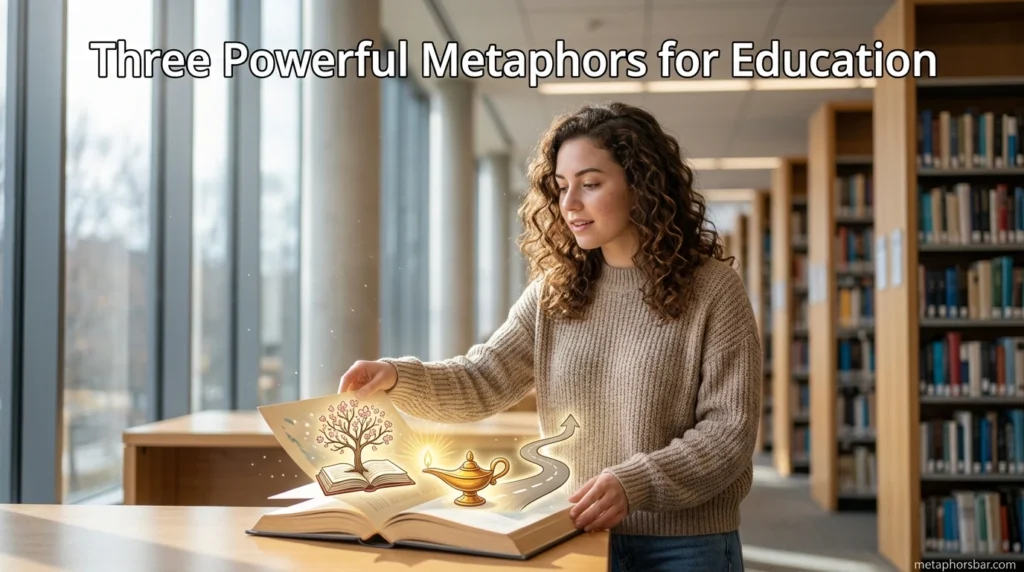
1. Education as a Journey
One of the most common and effective metaphors for education is the journey. It is fitting because learning is not a single event. It happens over time, through experiences, setbacks, surprises, and discoveries. A journey suggests direction, effort, and destination.
Meaning and explanation
When education is described as a journey, the learner becomes a traveler. The classroom becomes part of the road. Lessons are stops along the way. Teachers are guides, fellow travelers, or signposts. This metaphor works because education is not static—it moves. Students begin in one place and, with support and effort, travel toward new understanding.
This image is especially helpful for students who feel discouraged. A journey reminds them that they do not need to reach the destination all at once. They only need to keep walking, asking, and learning.
Example sentence or scenario
Her education was a journey across many landscapes, with each lesson opening a new road she had never seen before.
This works beautifully in speeches, essays, graduation notes, and classroom reflections because it emphasizes progress rather than perfection.
Alternative ways to express it
- a path of discovery
- a road to knowledge
- a lifelong trek
- a guided trip through ideas
- a route toward understanding
Sensory and emotional details
You can imagine footsteps on gravel, the sound of turning pages, the sight of a winding road, and the feeling of moving toward something larger than yourself. Emotionally, this metaphor feels hopeful, steady, and purposeful. It suggests that learning is a process of becoming, not a race to finish.
Mini storytelling touch
A student once said that starting college felt like standing at the edge of a map with no roads drawn yet. By the end of the first year, she realized education was less about knowing every turn and more about learning how to travel with curiosity. That is the gift of the journey metaphor: it makes uncertainty feel like part of the adventure rather than a failure.
Literary or cultural reference
Journeys appear throughout literature and mythology as symbols of growth, transformation, and initiation. From pilgrimages to hero quests, the road has long represented learning through experience.
2. Education as a Garden
A garden is one of the most beautiful metaphors for education because learning, like planting, needs time, care, patience, and the right conditions to bloom. Not everything grows at the same pace. Some things flower quickly; others take seasons. Education works in much the same way.
Meaning and explanation
When education is described as a garden, the emphasis is on nurturing, growth, and cultivation. A teacher may plant ideas. A lesson may water curiosity. Practice may pull weeds of confusion. Over time, knowledge blossoms. This metaphor is especially powerful because it shows that learning is not forced—it is tended.
It also reminds us that students grow differently. A garden does not bloom all at once, and neither do all learners. Some need sun. Some need shade, Some take root slowly but deeply. That makes the garden metaphor especially inclusive and compassionate.
Example sentence or scenario
The classroom was a garden where questions were seeds, patience was sunlight, and understanding blossomed in its own time.
This metaphor is excellent for describing teaching, child development, lifelong learning, and environments where growth is valued over speed.
Alternative ways to express it
- a bed of growing ideas
- a field of possibility
- a place where knowledge blooms
- a cultivated mind
- a living landscape of learning
Sensory and emotional details
You can smell fresh soil, feel warm sunlight, and hear the quiet rustle of leaves or the hum of bees. Emotionally, this metaphor feels tender, patient, and nourishing. It suggests that learning is a form of care and that education can help people flourish.
Mini storytelling touch
A teacher once kept a small potted plant near her desk and told her students, “That plant and your minds need the same thing: attention over time.” It was a simple idea, but it stayed with them. That is why the garden metaphor works so well—it makes growth visible and gentle at the same time.
Literary or cultural reference
Gardens have long represented wisdom, cultivation, and renewal in literature and culture. They appear in stories as places where care and patience reveal hidden beauty. Education, too, often grows best when it is tended rather than rushed.
3. Education as a Lighthouse
A lighthouse is a powerful metaphor for education because it gives guidance, clarity, and direction. In a world full of uncertainty, education often helps people find their way. It does not eliminate every storm, but it shows a path through them.
Meaning and explanation
When education is compared to a lighthouse, it suggests that learning provides light in dark or confusing places. A student may feel lost, but education can help them see farther ahead. A teacher can act as the light that reveals a route. This metaphor works especially well when talking about knowledge as a source of guidance, safety, and hope.
The lighthouse is especially meaningful because it does not move around or chase the ships. It stands firm and shines steadily. That makes it a beautiful image for education as a constant source of illumination.
Example sentence or scenario
For many students, education is a lighthouse—steady, bright, and visible even when the sea of life grows rough.
This metaphor works well in speeches, graduation messages, educational essays, and reflective writing about the role of knowledge.
Alternative ways to express it
- a beacon of understanding
- a guiding light
- a lamp in the fog
- a signal through the dark
- a tower of clarity
Sensory and emotional details
You can imagine waves crashing below, wind moving through the air, and a bright beam cutting through darkness. Emotionally, this metaphor feels reassuring, stable, and wise. It suggests that education is not just information; it is direction.
Mini storytelling touch
A first-generation college student once said that every book she opened felt like a light turning on in a room she did not know had been dark. That is the beauty of the lighthouse metaphor. Education often feels like finally being able to see the shoreline.
Literary or cultural reference
Lighthouses often symbolize guidance, hope, and safety in literature and art. As a metaphor for education, they remind us that knowledge can be a form of rescue, orientation, and trust.
How to Choose the Right Metaphor for Education
Use journey when you want to show growth over time
Choose this metaphor when learning feels like a process of moving forward, step by step.
Use garden when you want to show nurturing and development
This is the best choice when education feels like care, patience, and natural growth.
Use lighthouse when you want to show guidance and clarity
Choose this image when education is helping someone find direction in uncertainty.
The best metaphor depends on what you want to emphasize. Education can travel, bloom, and guide—and often it does all three.
Interactive Exercises for Practicing Metaphors for Education
Exercise 1: Complete the sentence
Finish this prompt in three different ways:
“Education is like ______ because ______.”
Try one answer that focuses on growth, one on guidance, and one on discovery.
Example: Education is like a garden because ideas grow best when they are watered with care and patience.
Exercise 2: Sensory mapping
Think of a learning experience you remember well. Write down:
- one sound
- one smell
- one color
- one object
- one emotion
Then turn those details into a metaphor.
For example: The lesson smelled like old books and pencils, sounded like a room full of questions, looked like a path lined with lanterns, and felt like a garden slowly opening in spring.
Exercise 3: Story starter
Begin a paragraph with:
“Learning felt like…”
Let the image guide the tone. You can make it hopeful, reflective, surprising, or warm.
Exercise 4: Social media or journal prompt
Try writing one line about learning:
- “Education is a road I keep walking.”
- “My mind is a garden of growing questions.”
- “Knowledge was a lighthouse when I needed direction.”
Bonus Tips for Using Metaphors for Education in Writing, Teaching, and Daily Life
In writing
Use these metaphors in essays, speeches, lesson plans, and reflective pieces to make the subject of education feel more vivid and meaningful.
In teaching
Metaphors can help students understand difficult ideas more easily. A journey can explain progress. A garden can explain growth. A lighthouse can explain guidance.
In social media
A short metaphor can make a post about learning, school, or graduation feel thoughtful and memorable.
In daily conversation
Metaphors can help you talk about learning in a more human and encouraging way. Instead of saying “I’m still learning,” you might say, “I’m still on the journey.”
Keep the image true
The strongest metaphor is the one that matches the learning experience you want to describe. Some lessons feel like roads. Some feel like gardens, Some feel like lights in the dark.
FAQs
1. What is a metaphor for education?
A metaphor for education is a figurative comparison that describes learning using another image, such as a journey, garden, or lighthouse.
2. Why are metaphors for education useful?
They help make learning easier to understand, more memorable, and more emotionally meaningful.
3. What is a simple metaphor for education?
A simple example is: Education is a journey. It suggests movement, progress, and discovery.
4. Can these metaphors be used in teaching?
Yes. They are especially useful for helping students understand growth, structure, and purpose in learning.
5. How do I create my own metaphor for education?
Think about what education does—guides, nurtures, or moves people—and compare it to something with similar qualities.
6. Are these metaphors only for school writing?
No. They can also be used in speeches, social media, reflections, and everyday conversations about learning.
7. What makes a strong metaphor for education?
A strong metaphor is vivid, emotionally fitting, and easy to imagine. It should help the reader see learning as a living process.
Conclusion
Education is more than tests, grades, and classrooms. It is a lifelong process of discovering, growing, and finding direction. That is why metaphors matter—they help us describe the deep and human experience of learning in ways that feel clear and lasting.
A journey gives education movement and discovery. A garden gives it care and growth. A lighthouse gives it clarity and guidance. Together, these images remind us that education is not just information—it is transformation.
So when you write or speak about education, do not settle for plain description alone. Let it travel, bloom, and shine through your words. A good metaphor can make learning feel unforgettable.