
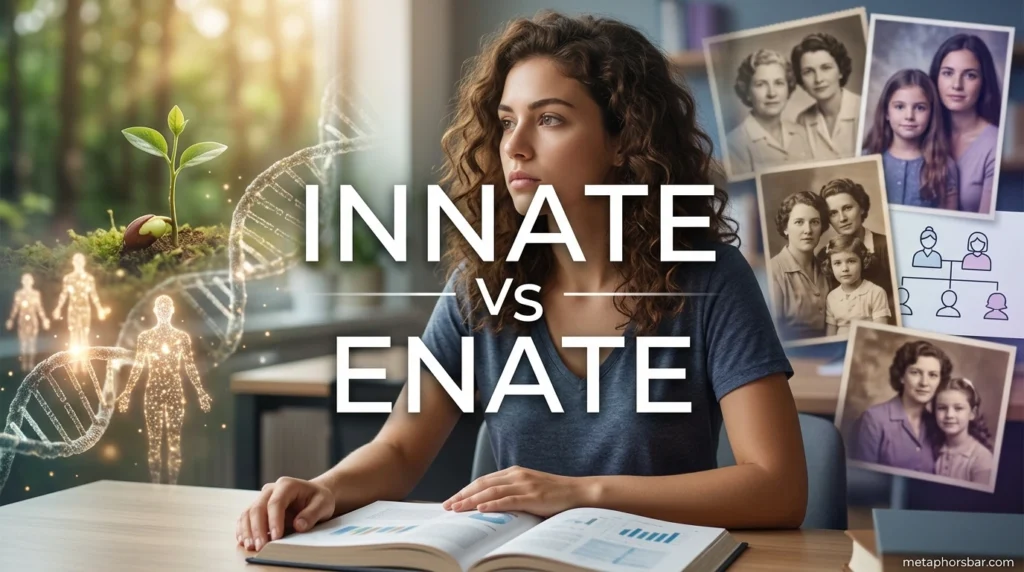
English learners often get confused by innate vs enate because the two words look similar, but they do not mean the same thing. That matters in everyday writing, speaking, exams, and professional communication because using the wrong word can change the meaning completely. Innate is the word most people mean when they talk about something that is inborn or natural, while enate has a much more specialized meaning, referring to someone related through the mother’s side or, in biology, something that grows out or outward.
The good news is that this topic is easy once you separate the meanings clearly. In this guide, you will learn what each word means, how to spell and pronounce them, how they work in sentences, common mistakes to avoid, and simple memory tips so you can use them confidently.
What Do “Innate” and “Enate” Mean?
Innate is an adjective meaning something that is inborn, natural, or present from birth. Dictionaries describe it as existing in or belonging to a person from birth, or as being part of a thing’s essential nature. Learner dictionaries also gloss it as “born with” or “present naturally,” often with examples like an innate ability or an innate sense of fun.
Enate, by contrast, is a different word. Merriam-Webster and Collins define it with a specialized sense: it can mean related on the mother’s side, and it is also listed as an adjective meaning growing out or outwards in biology; Collins also gives the related adjective enatic. In other words, enate is not a synonym of innate. It belongs to a different meaning family.
Simple meaning table
| Word | Main meaning | Typical area of use |
| innate | inborn, natural, part of one’s nature | general English, psychology, education |
| enate | related through the mother’s side; also growing out/outwards | genealogy, botany, specialized vocabulary |
What this means in practice
If you want to say someone has a talent or quality they were born with, the correct word is innate. If you are writing about family relationships through the mother’s line, or using a specialized biological sense, enate may be the right word.
Which Word Should You Use in Everyday Writing?
For ordinary writing, innate is the word most people mean when they talk about something natural, inborn, or instinctive. Common dictionary examples include phrases such as innate ability, innate sense of fun, innate sense of justice, and innate beauty.
Use enate only if you really mean one of its specialized senses: a relative on the mother’s side, or a biological term for something growing out or outward. In most everyday essays, emails, speeches, and schoolwork, enate is unlikely to be the word you need.
Everyday usage comparison table
| Situation | Better word | Example |
| born with a talent | innate | She has an innate ability to learn quickly. |
| natural kindness | innate | He has an innate sense of kindness. |
| mother’s-side relative | enate | Her enate relatives came from her mother’s family line. |
| biology / plant term | enate | The botanical sense of enate refers to growing out. |
Quick rule
If your sentence sounds like inborn, natural, instinctive, or part of someone’s essential nature, choose innate. If it sounds like mother’s side of the family or a technical biological term, enate may be correct.
Spelling and Form Differences
The two words are spelled differently, and the spelling difference is important because the meanings are different too.
Innate is spelled with two n’s and ends in -ate.
Enate begins with e- and also ends in -ate.
Spelling table
| Word | Spelling | Notes |
| innate | i-n-n-a-t-e | the “inborn” word |
| enate | e-n-a-t-e | specialized word, not the same meaning |
Related word forms
| Word | Related forms from dictionary sources | Example |
| innate | innately, innateness | She behaved innately with confidence. |
| enate | enatic, enates | His enate relatives were listed in the family tree. |
Merriam-Webster lists innately as the adverb and innateness as the noun derived from innate. Collins lists enatic as a related adjective and Merriam-Webster gives enate as a noun with the plural enates.
Comparison table: word families
| Base word | Adjective | Adverb | Noun |
| innate | innate | innately | innateness |
| enate | enate / enatic | — | enate / enates |
Practical spelling tip
A simple way to remember it:
- innate begins with in-, which helps many learners connect it to inborn or inside nature
- enate begins with e-, which is easy to remember as the word for the mother’s side in genealogy contexts
Grammar Rules and Word Forms
Innate
Innate is mainly an adjective. Learner dictionaries and major dictionaries define it as a quality or ability someone has from birth, or as something inherent to a thing’s nature. It commonly modifies nouns like ability, sense, talent, beauty, justice, or goodness.
Examples:
- an innate ability
- an innate sense of fun
- innate beauty
- innate intelligence
Enate
Enate can be an adjective or a noun. Collins and Merriam-Webster describe the adjective as “growing out” or “related on the side of the mother,” and the noun as a relative on the mother’s side. Merriam-Webster also notes the plural enates.
Examples:
- an enate relative
- enate kin
- the plural enates
Grammar table
| Word | Part of speech | Example | Function |
| innate | adjective | innate talent | describes a natural quality |
| innately | adverb | She is innately curious. | modifies the verb/adjective |
| enate | adjective / noun | enate relative / an enate | describes or names a maternal relative |
| enatic | adjective | enatic relationship | related form listed by Collins |
Important grammar note
Because innate is the common adjective for “inborn,” you will usually place it before a noun:
- innate talent
- innate fear
- innate sense
Because enate is specialized, you are more likely to see it in technical or genealogical writing than in daily conversation.
Sentence Examples: Correct and Incorrect Usage
Examples make the difference very clear.
Correct examples with innate
- She has an innate sense of direction.
- He showed innate kindness from a young age.
- The child has an innate ability to solve puzzles.
- Her confidence seemed innate.
- Humans are often said to have innate capacities.
Correct examples with enate
- The family tree identified her enate relatives.
- In this genealogy chart, the maternal line is marked as enate.
- The botanist used enate in a technical description of the plant structure.
Incorrect examples
- Her enate ability to sing is amazing.
Use innate here, because “ability to sing” refers to a natural talent. - He has an innate relation on his mother’s side.
Use enate if you mean a maternal relative. - She is innate to the family tree.
Use enate or a clearer family-word phrase.
Correct vs incorrect table
| Incorrect | Correct |
| Her enate ability is impressive. | Her innate ability is impressive. |
| He is innate on his mother’s side. | He is an enate relative on his mother’s side. |
| an enate sense of fun | an innate sense of fun |
| innate relative | enate relative |
A good habit
If you are writing about:
- talent, temperament, instinct, or natural quality → use innate
- mother’s-side genealogy or a botany term → use enate
Pronunciation, Style, and British vs American English
Pronunciation
The pronunciation differs slightly, and that can help you remember the spelling.
- innate is pronounced /ɪˈneɪt/ in Oxford and Cambridge learner sources.
- enate is pronounced /ˈiːneɪt/ in Collins, and Merriam-Webster gives /ˈēˌnāt/.
Pronunciation table
| Word | Approximate pronunciation | Notes |
| innate | /ɪˈneɪt/ | stress on the second syllable |
| enate | /ˈiːneɪt/ | stress on the first syllable |
Style
Innate is common in general English, academic writing, and everyday speech. It appears with learner-friendly examples in Oxford and Cambridge entries such as innate ability and innate sense.
Enate is a specialized term in the dictionaries I checked, used for mother-side relations or a botanical sense.
British vs American English
There is no British/American spelling split like color/colour for these two words. The spellings are the same across the major sources I checked; what changes is the meaning and how common the words are in everyday use. Oxford and Cambridge define innate in both British and American learner entries, while enate appears in specialized dictionary entries with the same spelling.
Style comparison table
| Word | Tone | Best use |
| innate | standard, natural, clear | ordinary writing, academic language |
| enate | technical, specialized | genealogy, botany, rare formal contexts |
Common Mistakes Learners Make
Because the words are similar in shape, learners often confuse them.
Mistake 1: Using enate when innate is needed
- Wrong: She has an enate talent for music.
- Right: She has an innate talent for music.
Mistake 2: Using innate for maternal family relations
- Wrong: He is my innate uncle.
- Right: He is my enate uncle.
3: Treating enate as a common everyday synonym
- Wrong: Her innate relatives arrived.
- Right: Her enate relatives arrived.
4: Mixing up pronunciation and spelling
Because the words sound similar, learners may write the wrong one even when they know the meaning.
5: Using the words interchangeably
They are not interchangeable. Innate is about being born with a quality or having it naturally; enate is about the maternal side or a specialized biological sense.
Common mistake table
| Wrong sentence | Correct sentence |
| He has enate kindness. | He has innate kindness. |
| Her innate grandmother visited. | Her enate grandmother visited. |
| innate relatives | enate relatives |
| enate ability to learn | innate ability to learn |
Easy memory tip
Think:
- innate = inside you from birth
- enate = family line through the mother
That one contrast is usually enough to prevent confusion.
FAQs
Is innate the same as enate?
No. They are different words with different meanings. Innate means inborn or natural; enate means related through the mother’s side or a specialized biological sense.
Which word is more common in everyday English?
Innate is the word you are far more likely to need when talking about natural qualities, talents, or instincts, as shown in learner dictionaries from Oxford and Cambridge.
Is enate a real English word?
Yes. Merriam-Webster and Collins both list enate with specialized senses related to the mother’s side and, in Collins, a biological sense of growing out or outwards.
What is the adverb form of innate?
The adverb is innately, which Cambridge and Merriam-Webster both recognize.
What is the noun form of innate?
Merriam-Webster lists innateness as the noun.
What is the related adjective for enate?
Collins lists enatic as a related adjective. Merriam-Webster also labels enate as “enatic” in one of its senses.
Can I use enate in a normal essay?
Only if the topic is genealogy, family lines, or a specialized biological context. Otherwise, it is usually not the word you need.
How do I remember the difference quickly?
Use innate for inborn qualities and enate for maternal-side relationships. That is the simplest and safest rule.
Conclusion
The difference between innate and enate is clear once you separate meaning from spelling. Innate is the word you use for something inborn, natural, or part of a person’s essential nature. Dictionaries define it that way across learner and general sources, and they also give related forms like innately and innateness.
Enate, on the other hand, is a specialized word. Merriam-Webster and Collins define it as referring to a relative on the mother’s side, and Collins also gives a biological sense of growing out or outwards with the related adjective enatic. That means it is not a substitute for innate in ordinary writing.
Here is the easiest way to remember it:
- innate = inborn, natural, from birth
- enate = maternal-side relative, or a specialized biological term
- innately = adverb from innate
- innateness = noun from innate
So write:
- an innate talent
- an innate sense of justice
- an enate relative
- an enatic description in biology
If you remember only one thing, remember this: use “innate” for natural qualities and “enate” only for the special meaning involving the mother’s side or a technical biological sense. That simple rule will help you choose the right word with confidence in school, work, and everyday English.