
The first thing you notice in a dance is not always the dancer. Sometimes it is the hush before the music starts, the tiny lift of a shoulder, the way the floor seems to wait. Then the body answers the music. A step becomes a sentence. A spin becomes a sigh. A leap becomes a kind of declaration. Dance is one of those rare art forms that can be felt before it is understood.
That is why metaphors for dance are so useful. Dance is movement, yes—but it is also feeling, timing, breath, identity, and story. A strong metaphor can help us describe not just what dance looks like, but what it feels like to watch, perform, or imagine. Whether you are writing poetry, a review, a caption, a speech, or a personal reflection, metaphors for dance can make your language more vivid, musical, and alive.
Why Metaphors for Dance Matter in Writing and Communication
They turn motion into meaning
Dance can be fast, slow, graceful, dramatic, or wild. Metaphors help turn those physical qualities into something emotional and memorable.
They help express the feeling behind the movement
A dancer may seem to glide, fight, flow, or soar. A metaphor reveals the mood under the motion.
They make writing more memorable
A sentence like “the performance was beautiful” tells the reader the fact. A sentence like “the performance was a river of light moving across the stage” leaves an image behind.
They connect body and language
Dance lives in the body, but metaphor lets us carry it into words without losing its energy.
Three Powerful Metaphors for Dance
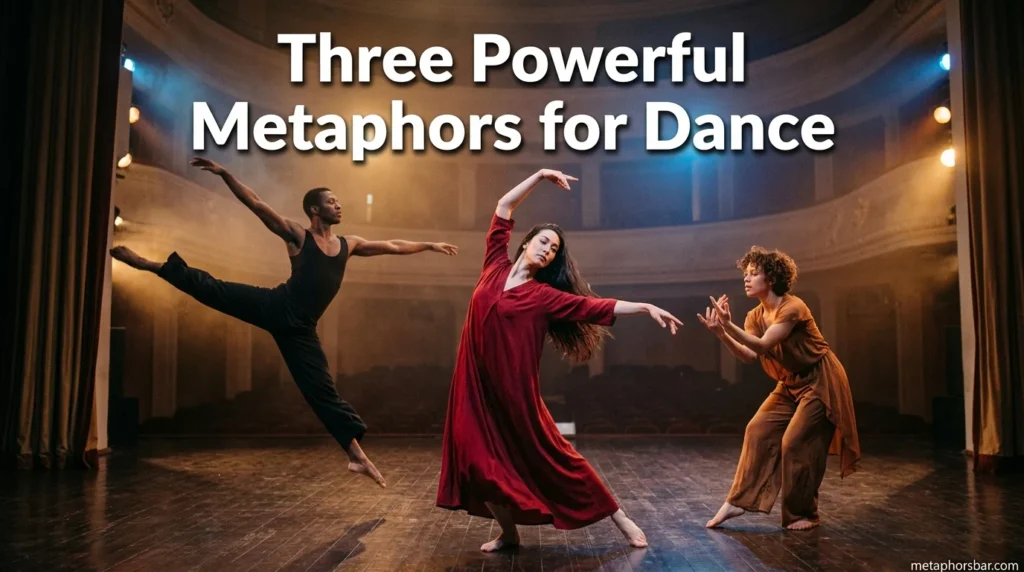
1. Dance as a Conversation
Dance often feels like a conversation because it is full of response, timing, and exchange. One movement answers another. A partner leans in; the other shifts back. The music speaks, and the body replies. This metaphor works especially well when dance feels intimate, improvisational, or deeply connected.
Meaning and explanation
When dance is compared to a conversation, the emphasis is on dialogue and interaction. Just as people speak and listen, dancers offer and respond, lead and follow, pause and continue. This image is especially useful for partner dances, ensemble pieces, or any performance where the movement seems to “say” something.
It also suggests that dance is not one-sided. It is not merely a display—it is exchange. The dancer listens with the body, and the body answers. That makes this metaphor powerful for describing chemistry between dancers, or the way movement can communicate emotions that words cannot.
Example sentence or scenario
Their dance was a conversation without words, every turn and handhold answering the other like a sentence completed in motion.
This metaphor works beautifully in reviews, poetry, and reflective writing about connection or partnership.
Alternative ways to express it
- a dialogue of movement
- a silent exchange
- a body-to-body conversation
- a language of response
- a spoken rhythm in motion
Sensory and emotional details
You can imagine the subtle shift of weight, the brush of a hand, and the quiet tension of two people moving as if they already understand one another. Emotionally, this metaphor feels intimate, responsive, and alive. It suggests that dance can be as thoughtful as speech and sometimes more honest.
Mini storytelling touch
A tango teacher once told her students, “If you lead, you must also listen.” That idea captures the heart of this metaphor. In a good conversation, you do not only speak—you pay attention. In a good dance, the same is true. The body listens before it moves.
Literary or cultural reference
Many dance traditions, from tango to partner waltz to contact improvisation, are built on the idea of exchange. As a metaphor, dance as conversation feels timeless because it reflects the human need to communicate beyond words.
2. Dance as a River
Dance can also feel like a river: flowing, continuous, changing shape without losing its essence. A river is alive with motion. It bends, carries, swirls, and gathers force. As a metaphor, it is especially useful when dance feels smooth, natural, and impossible to stop once it begins.
Meaning and explanation
When dance is compared to a river, the emphasis is on flow and movement. A river does not move in stiff lines; it curves around obstacles and finds its own path. This makes it a perfect metaphor for dance that feels fluid, graceful, or deeply connected to rhythm.
It also suggests that dance is not only movement—it is movement that carries feeling. A river can be calm or powerful, shallow or deep, slow or rushing. In the same way, dance can hold many emotional currents at once.
Example sentence or scenario
She moved across the stage like a river of silk, each step flowing into the next with quiet certainty.
This metaphor works especially well in descriptions of ballet, contemporary dance, and performances where smooth transitions and fluid motion matter.
Alternative ways to express it
- a current of rhythm
- a flowing stream of motion
- a tide of movement
- a living current
- a waterfall of steps
Sensory and emotional details
You can imagine the soft sound of water moving over stone, the glimmer of sunlight on a surface, and the way the body seems to glide without effort. Emotionally, this metaphor feels peaceful, continuous, and graceful. It suggests that dance can be both natural and powerful, like water finding its way.
Mini storytelling touch
A young dancer once described her first performance as “feeling like I had turned into water.” That image stays because it captures what many dancers know: when the body and music are perfectly matched, movement can feel less like effort and more like current.
Literary or cultural reference
Rivers often symbolize life, time, and change in literature and myth. As a metaphor for dance, the river gives motion a sense of inevitability and beauty, as if the dancer is carried by something larger than themselves.
3. Dance as Fire
Dance can also be like fire: energetic, consuming, bright, and impossible to ignore. This metaphor works especially well when the movement feels passionate, explosive, bold, or emotionally charged. Fire does not move quietly—it burns, flickers, and transforms everything it touches.
Meaning and explanation
When dance is compared to fire, the emphasis is on intensity and heat. A fiery dance may feel fierce, primal, daring, or full of urgency. This metaphor works especially well for flamenco, Latin dance, or performances where rhythm seems to ignite the body from within.
Fire also suggests transformation. Just as fire changes wood into flame and ash, dance can change emotion into motion. It can take fear, desire, joy, or grief and turn it into something visible and alive.
Example sentence or scenario
His dance was fire—sharp, dazzling, and alive with a kind of energy that made the whole room feel warmer.
This metaphor is ideal for writing about bold performances, emotional expression, and moments when dance feels magnetic and fierce.
Alternative ways to express it
- a blaze of motion
- a flame of rhythm
- a spark turned performance
- a burning pulse
- a wildfire of movement
Sensory and emotional details
You can imagine the crackle of flame, the shimmer of heat in the air, and the way a room seems to brighten around it. Emotionally, this metaphor feels passionate, vivid, and alive. It suggests that dance can be a force rather than just a form.
Mini storytelling touch
A flamenco performer once said that dance was “the only way I know to let the fire out safely.” That is the beauty of this metaphor. Dance gives passion a place to go. It lets intensity become art instead of remaining trapped inside.
Literary or cultural reference
Fire has long symbolized passion, transformation, and spirit in literature and performance traditions. In dance cultures such as flamenco, movement and fire often seem inseparable, making this metaphor especially resonant.
How to Choose the Right Metaphor for Dance
Use conversation when the dance feels relational
Choose this metaphor when the movement is about connection, exchange, or emotional response between dancers.
Use river when the dance feels fluid and graceful
This is the best choice when the movement flows naturally and smoothly.
Use fire when the dance feels passionate and intense
Choose this image when the energy is bold, burning, or emotionally charged.
The best metaphor depends on the kind of dance you want to describe. Dance can speak, flow, and burn—and often it does all three.
Interactive Exercises for Practicing Metaphors for Dance
Exercise 1: Complete the sentence
Finish this prompt in three different ways:
“The dance was like ______ because ______.”
Try one answer that feels emotional, one that feels visual, and one that feels energetic.
Example: The dance was like a conversation because every movement seemed to answer the last one.
Exercise 2: Sensory mapping
Think of a dance you watched or performed. Write down:
- one sound
- one movement
- one texture
- one color
- one emotion
Then turn those details into a metaphor.
For example: The dance sounded like a heartbeat, moved like a river, looked like fire against a dark stage, felt like silk in motion, and carried the emotion of longing.
Exercise 3: Story starter
Begin a short paragraph with:
“Dance felt like…”
Let the image guide the tone. You can make it poetic, dramatic, soft, or reflective.
Exercise 4: Journal or caption prompt
Try writing a one-line reflection:
- “Dance is a conversation the body remembers.”
- “Her movement flowed like a river.”
- “The performance was fire from the first step.”
Bonus Tips for Using Metaphors for Dance in Writing, Social Media, and Daily Life
In writing
Use these metaphors in poetry, fiction, reviews, and personal essays to bring dance to life on the page.
On social media
A short metaphor can make a dance caption feel more expressive and memorable. “That routine was fire” or “She moved like a river” can be simple but striking.
In everyday conversation
Metaphors can help you describe a performance more vividly. Instead of saying “It was beautiful,” you might say, “It felt like a conversation in motion.”
In event or performance descriptions
If you are writing about a recital, competition, or stage show, metaphors can help the audience imagine the energy and emotion of the piece.
Keep the image honest
The strongest metaphor is the one that truly fits the dance. Some dances speak, some flow, and some burn. Let the image match the feeling.
FAQs
1. What is a metaphor for dance?
A metaphor for dance is a figurative comparison that describes dance using another image, such as a conversation, a river, or fire.
2. Why are metaphors for dance useful?
They help make movement, rhythm, and emotion more vivid and memorable in writing or speech.
3. What is a simple metaphor for dance?
A simple example is: Dance is a conversation. It suggests exchange, timing, and response.
4. Can these metaphors be used in dance reviews or poetry?
Yes. They are especially effective in reviews, poetry, and creative writing because they capture both motion and feeling.
5. How do I create my own metaphor for dance?
Think about what the dance feels like—flowing, speaking, burning, or circling—and compare it to something with similar qualities.
6. Are these metaphors only for formal writing?
No. They can also be used in captions, journaling, performances, and everyday conversation.
7. What makes a strong metaphor for dance?
A strong metaphor is vivid, emotionally fitting, and easy to imagine. It should help the reader feel the movement, not just label it.
Conclusion
Dance is more than steps and music. It is the body’s way of speaking, flowing, and sometimes burning through feeling. That is why metaphors matter—they help us describe not only what dance looks like, but what it means to experience it.
A conversation gives dance its exchange and intimacy. A river gives it flow and continuity. Fire gives it passion and intensity. Together, these images remind us that dance can speak, move, and transform all at once.
So when you write about dance, do not settle for the obvious. Let it talk, flow, and ignite through your words. A good metaphor can make dance unforgettable.