
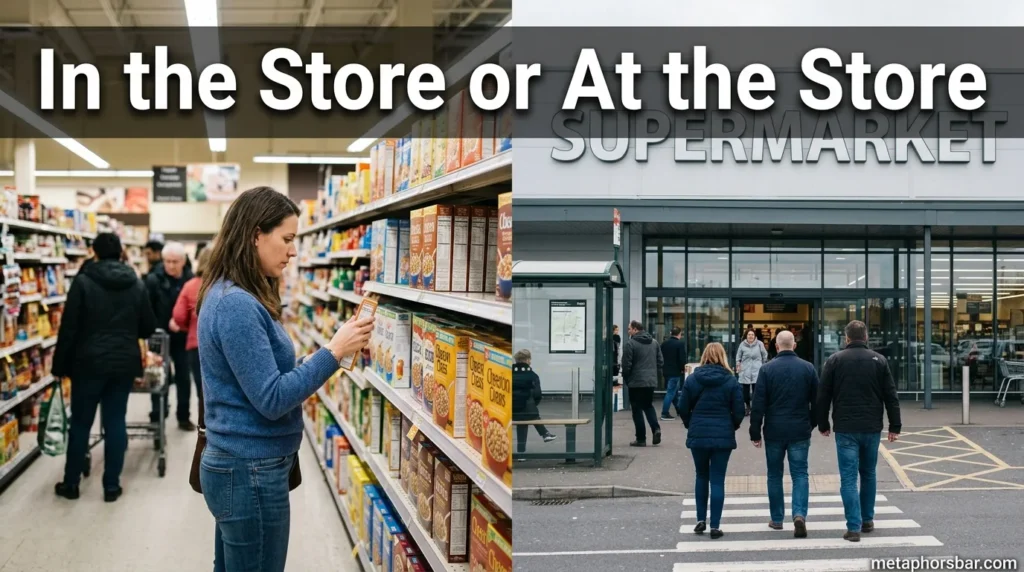
Many English learners and even native speakers sometimes wonder whether they should say “in the store” or “at the store.” Since both expressions are common and often seem interchangeable, it’s easy to become confused about when each one sounds more natural.
Understanding the difference matters because choosing the right preposition makes your English more accurate and natural. Whether you’re writing an essay, speaking in a job interview, taking an English exam, or chatting with friends, knowing when to use in and at correctly helps you communicate clearly.
The good news is that both expressions are correct—they simply emphasize different ideas. This guide explains the meaning, grammar, usage, examples, common mistakes, and practical tips so you’ll know exactly which phrase to use in any situation.
Understanding “In the Store” and “At the Store”
Both phrases refer to a store or shop, but they focus on different aspects of location.
- In the store emphasizes being inside the building.
- At the store emphasizes being at the location, whether inside, outside, or simply visiting.
Quick Comparison
| Phrase | Meaning | Focus | Example |
| In the store | Inside the building | Interior location | She is in the store buying groceries. |
| At the store | At the store’s location | General location | She is at the store right now. |
Think of it this way:
- In = inside.
- At = location.
Although people often use them interchangeably in conversation, understanding this distinction makes your English more precise.
When to Use “In the Store”
Use in the store when you want to emphasize that someone or something is inside the building.
Examples
- I’m in the store looking for milk.
- The manager is in the store today.
- We spent an hour in the store comparing prices.
- There were hundreds of customers in the store during the sale.
Here, the listener understands that the person is physically inside the shop.
More Examples
✅ Correct
- The children are playing in the store while their mother shops.
- We met our neighbors in the store yesterday.
- There’s a long line in the store.
❌ Incorrect
- I’m at the store looking around inside every aisle. (Not wrong, but less specific if emphasizing being inside.)
Situations Where “In the Store” Works Best
Use in the store when discussing:
- Shopping inside
- Walking through aisles
- Looking at products
- Waiting at the checkout
- Employees working inside
- Customers browsing
For example:
I left my wallet in the store.
The wallet is physically inside the building.
When to Use “At the Store”
Use at the store when referring to the store as a place or destination rather than its interior.
Examples
- I’m at the store right now.
- Meet me at the store at 5 p.m.
- She’s at the store buying groceries.
- Dad stopped at the store on his way home.
Here, the exact position isn’t important. The person is simply at that location.
More Correct Examples
- I’ll be at the store for another 20 minutes.
- We arrived at the store before it opened.
- My brother is at the store.
Why “At” Sounds Natural
English often uses at when talking about destinations:
- at school
- at work
- at home
- at the airport
- at the hospital
- at the station
Similarly:
- at the store
It simply identifies where someone is.
The Main Difference Between “In the Store” and “At the Store”
Although both expressions are correct, they highlight different meanings.
Side-by-Side Comparison
| Situation | In the Store | At the Store |
| Inside the building | ✅ Best choice | ✅ Acceptable |
| Talking about location generally | Possible | ✅ Best choice |
| Describing shopping inside | ✅ Natural | Natural |
| Meeting someone | Less common | ✅ Most common |
| Talking about where someone is | Specific | General |
Example 1
I’m in the store.
Meaning:
I am physically inside.
I’m at the store.
Meaning:
I’m at the shopping location.
Example 2
The baby is sleeping in the store.
Focus:
Inside the building.
The baby is at the store with Grandma.
Focus:
The baby is accompanying Grandma to the store.
Grammar Rule: Why Different Prepositions Change Meaning
Prepositions describe relationships between people, places, and things.
“In”
In usually means:
- inside
- enclosed by something
- within boundaries
Examples:
- in the room
- in the house
- in the car
- in the office
- in the store
“At”
At usually means:
- a point
- a place
- a location
- an event
Examples:
- at school
- at work
- at the station
- at the mall
- at the store
Comparison Table
| Preposition | Basic Meaning | Example |
| In | Inside something | She is in the store. |
| At | At a place or location | She is at the store. |
Understanding these general meanings helps you choose the correct expression naturally.
Everyday Examples of Both Expressions
Let’s compare them in real conversations.
Conversation 1
A: Where’s Sarah?
B: She’s at the store.
Meaning:
She’s there somewhere.
Conversation 2
A: Where exactly is Sarah?
B: She’s in the store near the bakery.
Meaning:
She’s inside.
Conversation 3
A: Where should we meet?
B: Meet me at the store.
This sounds much more natural than:
Meet me in the store.
Why?
Because you’re talking about the meeting location, not the inside of the building.
Conversation 4
A: I can’t find Dad.
B: He’s in the store buying vegetables.
This emphasizes that he is inside.
Can You Use Either One?
Yes—many situations allow either phrase.
For example:
- I’m at the store shopping.
- I’m in the store shopping.
Both are correct.
The difference is very small.
- At focuses on the destination.
- In focuses on being inside.
Native speakers often choose whichever sounds more natural in the conversation.
British and American English
There is no major difference between British and American English regarding in the store and at the store.
However, there is a vocabulary difference.
Vocabulary Comparison
| American English | British English |
| Store | Shop |
| Grocery store | Supermarket |
| Drugstore | Chemist’s |
| Department store | Department store |
Americans commonly say:
- I’m at the store.
- I’m in the store.
British speakers often say:
- I’m at the shop.
- I’m in the shop.
The grammar stays the same.
Pronunciation Guide
In the Store
IPA (American):
/ɪn ðə stɔr/
At the Store
IPA (American):
/æt ðə stɔr/
Pronunciation Tips
Native speakers often reduce sounds:
In the store
Sounds like:
“inn-thuh-store”
At the store
Often sounds like:
“at-thuh-store”
Speak smoothly without pausing between the words.
Common Mistakes and How to Avoid Them
Many learners confuse these expressions because both are correct in many situations.
Here are the most common mistakes.
Mistake 1: Using “In” for General Location
❌ I’m in the store. Meet me there.
Better:
✅ I’m at the store. Meet me there.
Reason:
You’re referring to the meeting place.
Mistake 2: Using “At” When Describing Interior Details
❌ There were many customers at the store’s aisles.
Better:
✅ There were many customers in the store.
Reason:
The customers were physically inside.
Mistake 3: Thinking Only One Is Correct
Many learners believe:
- only at the store is correct
- only in the store is correct
Actually:
✅ Both are correct.
The context determines which sounds better.
Mistake 4: Confusing “To,” “At,” and “In”
Compare these:
- I’m going to the store.
- I’m at the store.
- I’m in the store.
Each has a different meaning.
| Phrase | Meaning |
| To the store | Moving toward it |
| At the store | Located there |
| In the store | Inside the building |
Examples in Different Situations
Shopping
- She’s in the store trying on shoes.
- She’s at the store buying shoes.
Work
- The manager is in the store checking inventory.
- The manager is at the store until 8 p.m.
Family
- Mom is at the store.
- Mom is in the store choosing fruit.
Lost Items
- I left my keys in the store.
Not:
- I left my keys at the store.
While both are possible, in the store clearly tells us the keys are inside.
Meeting Someone
Natural:
- I’ll meet you at the store.
Less common:
- I’ll meet you in the store.
The second suggests meeting somewhere inside the building.
Helpful Tips to Remember the Difference
Here are some easy tricks.
Remember “Inside”
If you’re thinking about the building’s interior, choose:
In the store
Example:
We walked in the store for an hour.
Remember “Location”
If you’re simply identifying where someone is:
At the store
Example:
He’s at the store.
Think About the Question
Question:
Where is Tom?
Answer:
He’s at the store.
Question:
Where exactly?
Answer:
He’s in the store, near the bakery.
Practice Sentences
Choose the best answer.
1.
I’m waiting _____ the store.
Answer:
✅ at
2.
There are fifty customers _____ the store.
Answer:
✅ in
3.
Meet me _____ the store after work.
Answer:
✅ at
4.
The children are running around _____ the store.
Answer:
✅ in
5.
My parents are _____ the store buying groceries.
Answer:
✅ at or in
Both are correct depending on the emphasis.
FAQs
Is “in the store” grammatically correct?
Yes. It means someone or something is physically inside the store.
Is “at the store” grammatically correct?
Yes. It refers to the store as a location or destination and is extremely common in everyday English.
Which phrase is more common?
At the store is slightly more common in casual conversation because speakers often focus on location rather than the exact position inside the building.
Can both expressions be used in the same sentence?
Yes.
Example:
We arrived at the store, and then we waited in the store until it opened.
Which is better for formal writing?
Both are appropriate. Choose the one that best matches your intended meaning:
- At the store for general location.
- In the store for the interior of the building.
Do native speakers use both?
Absolutely. Native speakers regularly use both expressions depending on context.
Is there a grammar rule that always decides?
The basic rule is simple:
- Use in for being inside.
- Use at for referring to a location.
However, conversational English allows some flexibility, so both may sound natural in many situations.
Conclusion
Choosing between “in the store” and “at the store” is easier once you understand what each preposition emphasizes. In the store points to someone or something being physically inside the building, while at the store identifies the store as a location or destination without focusing on the exact position.
A simple way to remember the difference is this:
- In = inside the building.
- At = at the location.
In everyday conversation, native speakers often use both expressions naturally, and in many situations either one is acceptable. However, selecting the phrase that best matches your intended meaning will make your English sound clearer, more accurate, and more fluent.
The next time you talk about shopping, meeting someone, or describing where a person is, think about whether you’re emphasizing the inside of the store or simply the store as a place. With that small distinction in mind, you’ll be able to use “in the store” and “at the store” confidently in both spoken and written English.