

Courage rarely arrives with a fanfare. More often, it appears in smaller, quieter ways: a steady breath before a difficult conversation, a trembling hand that still reaches for the door, a voice that shakes but does not disappear. It can feel like warmth gathering in the chest, like a lantern lifted in the dark, like a stone planted firmly in shifting ground. Courage is not always loud. Sometimes it is simply the decision to move forward while fear is still sitting beside you.
That is why metaphors for courage matter so much. Courage is one of the most important human qualities, but it can be surprisingly difficult to describe directly. A metaphor can give it shape, weight, and light. It can turn bravery into something readers can see, feel, and remember. Whether you are writing a speech, a poem, a story, a caption, or a personal reflection, metaphors for courage help you express strength in a way that feels vivid and alive.
Why Metaphors for Courage Matter in Writing and Communication
They give bravery a visible form
Courage can be inward and private, which makes it hard to show on the page. A metaphor helps turn that invisible strength into an image the mind can hold.
They reveal the kind of courage you mean
Some courage is calm and steady. Some is loud and defiant, Some is quiet, like enduring one more hour, one more step, one more breath. The metaphor you choose can show that difference clearly.
They make your words more memorable
A sentence like “she was brave” is true, but a sentence like “she stood like a lighthouse through the storm” lingers in the imagination. Metaphors stay with readers because they create feeling as well as meaning.
Three Powerful Metaphors for Courage
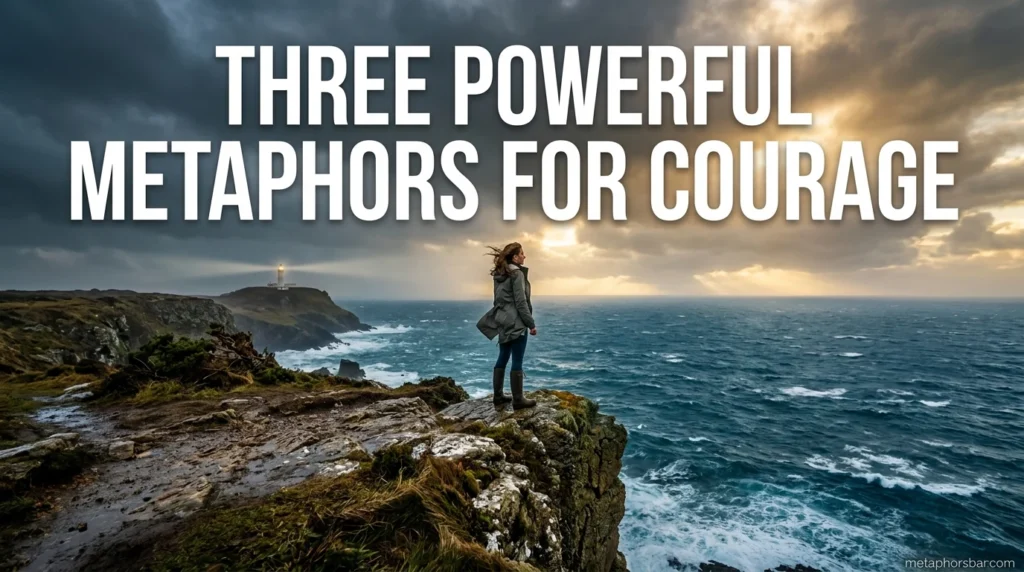
1. Courage as a Lighthouse
A lighthouse stands on the edge of rough waters, shining steadily through fog, wind, and darkness. It does not stop the storm, but it helps others find the way. As a metaphor for courage, the lighthouse suggests steadfastness, guidance, and a quiet kind of bravery that refuses to go out when the world turns difficult.
Meaning and explanation
When courage is compared to a lighthouse, it suggests stability under pressure. A courageous person may not eliminate fear, but they remain visible and steady when conditions are harsh. This metaphor is especially useful when describing someone whose strength helps others feel safe or oriented. It can represent leadership, perseverance, and moral clarity.
The lighthouse metaphor is powerful because it combines light and endurance. It does not roar or rush. It simply keeps shining. That makes it perfect for courage that is patient, dependable, and calm.
Example sentence or scenario
Even when everything around her felt uncertain, she was a lighthouse—steady, bright, and impossible to ignore in the dark.
This metaphor works beautifully in speeches, essays, tributes, and stories about leadership or resilience.
Alternative ways to express it
- a beacon in the storm
- a guiding light
- a tower of calm
- a steady flame
- a signal through the fog
Sensory and emotional details
You can imagine waves crashing against rocks, the salt smell in the air, and a white beam cutting through the dark night. Emotionally, this metaphor feels reassuring, strong, and luminous. It suggests courage that helps others as much as it helps the person carrying it.
Mini storytelling touch
A teacher once stayed after school every day to help a student who was struggling with grief. She never made a speech about bravery. She just kept showing up. Years later, that student said, “She was my lighthouse.” That image captures the heart of this metaphor: courage often looks like staying lit when others are lost.
Literary or cultural reference
Lighthouses have long symbolized hope, guidance, and endurance in literature and art. As a metaphor for courage, they remind us that bravery is not always a dramatic leap; sometimes it is the refusal to go dark.
2. Courage as a Lion Heart
The lion has long been a symbol of bravery, but the phrase lion heart adds a deeper, more personal layer. It suggests boldness, dignity, and the ability to face danger with strength. As a metaphor for courage, the lion heart is powerful because it combines fierceness with heart—a reminder that bravery is not only about strength, but also about spirit.
Meaning and explanation
When courage is described as a lion heart, it means the person is fearless or fiercely determined despite danger, doubt, or pressure. This metaphor works well when the courage feels bold, visible, and unmistakable. It is especially fitting for moments that require standing up, speaking out, or protecting something important.
The lion heart is not just about physical bravery. It can also describe emotional courage—the willingness to love, to tell the truth, to keep going, or to defend what matters. The image carries nobility and power, but also purpose.
Example sentence or scenario
He walked into the interview with a lion heart, carrying his fear with him but refusing to let it lead.
This metaphor is especially effective in motivational writing, character descriptions, and inspirational speeches.
Alternative ways to express it
- a heart of a lion
- a fearless spirit
- a roaring resolve
- a brave soul
- a wild courage
Sensory and emotional details
You can imagine the deep rumble of a lion’s roar, the heat of sunlit grass, and the alert stillness before movement. Emotionally, this metaphor feels bold, proud, and protective. It suggests courage that is not timid or hidden but unmistakably alive.
Mini storytelling touch
A young woman once said that the hardest part of giving her first public speech was not the crowd, but the silence before she began. “I had to find my lion heart,” she laughed afterward. That line resonates because courage often begins in the few seconds before action—when fear is still present, but the heart steps forward anyway.
Literary or cultural reference
Lions have symbolized bravery, royalty, and strength for centuries across cultures. From heraldic emblems to fairy tales, the lion remains one of the most enduring images of courage.
3. Courage as a Bridge
A bridge stretches across water, gap, or empty space. It connects one side to another. As a metaphor for courage, a bridge suggests crossing over fear, uncertainty, or pain into something new. It is especially useful when courage involves transition: leaving a harmful situation, facing change, speaking a hard truth, or moving toward healing.
Meaning and explanation
When courage is compared to a bridge, the image emphasizes movement through uncertainty. A bridge does not remove the gap—it makes crossing possible. That is what courage often does. It allows a person to move from fear to action, from silence to expression, from loss to healing. The bridge metaphor works especially well when bravery is not about force, but about passage.
This metaphor is powerful because it reflects courage as something functional and connective. Courage is what carries us over what once seemed impassable.
Example sentence or scenario
Her apology was a bridge of courage, reaching across the silence that had divided them for months.
This metaphor works beautifully in personal essays, relationship writing, and stories about change or reconciliation.
Alternative ways to express it
- a crossing over fear
- a path through uncertainty
- a span of bravery
- a way across the divide
- a doorway over deep water
Sensory and emotional details
You can imagine walking over a bridge in mist, feeling the structure steady beneath your feet, and looking down at the gap below. Emotionally, this metaphor feels hopeful, transitional, and grounded. It suggests that courage helps a person get from one side of difficulty to the other.
Mini storytelling touch
A man once described leaving his long-time job to start his own business as “building a bridge while I was still standing on the old shore.” That image is vivid because courage rarely waits for perfect certainty. It often begins while the gap is still open.
Literary or cultural reference
Bridges often symbolize transformation and connection in literature. As a metaphor for courage, they remind us that bravery is often a crossing—one made step by step.
How to Choose the Right Metaphor for Courage
Use lighthouse when courage is steady and guiding
Choose this metaphor when bravery feels calm, dependable, and life-giving to others.
Use lion heart when courage is bold and fierce
This is the best choice when the moment requires strength, action, or a fearless stand.
Use bridge when courage is about change or crossing over
Choose this image when bravery means moving through fear toward a new place or state of being.
The best metaphor depends on the kind of courage you want to describe. Courage can shine, roar, and cross—and sometimes it does all three in one life.
Interactive Exercises for Practicing Metaphors for Courage
Exercise 1: Complete the sentence
Finish this prompt in three different ways:
“Courage felt like ______ because ______.”
Try one answer that feels steady, one that feels fierce, and one that feels transitional.
Example: Courage felt like a lighthouse because it kept shining while everything around it was uncertain.
Exercise 2: Sensory mapping
Think of a time when you felt brave. Write down:
- one sound
- one color
- one object
- one movement
- one emotion
Then turn those details into a metaphor.
For example: It sounded like a deep breath before a storm, looked like a beam of light in fog, felt like stone underfoot, moved like a bridge over dark water, and carried the emotion of resolve.
Exercise 3: Story starter
Begin a short paragraph with:
“Courage was like…”
Let the image guide the tone. You can make it poetic, dramatic, honest, or reflective.
Exercise 4: Social media or journal prompt
Try writing a one-line reflection:
- “Today my courage was a lighthouse in rough water.”
- “I found my lion heart when I needed it most.”
- “Courage was the bridge I built one step at a time.”
Bonus Tips for Using Metaphors for Courage in Writing, Social Media, and Daily Life
In writing
Use these metaphors in essays, memoirs, poems, and speeches to make bravery feel vivid and human. They can help readers feel courage rather than simply label it.
On social media
A short metaphor can make a caption, tribute, or motivational post more memorable. “Be a lighthouse” or “Find your lion heart” carries emotional weight in just a few words.
In everyday conversation
Metaphors can help you describe courage in a warmer, more expressive way. Instead of saying “She was brave,” you might say, “She was a bridge over fear.”
In storytelling
If you are writing a character or describing a real person, the metaphor can reveal whether courage is calm, fierce, or transitional. That adds depth to the portrait.
Keep the image honest
The strongest courage metaphor is the one that truly fits the moment. Some bravery shines quietly. Some roars, Some simply helps a person move across what once felt impossible.
FAQs
1. What is a metaphor for courage?
A metaphor for courage is a figurative comparison that describes bravery using another image, such as a lighthouse, lion heart, or bridge.
2. Why are metaphors for courage useful?
They help turn a difficult-to-see quality into a vivid and memorable image that readers can understand and feel.
3. What is a simple metaphor for courage?
A simple example is: Courage is a lighthouse. It suggests steadiness, guidance, and light in darkness.
4. Can these metaphors be used in speeches or tributes?
Yes. They are especially effective in speeches, tributes, essays, and motivational writing because they add emotional depth.
5. How do I create my own metaphor for courage?
Think about how courage feels—steady, fierce, transitional, or luminous—and compare it to something with similar qualities.
6. Are these metaphors only for serious writing?
No. They can also be used in captions, journaling, conversation, and creative prompts.
7. What makes a strong metaphor for courage?
A strong metaphor is vivid, emotionally accurate, and easy to picture. It should help the reader feel the bravery, not just identify it.
Conclusion
Courage is one of those qualities that can appear in many forms. It can be quiet, fierce, and transformative all at once. That is why metaphors matter—they help us describe not only what courage does, but what it feels like to carry it.
A lighthouse gives courage its steadiness and light. A lion heart gives it its fierceness and nobility. A bridge gives it its power to move across fear and into change. Together, these images remind us that courage is not one thing—it is a living force that shines, roars, and carries us forward.
So when you write about courage, do not settle for plain words alone. Let it glow, roar, or span the gap through your language. A good metaphor can make courage unforgettable.