
A community can feel like the smell of warm bread drifting from a neighborhood bakery, like porch lights glowing one by one at dusk, like the hum of familiar voices rising from a room where everyone has finally arrived. It is both ordinary and extraordinary. A community is made of people, yes—but also of trust, memory, help, laughter, routines, shared burdens, and small acts of care that quietly hold life together.
That is why metaphors for community matter so much. Community can be hard to define in plain language because it is not just a group of people standing near one another. It is connection. It is belonging, It is the invisible structure that helps people feel seen, supported, and part of something larger than themselves. A good metaphor gives that feeling shape. It can turn community into a quilt, a garden, a web, a campfire, a bridge, or a choir—images that help us feel its warmth and complexity.
Whether you are writing a speech, a poem, a social post, a community newsletter, a school essay, or a reflective essay, metaphors for community can make your language feel more vivid, emotional, and memorable.
Why Metaphors for Community Matter in Writing and Everyday Life
They turn belonging into something you can picture
Community is often felt before it is explained. A metaphor helps make belonging visible, so readers can see what support and connection look like.
They show the kind of community you mean
Not all communities feel the same. Some are warm and welcoming, some are collaborative, some are resilient, and some are quietly protective. The metaphor you choose can reveal that tone.
They make your words more memorable
A sentence like “our community is important” is true, but a sentence like “our community is the quilt that keeps us warm through winter” lingers much longer.
They help people feel less alone
Metaphors can remind readers that they are part of something shared. They can make the idea of “we” feel alive.
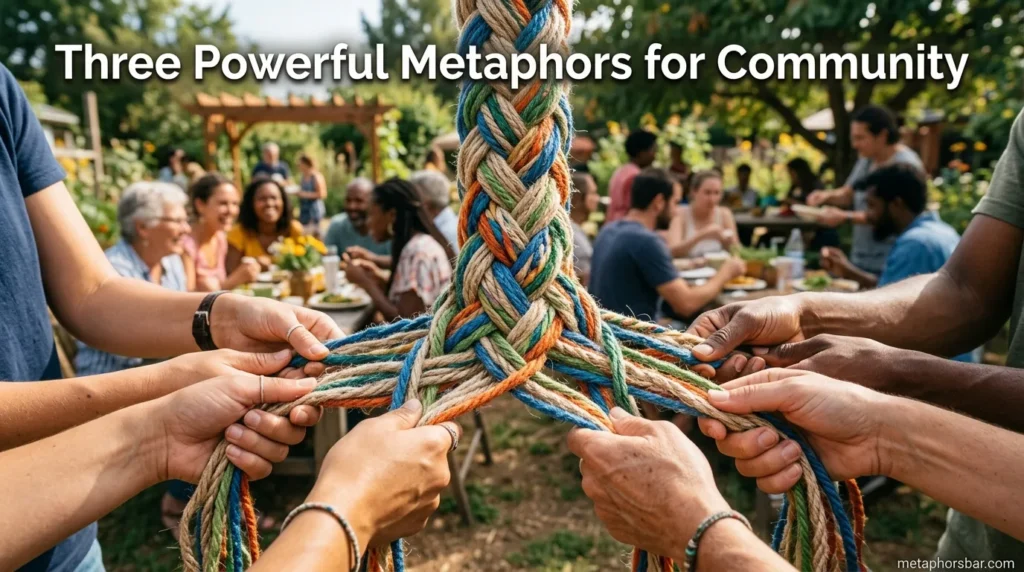
Three Powerful Metaphors for Community
1. Community as a Quilt
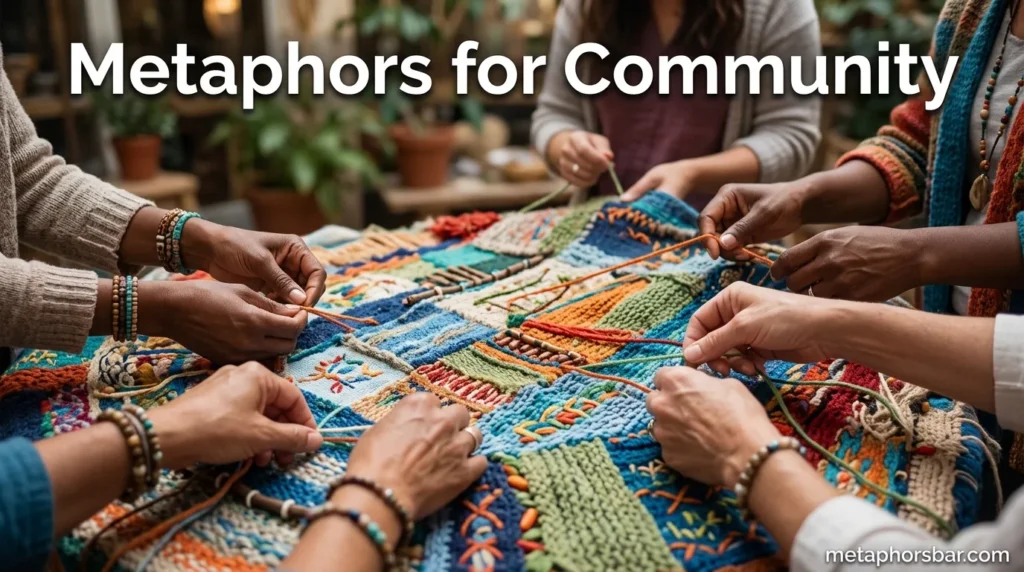
A quilt is made from many different pieces sewn together into one warm, useful, beautiful whole. As a metaphor for community, it suggests variety, connection, and the way different lives can create something stronger when joined with care. It is especially effective when you want community to feel welcoming, layered, and lovingly assembled.
Meaning and explanation
When community is compared to a quilt, the emphasis is on difference held together. Each person may be unique—different ages, backgrounds, stories, and strengths—but together they form something that offers warmth and protection. A quilt also suggests memory and intention. It is stitched, not accidental. That makes it a beautiful metaphor for a community built by care and participation.
This metaphor works well because it does not demand sameness. The pieces do not have to match to belong. Instead, their differences become part of the pattern.
Example sentence or scenario
The neighborhood felt like a quilt, with every family, shop owner, and neighbor stitched into the same living pattern of care.
This metaphor works especially well in speeches, community essays, school writing, and pieces about diversity or unity.
Alternative ways to express it
- a patchwork of people
- a woven blanket of belonging
- a stitched fabric of trust
- a warm patchwork of lives
- a handmade covering of shared stories
Sensory and emotional details
You can imagine soft fabric, varied colors and textures, and the gentle comfort of being wrapped in something handmade. Emotionally, this metaphor feels warm, inclusive, and deeply human. It suggests that community is not about sameness; it is about how differences can still hold together.
Mini storytelling touch
A teacher once asked her students to bring one object that represented their family’s history. One brought a prayer card, another a spoon from a grandparent, another a photo, another a scarf. When they arranged the objects together, the teacher said, “That looks like a community quilt.” That image stays because it captures how many small, distinct lives can become one shared whole.
Literary or cultural reference
Patchwork quilts appear often in literature and folk tradition as symbols of home, memory, and resilience. As a metaphor for community, the quilt reflects the beauty of many parts becoming one sheltering whole.
2. Community as a Garden
A garden is alive, changing, and cared for over time. As a metaphor for community, it suggests growth, patience, mutual nourishment, and the way people can flourish when given room, attention, and light. It is especially useful when you want community to feel organic, generous, and ever-growing.
Meaning and explanation
When community is compared to a garden, it suggests that connection must be tended. Seeds are planted, watered, protected, and allowed to bloom. In the same way, community needs time, kindness, listening, and support. A garden also contains variety: flowers, herbs, roots, and fruit all growing together. That makes it a wonderful metaphor for a community with many kinds of people and contributions.
This image is especially powerful because it shows that community is not static. It is something that grows and changes when cared for.
Example sentence or scenario
Our community was a garden, where every act of kindness felt like water and every shared effort helped something new begin to grow.
This metaphor is ideal for writing about education, neighborhood life, team-building, or social change.
Alternative ways to express it
- a field of shared growth
- a living bed of trust
- a space where people bloom
- a rooted place of care
- a cultivated field of belonging
Sensory and emotional details
You can imagine the smell of soil after rain, the warmth of sunlight on leaves, and the quiet patience of growth happening beneath the surface. Emotionally, this metaphor feels hopeful, nurturing, and life-giving. It suggests that community is made not just by gathering, but by tending.
Mini storytelling touch
A community center once turned an empty lot into a garden. Neighbors who had barely spoken before began showing up with shovels, seeds, and coffee. Months later, someone said, “The garden didn’t just grow tomatoes. It grew us.” That is the essence of this metaphor: community, like a garden, becomes alive through care.
Literary or cultural reference
Gardens often symbolize renewal, cooperation, and shared stewardship in literature and culture. As a metaphor for community, the garden reminds us that belonging is something grown, not simply declared.
3. Community as a Campfire
A campfire gives warmth, light, and a place to gather. As a metaphor for community, it suggests shared stories, comfort, and the feeling of being drawn together around a common center. It is especially strong when the community feels intimate, welcoming, and alive with conversation.
Meaning and explanation
When community is compared to a campfire, it emphasizes gathering and shared presence. People come closer to the fire to speak, listen, rest, and feel safe. The fire itself becomes a center—a place where stories are told and relationships are strengthened. This makes the campfire a beautiful metaphor for community as a place of warmth and belonging.
This image works especially well when you want community to feel human, close, and full of story.
Example sentence or scenario
The town meeting felt like a campfire, with people leaning in, sharing stories, and warming one another with the simple act of being heard.
This metaphor works wonderfully in speeches, essays, community reflection pieces, and writing about connection and shared purpose.
Alternative ways to express it
- a circle of warmth
- a fire of shared stories
- a glowing hearth of belonging
- a place where voices gather
- a flame that draws people in
Sensory and emotional details
You can imagine the crackle of wood, the orange glow on faces, the scent of smoke, and the hush that falls when someone begins to speak. Emotionally, this metaphor feels intimate, comforting, and alive with memory. It suggests that community is often the place where people come to be known.
Mini storytelling touch
A family once spent every Saturday evening around a backyard fire, inviting neighbors to bring chairs and stories. Over time, the gatherings became more than social—they became the heartbeat of the street. Someone later said, “That fire was the center of the neighborhood.” That is the beauty of the campfire metaphor: community becomes the place where warmth is shared, not hoarded.
Literary or cultural reference
Fire has long symbolized home, connection, and story in literature and folklore. As a metaphor for community, the campfire gives warmth a visible and shared form.
How to Choose the Right Metaphor for Community
Use quilt when community feels diverse and interwoven
Choose this metaphor when you want to emphasize many different people or groups coming together into one fabric of belonging.
Use garden when community feels alive and growing
This is the best choice when the focus is on nurturing, development, and shared flourishing.
Use campfire when community feels warm and story-filled
Choose this image when the emphasis is on gathering, conversation, and emotional closeness.
The best metaphor depends on what you want to honor about community. Some communities wrap, some grow, and some gather. Many do all three.
Interactive Exercises for Practicing Metaphors for Community
Exercise 1: Complete the sentence
Finish this prompt in three different ways:
“Our community is like ______ because ______.”
Try one answer that feels warm, one that feels alive, and one that feels welcoming.
Example: Our community is like a quilt because people with different stories and strengths are sewn together by care and trust.
Exercise 2: Sensory mapping
Think of a community you know well. Write down:
- one smell
- one sound
- one color
- one object
- one feeling
Then turn those details into a metaphor.
For example: The community smelled like coffee and rain, sounded like laughter and footsteps, looked like warm windows at dusk, felt like a campfire on a cold night, and carried the feeling of being held.
Exercise 3: Story starter
Begin a short paragraph with:
“The community was like…”
Let the image guide the tone. You can make it poetic, hopeful, realistic, or reflective.
Exercise 4: Caption or speech prompt
Try turning your metaphor into a line for a post, note, or speech:
- “Our community is a quilt of many voices.”
- “This neighborhood is a garden that grows together.”
- “We gather like people around a campfire.”
Bonus Tips for Using Metaphors for Community in Writing, Social Media, and Daily Life
In writing
Use these metaphors in essays, speeches, poems, and reflective pieces to create emotional depth and a vivid sense of connection.
On social media
A short metaphor can make a community post, event announcement, or thank-you message feel more memorable. “Our community is a garden” can say a lot in a few words.
In everyday conversation
Metaphors can help you talk about your community in a more colorful and meaningful way. Instead of saying “We support each other,” you might say, “We’re a quilt.”
In newsletters or outreach
If you are writing for a school, church, neighborhood, or organization, metaphors can make the message feel warm and inclusive.
Keep it truthful
The strongest community metaphor is the one that genuinely fits your experience. Some communities are stitched, some are growing, and some are glowing around a shared fire.
FAQs
1. What is a metaphor for community?
A metaphor for community is a figurative comparison that describes community using another image, such as a quilt, garden, or campfire.
2. Why are metaphors for community useful?
They help make belonging, support, and shared life more vivid and memorable.
3. What is a simple metaphor for community?
A simple example is: Our community is a quilt. It suggests many different people held together with care.
4. Can these metaphors be used in speeches or essays?
Yes. They are especially effective in speeches, essays, newsletters, and community reflections because they make shared life feel tangible.
5. How do I create my own metaphor for my community?
Think about what your community does—gather, grow, protect, or support—and compare that to something with similar qualities.
6. Are these metaphors only for positive communities?
No. They can also be used thoughtfully for communities that are healing, changing, or struggling, as long as the tone is honest and respectful.
7. What makes a strong metaphor for community?
A strong metaphor is vivid, emotionally true, and easy to picture. It should help the reader feel what the community means, not just identify it.
Conclusion
Community is one of the most meaningful parts of human life because it turns individual lives into something shared. That is why metaphors matter—they help us describe not only what community is, but what it feels like to belong to it.
A quilt gives community its warmth and variety. A garden gives it growth and care. A campfire gives it gathering and story. Together, these images remind us that community is not just a group of people—it is a living, breathing field of connection.
So when you write about community, do not settle for the obvious. Let it wrap, grow, or glow through your words. A good metaphor can make community unforgettable.