
The first time a car engine comes to life, it can feel like more than sound. There is a low hum, a slight shiver through the frame, a vibration under the hand, and then the whole machine seems to wake up and say, let’s go. A car is not just metal, glass, and rubber. It can feel like freedom with four wheels, a private room in motion, a memory waiting to happen, or a companion that carries us through ordinary days and unforgettable journeys.
That is why metaphors for cars matter so much. Cars are part of everyday life, but they are also rich with meaning. They can symbolize independence, status, comfort, speed, nostalgia, control, and transition. A strong metaphor helps us describe not only what a car is, but what it feels like to drive, ride in, own, or remember.
Whether you are writing fiction, a poem, a social media caption, a review, or a personal essay, metaphors for cars can make your language more vivid, memorable, and alive.
Why Metaphors for Cars Matter in Writing and Communication
They turn an ordinary object into something meaningful
Cars are everywhere, which makes them easy to overlook. A metaphor gives them emotional weight and visual energy.
They help show the kind of car experience you mean
Not every car feels the same. Some feel powerful, some feel cozy, some feel fast, some feel nostalgic. The metaphor you choose can reveal that exact tone.
They make writing more memorable
A sentence like “the car was fast” tells the reader the fact. A sentence like “the car was a silver arrow through the rain” leaves an image behind.
They work in many forms of writing
Metaphors for cars are useful in storytelling, branding, travel writing, product descriptions, speeches, and daily conversation.
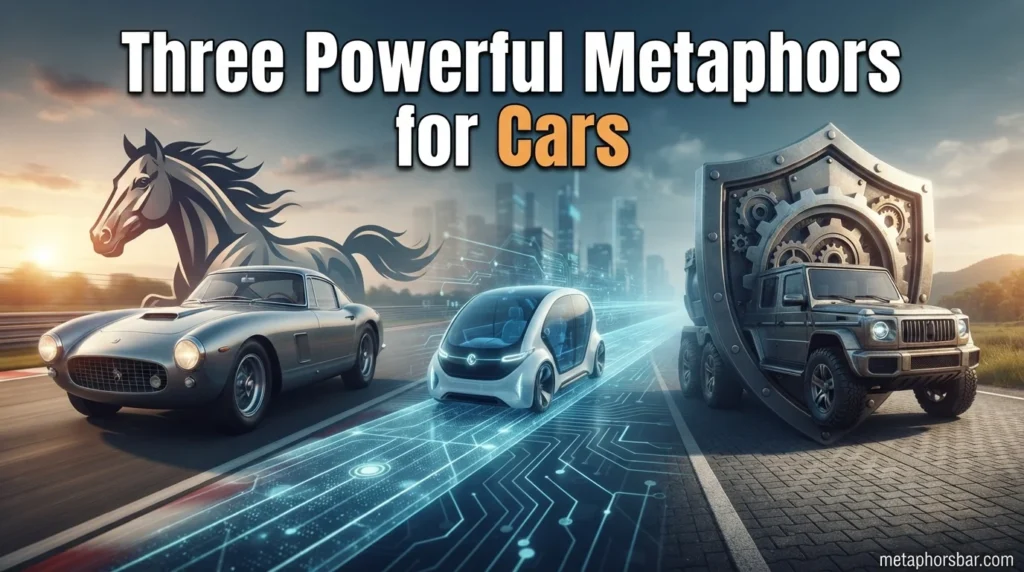
Three Powerful Metaphors for Cars
1. Cars as Horses
A car as a horse is one of the oldest and most natural metaphors for a vehicle. Long before cars existed, horses were the great symbols of travel, power, and personal freedom. The car inherited that role, and the metaphor still feels alive today. It works especially well when the car feels energetic, loyal, and ready to carry someone forward.
Meaning and explanation
When a car is compared to a horse, it suggests motion, strength, and a kind of living partnership with the driver. A horse does not merely move—it responds, carries, and obeys with a certain spirit. In the same way, a good car can feel like an extension of the person behind the wheel. This metaphor works especially well when the vehicle feels reliable, powerful, or free.
It also carries a sense of old-world romance. Horses evoke open roads, long journeys, and the thrill of movement. A car described as a horse feels less like a machine and more like a trusted creature taking you somewhere important.
Example sentence or scenario
The old pickup was a stubborn horse—dusty, loyal, and always ready to pull him through another long stretch of road.
This metaphor works beautifully in memoirs, rural writing, travel scenes, and stories where the car feels tied to personal history or freedom.
Alternative ways to express it
- a steel horse
- a road-bound steed
- a mechanical stallion
- a four-wheeled partner
- a chrome horse of the highway
Sensory and emotional details
You can imagine the low rumble of the engine, the vibration beneath the seat, and the steady pull of the road ahead. Emotionally, this metaphor feels energetic, classic, and free. It suggests motion that is almost alive, with a hint of adventure and trust.
Mini storytelling touch
A man once described his first car as “the first thing I ever owned that felt like it wanted to go somewhere with me.” That is the heart of the horse metaphor. It captures the feeling that a car can be more than transportation—it can be a willing companion on the road.
Literary or cultural reference
The horse has long symbolized strength, movement, and independence in literature and culture. As a metaphor for cars, it creates a bridge between the past and the present, showing how modern mobility still carries ancient dreams of travel and freedom.
2. Cars as Time Machines
Cars are deeply tied to memory. A certain dashboard, smell, song, or worn seat can instantly carry you backward into another moment. That is why the time machine metaphor works so well. A car can carry us not only through space, but through memory. It can return us to road trips, first jobs, family outings, late-night drives, and all the versions of ourselves who once sat behind that wheel.
Meaning and explanation
When a car is compared to a time machine, the emphasis is on memory, transition, and emotional travel. Cars are often where people think, talk, grieve, celebrate, and remember. A drive can bring up the past as vividly as a photograph. This metaphor is especially useful when the car is connected to nostalgia, reflection, or life milestones.
It also works because the interior of a car can feel suspended between places. You are not fully where you were, but not yet where you are going. That in-between feeling makes the car a perfect symbol of time and change.
Example sentence or scenario
The old sedan was a time machine, each crack in the dashboard carrying him back to summers of roadside diners, siblings asleep in the backseat, and songs he had not heard in years.
This metaphor is ideal for memoirs, reflective essays, family stories, and scenes steeped in memory.
Alternative ways to express it
- a rolling memory box
- a road-bound archive
- a machine of recollection
- a moving scrapbook
- a vehicle of return
Sensory and emotional details
You can imagine the smell of old upholstery, the static of a half-forgotten song on the radio, and the way a familiar road can suddenly feel full of ghosts. Emotionally, this metaphor feels wistful, warm, and deeply personal. It suggests that cars often hold our history quietly, in the fabric and silence.
Mini storytelling touch
A woman once said that every time she sat in her father’s old car, she could “hear her childhood before she even turned the key.” That is the power of the time machine metaphor. A car can hold the echoes of who we were and who we loved.
Literary or cultural reference
Time machines appear often in literature and film as symbols of memory, longing, and transformation. As a metaphor for cars, the image works because driving often becomes a way of revisiting places, people, and moments that still live in the heart.
3. Cars as Cocoon or Second Home
A car can also feel like a cocoon: enclosed, private, protective, and quietly personal. For many people, a car is where they cry, sing, think, pray, argue, call friends, or simply sit in silence before going back into the world. As a metaphor, the car as cocoon or second home emphasizes comfort, refuge, and intimate routine.
Meaning and explanation
When a car is compared to a cocoon or second home, it suggests shelter and transformation. A cocoon is a place of waiting, safety, and becoming. A second home is a place where life unfolds between destinations. This metaphor is especially useful when the car is not about speed or power, but about privacy, routine, and emotional space.
It is a beautiful image for those long solo drives where thoughts settle, or for family cars that become familiar little worlds on wheels. It can also suggest that a car becomes part of a person’s identity.
Example sentence or scenario
Her little hatchback felt like a second home—a cocoon on wheels where she could breathe, think, and listen to the rain without being seen.
This metaphor works well in personal writing, reflective pieces, and descriptions of cars that feel comforting and familiar.
Alternative ways to express it
- a rolling refuge
- a cocoon of quiet
- a shelter on wheels
- a private room in motion
- a small moving home
Sensory and emotional details
You can imagine the soft hum of the engine, the warmth of the seats, rain tapping the windows, and the comfort of being enclosed while the world moves outside. Emotionally, this metaphor feels safe, intimate, and grounding. It suggests that a car can be a place to collect yourself before stepping back into life.
Mini storytelling touch
A student once said that after a hard day, she would sit in her parked car for ten minutes before going inside. “It’s the only place I can be alone without being alone,” she explained. That sentence captures the cocoon metaphor perfectly. A car can be a pause, a hiding place, and a small room for becoming.
Literary or cultural reference
Cocoons and homes often symbolize transformation and belonging in literature. As a metaphor for cars, the idea makes sense because cars are often where we move through change while still having a place that feels ours.
How to Choose the Right Metaphor for Cars
Use horse when the car feels powerful and free
Choose this metaphor when you want motion, strength, and a sense of partnership with the road.
Use time machine when the car feels nostalgic
This is the best choice when memory, family, and the passage of time are central to the feeling.
Use cocoon or second home when the car feels private and comforting
Choose this image when the car is a refuge, a pause, or a place of emotional settling.
The best metaphor depends on what you want to say about the car. Cars can carry, remember, and shelter—and sometimes they do all three.
Interactive Exercises for Practicing Metaphors for Cars
Exercise 1: Complete the sentence
Finish this prompt in three different ways:
“The car was like ______ because ______.”
Try one answer that feels fast, one that feels nostalgic, and one that feels comforting.
Example: The car was like a horse because it carried us down the highway with the steady energy of something alive and loyal.
Exercise 2: Sensory mapping
Think of a car you remember well. Write down:
- one sound
- one smell
- one texture
- one movement
- one emotion
Then turn those details into a metaphor.
For example: The car smelled like rain and old leather, sounded like a low engine humming under the road, felt like a cocoon of warmth, moved like a horse across open land, and carried the emotion of freedom.
Exercise 3: Story starter
Begin a short paragraph with:
“The car felt like…”
Let the image guide the tone. You can make it poetic, practical, nostalgic, or playful.
Exercise 4: Caption or journal prompt
Try writing a one-line reflection:
- “This car is my time machine.”
- “The road felt like freedom on four wheels.”
- “My car is a cocoon between the places I have to be.”
Bonus Tips for Using Metaphors for Cars in Writing, Social Media, and Daily Life
In writing
Use car metaphors in fiction, essays, memoirs, and travel writing to make motion and memory feel vivid. They are especially effective when the car is more than just transportation.
On social media
A short metaphor can make a car caption feel more personal and memorable. “Steel horse” or “time machine on the highway” can say a lot in just a few words.
In everyday conversation
Metaphors can help you describe your car with more personality. Instead of saying “I love driving it,” you might say, “It feels like my second home.”
In storytelling
If you are writing a scene in a car, the metaphor can reveal whether the car feels like freedom, memory, or shelter. That adds depth and atmosphere.
Keep the image true to the car
The strongest metaphor is the one that truly fits the vehicle and the feeling around it. Some cars are horses, some are time machines, and some are cocoons. Many are all three at different moments.
FAQs
1. What is a metaphor for cars?
A metaphor for cars is a figurative comparison that describes cars using another image, such as a horse, time machine, or cocoon.
2. Why are metaphors for cars useful?
They help make a car’s meaning, feeling, and role in a person’s life more vivid and memorable.
3. What is a simple metaphor for a car?
A simple example is: A car is a steel horse. It suggests power, movement, and freedom.
4. Can these metaphors be used in writing or captions?
Yes. They are especially effective in memoirs, fiction, travel writing, and social media captions.
5. How do I create my own metaphor for a car?
Think about what the car feels like—free, nostalgic, protective, or powerful—and compare it to something with similar qualities.
6. Are these metaphors only for personal writing?
No. They can also be used in marketing, product descriptions, speeches, and everyday conversation.
7. What makes a strong metaphor for cars?
A strong metaphor is vivid, emotionally fitting, and easy to picture. It should help the reader feel the car, not just identify it.
Conclusion
Cars are so common that it is easy to forget how much meaning they carry. They move us, hold our memories, and sometimes become part of who we are. That is why metaphors matter—they help us describe not only what cars do, but what they feel like to live with and remember.
A horse gives a car its freedom and strength. A time machine gives it memory and nostalgia. A cocoon or second home gives it comfort and privacy. Together, these images remind us that cars are never just machines—they are motion, memory, and small moving worlds.
So when you write about cars, do not settle for the obvious. Let them carry, remember, or shelter through your language. A good metaphor can make a car unforgettable.