
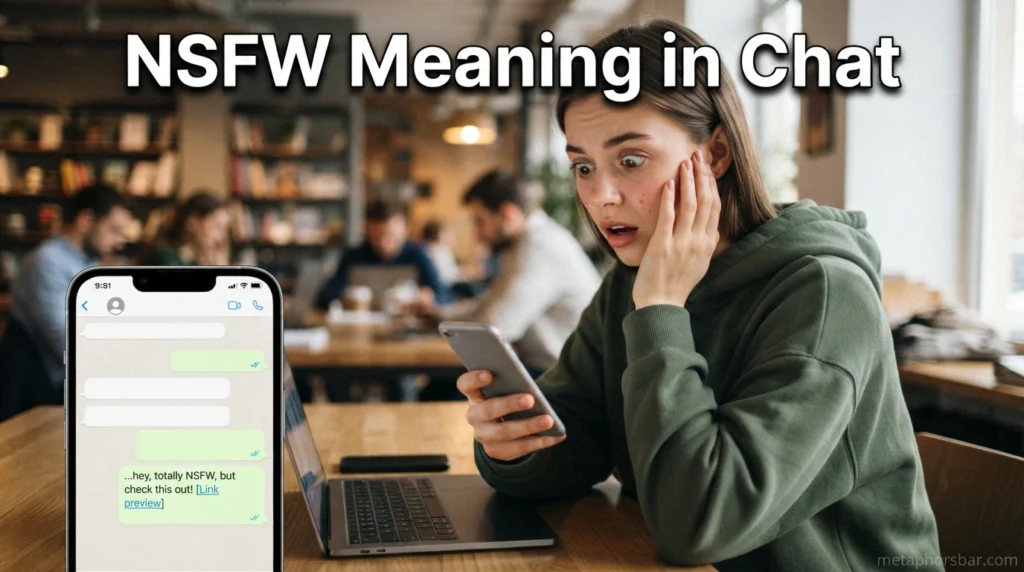
If you have seen NSFW in a message, post, or comment and wondered what it means, you are not alone. People search for nsfw meaning in chat because internet slang can be confusing, especially when a warning appears without any explanation. In modern digital conversations, a short label can tell you a lot about the kind of content you are about to see. That matters on WhatsApp, Instagram, TikTok, Snapchat, email, and web pages, because you do not always want to open something graphic, sexual, violent, or otherwise inappropriate in public or at work.
Understanding internet slang helps you avoid awkward surprises, read tone correctly, and decide when to open, ignore, or save something for later. NSFW is one of the most useful warning tags online because it is simple, widely recognized, and designed to protect viewers from content they may not want to see right away.
What Does NSFW Mean in Chat?
In chat, NSFW means “not safe for work” or “not suitable for work.” Merriam-Webster defines it as an abbreviation used to warn someone that a website, email attachment, or other content is not suitable for viewing in most workplaces, and explains that it refers to explicit digital content you would not want to be caught watching in public or at work.
Full Form of NSFW
The full form is:
Not Safe For Work or Not Suitable For Work.
Short Meaning in Simple English
In simple English, NSFW means:
- This content may be inappropriate to open in public.
- This content may be too explicit for work or school.
- This content may include sex, profanity, graphic violence, or other mature material.
So if someone sends you a link and writes “NSFW,” they are warning you that the content is meant for private viewing, not for a workplace or other public setting.
Why People Search for NSFW Meaning in Chat
People search for this term because they want to know whether it is safe to open a link, image, video, or message right away. That is especially important when you are in class, at work, in a family setting, or around other people. Dictionary sources show that NSFW is specifically used as a warning for content that would not be appropriate at most places of employment or in public spaces.
Another reason is that NSFW is now part of everyday internet language. Merriam-Webster includes it in its dictionary as a standard abbreviation, which shows that it is not just a niche internet joke; it is a recognized warning label in online communication.
Origin and Rise in Popularity
NSFW became popular as online content expanded and people needed a fast, universal way to warn others about mature material. The abbreviation is now common enough to appear in major dictionaries, and current dictionary entries still describe it as a live, widely understood warning term. That shows it has moved from internet jargon into mainstream digital literacy.
Its rise also connects to the way people consume content today. Because links, images, and videos can travel instantly across chats and social feeds, users often add a quick warning so others can choose when and where to open the material.describes NSFW content as common online and often involving sexual, profane, offensive, violent, or graphic material.
How NSFW Is Used in Real Conversations
NSFW is usually attached to a link, image, video, or post title. It acts like a heads-up. Merriam-Webster says it is used to warn someone that a website or email attachment is not suitable for viewing at most places of employment, and says it describes explicit digital content you would not want to be caught watching in professional or public places.
Here are some natural chat examples:
- “NSFW link, open later.”
- “This meme is NSFW.”
- “I am sending you a NSFW video.”
- “That post is NSFW, do not open it in class.”
These examples are original, but they follow the standard warning meaning described by major dictionaries.
What NSFW Usually Sounds Like
NSFW can sound:
- cautionary
- polite
- practical
- serious
- sometimes humorous if used jokingly among friends
Even when it is used casually, the purpose is still to warn the reader about mature content before they open it.
NSFW Meaning on WhatsApp, Instagram, TikTok, and Snapchat
NSFW appears on any platform where people share links, videos, images, or private messages. The meaning stays the same: it warns you that the content may not be appropriate to view in public or at work. Because NSFW is defined as a warning for digital content, it can naturally show up in chat apps and social feeds.
On WhatsApp
On WhatsApp, someone may add NSFW before sharing a link, picture, or video if they want to warn you that the content is mature. Because WhatsApp is often used for private messaging, the warning helps the receiver decide whether to open the content right away. This is an inference based on NSFW’s standard warning meaning.
Example: “NSFW, do not open this at work.”
On Instagram
On Instagram, NSFW can appear in captions, DMs, or comments when a post includes mature material or references it. Since Instagram is a visual platform, the label helps people avoid opening something in the wrong place or around the wrong audience. This is an inference from the general warning function of NSFW.
On TikTok
On TikTok, the meaning on TikTok is still the same. People may write NSFW in captions or comments to warn that a clip is mature, graphic, or otherwise not safe for public viewing. The abbreviation itself does not change; only the surrounding content does. This is an inference from the standard definition of NSFW as a warning label for explicit digital content.
On Snapchat
On Snapchat, NSFW may be used before sending something private and mature so the recipient knows what to expect. Since Snapchat messages are often shared quickly, the warning is useful for privacy and courtesy. This is an inference from the general usage of NSFW in chat and digital content.
NSFW vs SFW and CW
NSFW is often compared with SFW, which means safe for work or suitable for work. Merriam-Webster defines SFW exactly that way and says it is used to tell someone that a website or attachment is appropriate to view at most workplaces.
Another useful related abbreviation is CW, which stands for content warning. defines content warning as a warning that the following text, video, or other content may upset or offend someone, and notes that CW is a common short form.
So the difference is simple:
- NSFW = not safe for work
- SFW = safe for work
- CW = content warning
What NSFW Does Not Mean
NSFW does not mean:
- a random insult
- a joke about being unfriendly
- a school subject
- a harmless regular photo
- something that is always illegal
Instead, it is a warning label. It tells you the content may be sexual, profane, offensive, violent, or graphic, depending on the post or message.
Common Confusions and Wrong Interpretations
A common mistake is thinking NSFW only means sexual content. That is not accurate. says NSFW content may involve sexual, profane, offensive, violent, or otherwise graphic material. So the label is broader than sex alone.
Another mistake is assuming NSFW always means “do not open ever.” That is not what the label says. It means “be careful where and when you open this,” especially if you are at work, in public, or around others. Merriam-Webster’s definition makes that purpose very clear.
Similar Slang Terms and Alternatives
If you are learning NSFW, these related terms help:
- SFW = safe for work.
- CW = content warning.
- TW = trigger warning, often used similarly to CW in discussions about upsetting content. explains that content warning is a common substitute for trigger warning.
If you want plain English alternatives, people may write:
- “mature content”
- “graphic content”
- “adult content”
- “warning: sensitive material”
Those phrases are not abbreviations, but they do the same basic job: they tell you to be cautious before opening the content.
How to Reply When Someone Says NSFW
Your reply depends on what the sender is sharing and how comfortable you are with it.
Polite replies
- “Got it, I will open it later.”
- “Thanks for the warning.”
- “Okay, I will check it privately.”
- “Appreciate the heads-up.”
Flirty replies
Use these only if the conversation is already playful and mutual:
- “Hmm, that sounds interesting.”
- “Okay, now I am curious.”
- “You definitely got my attention.”
- “I will save that for later 😉”
Boundary-respecting replies
- “Please do not send me that kind of content.”
- “I am not comfortable opening NSFW material.”
- “Let us keep it appropriate.”
- “I would rather not receive that.”
If the message feels inappropriate, it is okay to step back or set a boundary. NSFW is only a warning label; it does not mean you are required to engage with the content.
Is NSFW Still Popular?
Yes, NSFW is still very popular and widely understood. It remains in current dictionary entries, and those entries continue to describe it as an active warning label for digital content. That shows the abbreviation is still part of modern internet language rather than an outdated term.
NSFW in Gen Z slang culture
In Gen Z internet culture, NSFW is usually treated less like a “trend word” and more like a stable online safety tag. It helps people move quickly through social feeds while avoiding surprise mature content. Because modern apps make sharing instant, a short warning like NSFW still does useful work. That is a reasonable inference from its ongoing use in dictionaries and online content warnings.
WYLL Is Different
NSFW is not the same as WYLL. Merriam-Webster defines WYLL as “what do you look like?” and says it is a slang abbreviation used on social media and in text messages. That is a completely different meaning from NSFW’s warning label.
So the difference is simple:
- NSFW = not safe for work
- WYLL = what do you look like?
FAQs
What does NSFW mean in chat?
NSFW means not safe for work or not suitable for work. It warns you that the content may be too explicit, graphic, or otherwise inappropriate for public or work settings.
What is the full form of NSFW?
The full form of NSFW is not safe for work. Merriam-Webster also accepts not suitable for work.
What does NSFW mean on TikTok?
On TikTok, NSFW still means not safe for work. People may use it to warn about mature, graphic, or explicit clips. This is an inference from the general warning meaning of NSFW.
Is NSFW always sexual?
No. says NSFW content may be sexual, profane, offensive, violent, or otherwise graphic.
What is the difference between NSFW and SFW?
NSFW means not safe for work. SFW means safe for work or suitable for work.
What is the difference between NSFW and CW?
NSFW warns that content is not appropriate for work or public viewing. CW means content warning, a broader warning that the following content may upset or offend someone.
Conclusion
The nsfw meaning in chat is simple: not safe for work. It is a warning label that tells you a message, image, video, link, or post may be explicit, graphic, offensive, or otherwise not appropriate to open in public or at work. Merriam-Webster and both describe NSFW as a standard internet abbreviation used to warn viewers before they open content.
If you see NSFW on WhatsApp, Instagram, TikTok, Snapchat, or anywhere else online, treat it as a caution sign. Check the setting, the sender, and your surroundings before opening it. And do not confuse it with WYLL, which means what do you look like? Once you know the difference, NSFW becomes easy to understand and easy to use safely in everyday digital conversation.