
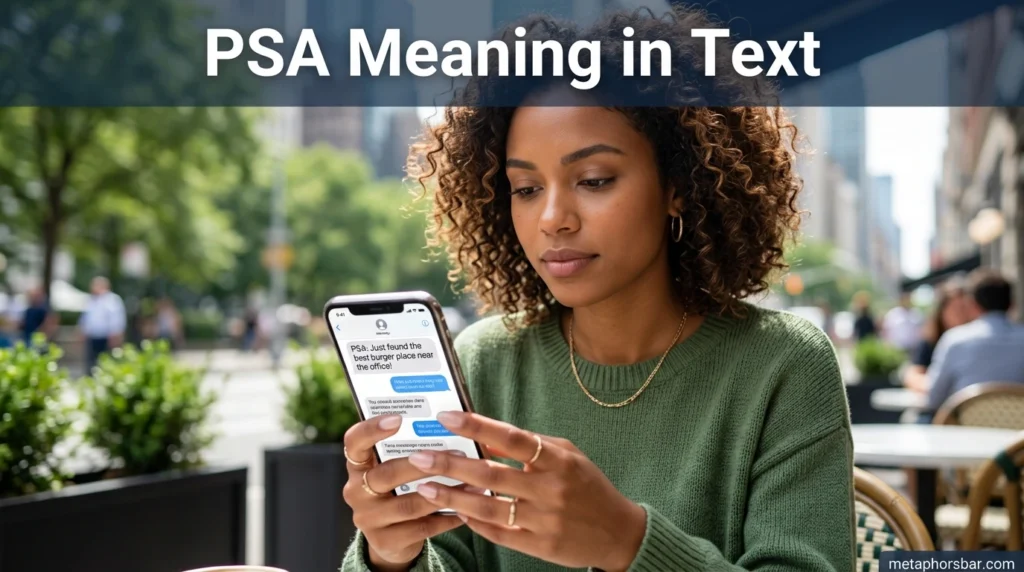
If you have seen PSA in a text, caption, comment, or DM and wondered what it means, you are definitely not alone. People search for psa meaning in text because this small abbreviation can feel a little formal, a little dramatic, and a little confusing all at once. In modern digital conversation, short forms often do more than save time. They also help set the tone of a message before the reader even gets to the main point.
PSA is one of those expressions that tells people, “Pay attention, this matters.” That is why understanding internet slang is useful today. It helps you read messages more clearly, respond in the right tone, and avoid misunderstandings on WhatsApp, Instagram, TikTok, and Snapchat. Once you know what PSA means, it becomes easy to recognize and even easier to use.
What does PSA mean in text?
In texting and online chat, PSA usually stands for Public Service Announcement. In casual digital use, it often works like a big attention signal that means the sender is about to share something important, useful, or warning-like. QuillBot’s explanation of PSA in text says it is used to introduce something important, while social-media writing guides describe it as a message that raises awareness or changes attitudes about a topic.
In simple English, PSA in text often means:
- “Here is an important note.”
- “Pay attention to this.”
- “I am sharing a useful warning or reminder.”
- “This is serious, funny, or important enough to announce.”
So when someone types “PSA,” they are usually not referring to a random word. They are signaling that the next part of the message deserves attention.
PSA full form
The full form of PSA is Public Service Announcement. That is the standard meaning used in media, education, public information campaigns, and social platforms. It originally referred to official messages that educate the public about health, safety, or community issues, but online users now use it more casually as a prefix for important messages.
PSA short meaning
The short meaning of PSA in text is usually:
- a heads-up
- an important announcement
- a warning
- a helpful reminder
- a message that should be taken seriously or noticed right away
Why people search for PSA meaning in text
People search for this because PSA can look like a formal phrase, but it appears in very informal places like chats, memes, and comment sections. That mix makes it easy to miss the tone if you have never seen it before. Current guides still explain PSA as a message that signals importance, and social media articles show that the abbreviation has become widely used in online conversation.
Another reason people look it up is that PSA can be used seriously or humorously. A message like “PSA: the office coffee machine is broken” is not the same as an official public-information broadcast, but it borrows that same “listen up” feeling.
Origin and rise in popularity
PSA began as Public Service Announcement, the kind of message used in television, radio, and public-interest campaigns to inform people about health, safety, or social issues. Purdue Global and other educational sources describe PSAs as communication used by organizations and public institutions to raise awareness and encourage action.
From there, the abbreviation moved into internet language. People liked using it because it instantly frames the next message as important. On social media, PSA can be serious, funny, or dramatic, but the core idea stays the same: the sender wants attention. A 2026 social-media explainer notes that PSA has found a powerful new life online, where reach and engagement can spread quickly.
How PSA is used in real conversations
In real chat, PSA usually appears at the start of a message. It works almost like a headline. The sender types “PSA,” then follows with the actual point. That point may be a warning, a tip, a joke, or a public reminder. QuillBot’s examples show this clearly: a PSA message in text is figurative rather than literal, but it still signals importance.
Here are some natural examples:
- “PSA: the stairs are slippery.”
- “PSA, the meeting moved to 3 PM.”
- “PSA for anyone driving tonight: traffic is bad.”
- “PSA: this restaurant closes early on Sundays.”
- “PSA: I will be offline for a few hours.”
These examples show that PSA can introduce a practical note, a warning, or a simple update. It is a flexible way to say, “Please notice this.”
PSA in casual chat
In casual chat, PSA is sometimes used with humor. For example, someone might write, “PSA: do not ask me to share fries if I am hungry.” That is not an official announcement, of course. It is a playful way to make a point and get people’s attention. That casual use is part of why PSA is still popular online.
PSA meaning on WhatsApp, Instagram, TikTok, and Snapchat
The core meaning of PSA stays the same across platforms: it usually introduces something important. What changes is the style and purpose. On WhatsApp, PSA often appears in group chats when someone needs to share a reminder or warning. On Instagram, it may show up in captions or comments when people want to make a statement. On TikTok, PSA is often used to grab attention before sharing a tip, opinion, or joke. On Snapchat, it can appear in quick story-style updates or DMs.
WhatsApp example
“PSA: don’t forget the event starts at 6.”
This works well in a group chat because it is short and clear. WhatsApp is built for fast messaging and file sharing, so short announcement-style posts fit naturally there.
Instagram example
“PSA: this is your sign to rest.”
On Instagram, PSA can make a caption sound direct and thoughtful. Social-media writing guides note that PSA is now used online to get attention and shape how people react to a message.
TikTok example
“PSA: stop doing this trend wrong.”
TikTok is one of the most visible places for PSA because it works well as a strong opener in captions and comments. It adds urgency, humor, or authority before the actual message.
Snapchat example
“PSA: I’m going to be late.”
Snapchat is fast and casual, so PSA often acts like a brief status update or quick warning. The message is still informal, but the tone says, “This matters.”
What PSA does not mean
PSA does not only refer to social media or texting. In formal contexts, it still means Public Service Announcement, the original and widely recognized phrase used in media and public-information work. Educational sources describe PSAs as messages created to raise awareness or encourage action on an important issue.
PSA also does not mean the medical term prostate-specific antigen in normal texting. That is a real medical abbreviation, but it is a completely different context. If the conversation is about chat, captions, or memes, the medical meaning is usually not the right one.
PSA is also not the same as WYLL. Merriam-Webster defines WYLL as “what do you look like?” so it is a separate slang abbreviation with a different purpose. PSA is about importance or announcement; WYLL is about appearance.
Common confusions and wrong interpretations
A common mistake is thinking PSA always has to be serious. It does not. Online, PSA can be serious, funny, playful, or even sarcastic, depending on the writer’s tone. That flexibility is one reason it became so common on social media.
Another confusion is assuming PSA is only for official public-information campaigns. That is where it started, but online language often reuses formal terms in a looser way. A PSA-style message in a text may simply be a helpful heads-up, not a government announcement.
A third mistake is reading PSA as a random acronym with no tone. In chat, the tone is the point. PSA says the writer wants the next message to feel important.
Similar slang terms and related abbreviations
PSA belongs to a bigger family of shorthand that changes how a message feels. Similar terms include:
- FYI = for your information
- HEADS-UP = warning or notice
- IMO = in my opinion
- TBH = to be honest
- BTW = by the way
PSA vs FYI
These two are close, but not identical.
- PSA = “this is important, pay attention”
- FYI = “for your information”
FYI is more informational and less dramatic. PSA feels more like an announcement.
PSA vs heads-up
A heads-up is more conversational, while PSA sounds a little more formal or attention-grabbing. Both can warn people, but PSA usually has more public-announcement energy.
How to reply when someone says PSA
How you reply depends on the content of the message. If the PSA is informative, a simple acknowledgment is enough. If it is funny, you can respond casually. If it is a reminder or warning, you can thank the person or act on it. Since PSA usually signals importance, a reply often shows that you noticed the message.
Polite replies
- “Got it, thanks.”
- “Helpful reminder.”
- “Good to know.”
- “Thanks for the heads-up.”
These are great when the PSA is practical or informational.
Flirty replies
PSA is not really a flirty phrase, but if the conversation already feels playful, you can answer lightly:
- “PSA noted, boss 😉”
- “Important announcement received.”
- “You definitely got my attention.”
These work only if the tone is already casual and fun.
Boundary-respecting replies
- “Thanks, but I’m not interested.”
- “I saw your message, and I’d rather keep it brief.”
- “Noted, but I’m going to pass.”
- “Please send the details without the extra pressure.”
These are useful if the message feels pushy or too intense.
Is PSA still popular?
Yes, PSA is still popular because it works in both formal and casual online spaces. It is a familiar abbreviation in media, education, and public information, and it has also become a common social-media prefix for attention-grabbing posts. A 2026 article on social media explains that PSA now has a strong life online, where it can be used for awareness, humor, or quick updates.
Its place in Gen Z slang culture is interesting because it is not a “cool for no reason” acronym. It is useful. It helps people frame a message like an announcement, which is exactly why it keeps showing up in comment sections, story captions, and group chats.
FAQs
What does PSA mean in text?
PSA in text usually means Public Service Announcement, or more casually, “I’m about to say something important.”
Is PSA slang?
Yes. Online, PSA is often used as a slang-style attention signal before an important, funny, or helpful message.
What does PSA mean on TikTok?
On TikTok, PSA usually introduces a tip, warning, opinion, or humorous announcement that the creator wants people to notice.
Is PSA always serious?
No. PSA can be serious, funny, or sarcastic depending on context.
What is the difference between PSA and FYI?
PSA feels more like an announcement or warning, while FYI simply means “for your information.”
Is PSA the same as WYLL?
No. PSA is about an announcement or important message. WYLL means “what do you look like?”
Conclusion
PSA in text usually means Public Service Announcement. In modern online chat, it often works like a strong attention signal that tells readers the next message is important, useful, funny, or warning-like. People use it on WhatsApp, Instagram, TikTok, Snapchat, and in everyday messages to frame a note as something worth noticing.
It is not the same as FYI, not the same as the medical abbreviation for prostate-specific antigen, and not the same as WYLL. Once you understand the tone, PSA becomes easy to read and easy to use. It is one of those abbreviations that can make a message feel clearer, faster, and more intentional in a digital conversation.