
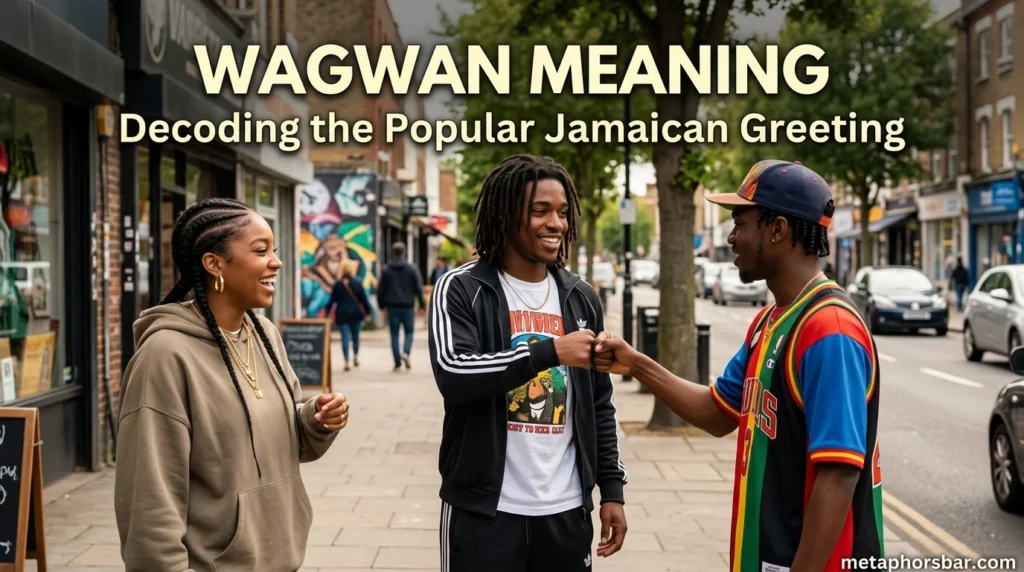
If you have seen wagwan in a text, caption, comment, or TikTok and wondered what it means, you are not alone. People search for wagwan meaning because the word looks playful, sounds different, and can feel confusing if you are not used to Jamaican-influenced slang. In modern digital conversation, short slang words spread fast, especially on social media where people like quick greetings and casual expressions.
Understanding a term like wagwan helps you follow chats better, reply naturally, and avoid sounding lost when someone greets you in a style that is new to you. It also matters because wagwan is not just random internet speech; it comes from Jamaican English and is widely used across the Jamaican diaspora. That gives it a real cultural background, not just meme value. says it means “What’s going on?” in Jamaican English, and Collins defines it as “what is happening?” in British English slang.
What does wagwan mean in text?
In texting and online chat, wagwan is a casual greeting that means “what’s going on?” or “what’s happening?” says wagwan is a way to say “What’s going on?” in Jamaican English, and Collins gives the shorter meaning “what is happening?” as a slang sentence substitute. Wiktionary also defines it as a greeting equivalent to “what’s up” or “what’s happening.”
In simple English, wagwan usually means:
- hello
- what’s up
- what’s happening
- how are you doing
- what are you saying / what’s going on
Is wagwan a full form?
Wagwan is not a standard acronym, so it does not have a “full form” the way abbreviations like BRB or IDK do. Instead, it is a contracted Jamaican-English greeting that comes from the idea of “what’s going on?” Wiktionary says it is borrowed from Jamaican Creole wah gwan, literally “wha’ goi’ on,” and also explains it as a Jamaican-English way of asking “What’s going on?”
Short meaning of wagwan
The shortest meaning of wagwan is:
- a friendly greeting
- “what’s going on?”
- “what’s up?”
- “what’s happening?”
Why people search for wagwan meaning
People search for wagwan because it shows up in music, memes, comments, and chats, but it is not obvious if you have not seen Jamaican English or UK slang before. says wagwan is used throughout the Jamaican diaspora, especially in South London, while Wiktionary says it is used throughout the Jamaican diaspora and in hip-hop culture and by reggae fans. Collins also notes that it comes from Jamaican patois and functions as a slang sentence substitute.
It can also feel confusing because it looks like a fixed “word,” but its meaning is really about greeting someone casually. That is why people often look it up before replying, especially if they see it in TikTok comments, Instagram DMs, or WhatsApp chats.
Origin and rise in popularity
Wagwan comes from Jamaican Creole. Wiktionary says it is borrowed from wah gwan, literally “wha’ goi’ on,” and Collins says it is derived from Jamaican patois and means “what is happening?” Dictionary.com says it is used throughout the Jamaican diaspora and became especially common in South London. A Collins blog also notes that it comes from Jamaican patois and is now a recognizable part of Multicultural London English.
Its rise in popularity is tied to music, migration, and youth slang. Wiktionary lists usage notes showing it appears in hip-hop culture and among reggae fans, and Collins notes that it has traveled outside London and is now more widely recognized. Current examples still appear in music titles like Central Cee’s “WAGWAN,” showing the word remains active in modern pop culture.
How wagwan is used in real conversations
Wagwan is used as a casual greeting. It is basically the kind of thing you say when you want to say hello in a relaxed, friendly, culturally rooted way. Collins, and Wiktionary all define it as a greeting equivalent to “what’s up” or “what’s happening.”
Here are natural examples:
- “Wagwan, fam?”
- “Wagwan, how you been?”
- “Wagwan, you good?”
- “Wagwan, bruv?”
- “Wagwan, long time no see.”
In each example, the word does not need a long explanation. It is just a relaxed greeting, similar to “hey,” “what’s up,” or “what’s happening?”
Standard response to wagwan
Wiktionary notes that the standard response is nagwan or nuttin nah gwaan, meaning “nothing is going on.” That makes wagwan part of a neat greeting-and-response pattern in Jamaican and diaspora slang.
Wagwan meaning on WhatsApp, Instagram, TikTok, and Snapchat
Wagwan works on all major social apps, but the setting changes how it feels. On WhatsApp, it is often a warm, informal greeting in private chats or groups. On Instagram, it appears in DMs or comments as a cool, casual opener, On TikTok, it is often used in captions, replies, or memes, On Snapchat, it fits naturally because the app encourages quick, informal conversation. That is an inference from its general greeting meaning and from the way those platforms favor short, casual language.
On WhatsApp, wagwan can be used when you want to greet a friend casually.
- “Wagwan, you coming later?”
- “Wagwan, long time!”
On Instagram, wagwan often appears in comments, story replies, or DMs.
- “Wagwan, nice pic.”
- “Wagwan, where you been?”
TikTok
On TikTok, wagwan is often used in comments or captions as a vibe word or greeting. It can also appear in song and meme references, which helps keep it visible in current youth culture. Central Cee’s 2026 “WAGWAN” release is one example of the word’s ongoing cultural life.
Snapchat
On Snapchat, wagwan feels very natural because the app is built for quick, casual back-and-forth messages.
- “Wagwan, send a snap.”
- “Wagwan, you free?”
What wagwan does not mean
Wagwan does not mean something formal or technical. It is not a business acronym, and it is not a school subject abbreviation. It is a slang greeting. Collins, and Wiktionary all frame it that way.
Wagwan also does not mean WYLL. WYLL is a different slang term entirely and means “what do you look like?” according to Merriam-Webster. That abbreviation is about appearance, while wagwan is about greeting and asking what is going on.
And wagwan does not have a standard “full form” as an acronym. The closest phrase behind it is “what’s going on?” or “what is happening?”
Common confusions and wrong interpretations
A common mistake is reading wagwan as a random made-up internet word. It is not random. It has a clear history in Jamaican English and Jamaican Creole, and it is used across the Jamaican diaspora.
Another mistake is treating wagwan as only a London slang word. Collins notes it is derived from Jamaican patois, and Wiktionary says it is used throughout the Jamaican diaspora, including hip-hop culture and reggae fandom. So it is bigger than just one city.
A third mistake is assuming it is rude or suspicious. It usually is not. It is a friendly greeting, like “what’s up.”
Similar slang terms and alternatives
If you understand wagwan, you will also recognize these related greetings:
- what’s up
- what’s happening
- sup
- yo
- safe
- what you saying? / what’re you saying?
Wiktionary also lists alternative forms such as whagwan, wha’ gwan, wha gwan, wagwarn, whatagwan, wag one, and wag1.
Wagwan vs what’s up
These are nearly the same in function. “What’s up” is the plain-English equivalent, and wagwan is the Jamaican-English / diaspora version.
Wagwan vs sup
“Sup” is another casual greeting with the same broad role. Wagwan sounds more Caribbean and London-influenced, while sup sounds more general internet slang. That comparison is an inference based on the greeting meanings from the sources.
How to reply when someone says wagwan
The easiest reply to wagwan is simply to answer with a greeting or with the standard response noted by Wiktionary. You do not need a long message.
Polite replies
- “Not much, you?”
- “All good.”
- “Hey, how are you?”
- “Same here.”
Flirty replies
- “Wagwan, handsome 😉”
- “Better now that you texted.”
- “Wagwan, stranger.”
These are playful and fit only if the conversation already feels light and mutual.
Boundary-respecting replies
- “Hey, what’s up?”
- “I’m busy right now.”
- “Not much going on.”
- “Talk later.”
These keep the reply short and clear without being rude.
Is wagwan still popular?
Yes. Wagwan is still popular and still recognizable in 2026. Current sources continue to define it as a Jamaican-English greeting used in diaspora communities, South London slang, hip-hop culture, and reggae fandom. Collins also notes its spread beyond London, and current music references like Central Cee’s “WAGWAN” show the word is still active in pop culture.
Its place in Gen Z slang culture is strong because it is short, stylish, and easy to use in casual chat. It also has a real cultural background, which gives it more depth than a made-up internet trend word. That is an inference based on its documented use in Jamaican diaspora speech and its continued appearance in modern music and social media.
FAQs
What does wagwan mean in text?
Wagwan means “what’s going on?” or “what’s happening?” in Jamaican English and slang chat.
Is wagwan slang?
Yes. It is slang and also a real greeting used in Jamaican English and the Jamaican diaspora.
What is the reply to wagwan?
A common reply is nagwan or nuttin nah gwaan, meaning “nothing is going on.”
Does wagwan mean hi?
Yes, in practice it works like a casual “hi” or “what’s up.”
Is wagwan the same as WYLL?
No. Wagwan is a greeting, while WYLL means “what do you look like?”
What does wagwan mean on TikTok?
On TikTok, wagwan is usually used as a casual greeting or vibe word in captions, comments, or song references. That is an inference based on its general greeting meaning and its current use in music and social content.
Conclusion
Wagwan is a friendly slang greeting that means “what’s going on?” or “what’s happening?” It comes from Jamaican Creole, is widely used in the Jamaican diaspora, and is especially familiar in South London, hip-hop culture, and reggae-fan communities. On WhatsApp, Instagram, TikTok, and Snapchat, it works like a relaxed hello. The usual response is nagwan or nuttin nah gwaan, meaning “nothing is going on.” It is not the same as WYLL, and it is not an acronym with a full form. Once you know the context, wagwan becomes easy to understand and easy to reply to naturally.