
The clock ticks, but it’s not the sound that moves you—it’s the feeling. A childhood memory flashes like sunlight on water. A long afternoon stretches like a quiet road with no end in sight. And suddenly, a year has passed without asking permission.
Time is always there, always moving, yet never fully seen. We measure it in seconds and seasons, but we experience it in moments, emotions, and memories. That’s why metaphors for time are so powerful. They give shape to something invisible, turning it into something we can feel, imagine, and understand.
Whether you’re writing poetry, storytelling, journaling, or crafting thoughtful captions, metaphors for time help bring depth and meaning to your words. They transform ticking seconds into something alive.
Why Metaphors for Time Matter in Writing and Everyday Expression
Time is one of the most universal yet abstract concepts. Everyone experiences it, but no one experiences it in exactly the same way.
Metaphors help us:
- make time feel visible and emotional
- express the speed or slowness of life
- connect memory, change, and growth
- add poetic depth to writing and speech
Instead of saying, “Time passed quickly,” you might say, “Time slipped through my fingers like sand.” That image lingers, because it feels true.
Time as a River
Meaning and Explanation
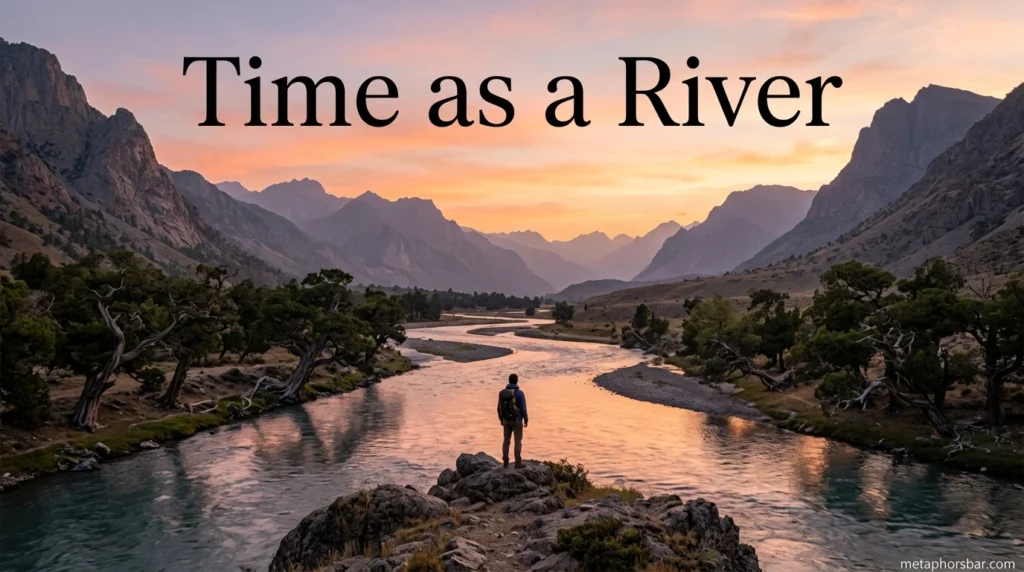
This metaphor presents time as something that flows continuously. Like a river, it moves forward without stopping, carrying everything along with it.
It’s perfect for expressing the unstoppable, ongoing nature of time and the idea that we are always moving with it.
Example Sentence or Scenario
Time flowed like a river, carrying their childhood far beyond the shore of memory.
This might describe growing older, drifting away from the past, or realizing how quickly life changes.
Alternative Ways to Express It
- time is a flowing stream
- moments drift like water
- carried by the current of life
- moving with the tide of time
Sensory or Emotional Details
You can hear the gentle rush of water, see reflections moving, feel the pull of the current. Emotionally, it feels calm, inevitable, and sometimes bittersweet.
Mini Storytelling Touch
An old man once sat by a river and told his grandson, “You can never step into the same river twice.” The child didn’t understand at first. Years later, standing in the same place, he finally did. The river had moved on—and so had he.
Cultural Reference
This idea echoes ancient philosophy, where thinkers often compared time to flowing water, emphasizing change and impermanence.
Time as a Thief
Meaning and Explanation
This metaphor shows time as something that quietly takes things away—youth, moments, opportunities. It highlights the fleeting nature of life and the subtle loss that comes with passing time.
It’s especially effective when expressing nostalgia or regret.
Example Sentence or Scenario
Time is a thief, stealing moments we didn’t realize were precious until they were gone.
This could describe looking back on childhood, missed opportunities, or relationships that faded.
Alternative Ways to Express It
- time slips things away
- moments vanish like shadows
- life quietly disappears
- memories fade under time’s hand
Sensory or Emotional Details
This metaphor feels quiet but sharp—like something slipping away unnoticed. Emotionally, it carries sadness, reflection, and sometimes urgency.
Real-Life Example
Think about how quickly school years pass or how fast children grow. One day feels long, but years disappear almost overnight. That’s time as a thief—subtle, constant, and unstoppable.
Time as a Sculptor
Meaning and Explanation
This metaphor presents time as something that shapes and transforms. Like a sculptor, time molds experiences, people, and lives into something new.
It’s ideal for expressing growth, change, and the gradual shaping of identity.
Example Sentence or Scenario
Time is a sculptor, carving wisdom into our lives with every passing year.
This could describe aging, learning from experience, or becoming who you are meant to be.
Alternative Ways to Express It
- shaped by time’s hands
- carved by experience
- molded through years
- formed by the passage of days
Sensory or Emotional Details
You can imagine the slow scraping of tools, the shaping of stone, the gradual emergence of form. Emotionally, it feels purposeful, reflective, and meaningful.
Mini Storytelling Touch
A young artist once rushed through every piece, wanting instant perfection. His mentor told him, “Even stone takes time to become art.” Years later, he realized that his own life had been sculpted in the same way—slowly, imperfectly, but beautifully.
How to Choose the Right Metaphor for Time
Different metaphors highlight different aspects of time:
- Use a river to show flow and movement
- Use a thief to show loss and fleeting moments
- Use a sculptor to show growth and transformation
Choose the metaphor that matches the feeling you want to express—peaceful, reflective, urgent, or hopeful.
Interactive Exercises: Practice Creating Your Own Metaphors for Time
Exercise 1: Personal Reflection
Complete the sentence: “Time feels like ______ because ______.”
Example: “Time feels like a fast train because it never slows down when I want it to.”
Exercise 2: Sensory Mapping
Describe time using:
- one sound
- one object
- one movement
Turn it into a metaphor.
Exercise 3: Story Starter
Begin a paragraph with: “Time moved like…”
Let your metaphor guide the tone of the story.
Exercise 4: Social Media Caption Practice
Try short, engaging lines:
- “Time flows, whether we swim or stand still.”
- “Moments matter before they vanish.”
- “Shaped by time, not rushed by it.”
Bonus Tips for Using Metaphors for Time
In Writing
Use time metaphors to add emotional depth to essays, stories, and poems.
In Social Media
Short metaphors can make captions thoughtful and relatable.
In Daily Life
They can help you reflect on how you experience time.
In Conversations
Metaphors make complex ideas easier to share and understand.
Keep It Simple
The best metaphors are clear and relatable.
FAQs About Metaphors for Time
1. What is a metaphor for time?
A metaphor for time is a figurative comparison that describes time using imagery, like a river, thief, or sculptor.
2. Why are time metaphors important?
They make abstract ideas about time more vivid and easier to understand.
3. Can time metaphors be emotional?
Yes. They often express feelings like nostalgia, urgency, or growth.
4. What is a simple metaphor for time?
Time is a river. It shows constant movement.
5. How do I create my own metaphor for time?
Think about how time feels to you and compare it to something with similar qualities.
6. Are time metaphors used in everyday language?
Yes. Phrases like “time flies” are common examples.
7. What makes a strong time metaphor?
Clarity, relatability, and emotional impact.
Conclusion
Time is always moving, shaping, and changing everything around us. Yet, without metaphors, it often feels distant and hard to grasp.
Through metaphors, time becomes a river we travel, a thief we try to outrun, or a sculptor shaping who we are. These images help us not only describe time—but understand it.
So the next time you think about time, don’t just measure it. Imagine it. Feel it. Turn it into something alive through your words. Because sometimes, the best way to understand time… is to give it a story.