
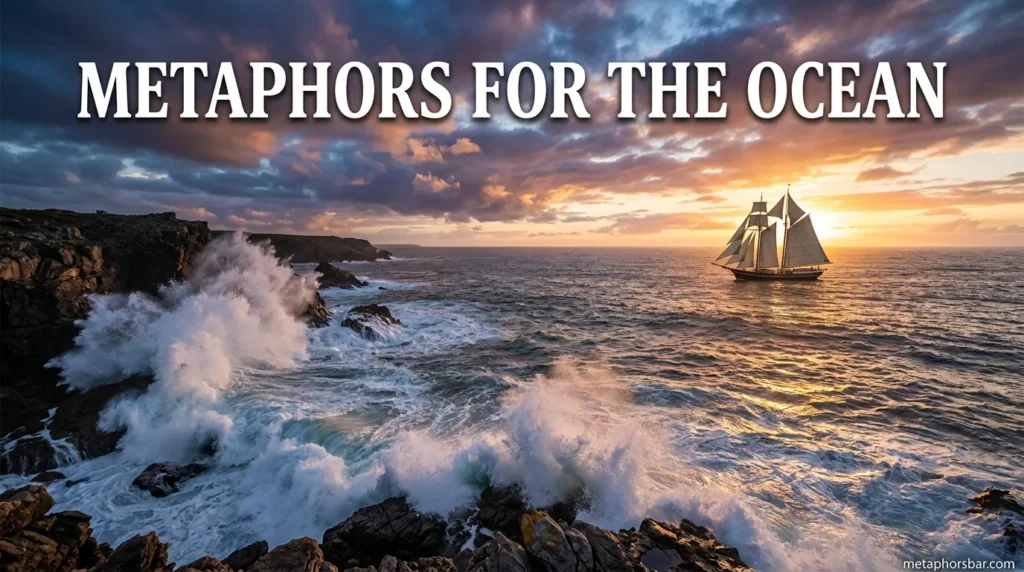
The ocean has a way of changing the air around it. Step closer, and you can smell salt on the wind. Listen, and you hear a low, endless breathing—waves rising, falling, returning like a thought that will not leave you alone. The horizon stretches so far it almost feels like a promise. Or a warning. Or both.
That is the beauty of the ocean: it is never just water. It is movement, memory, force, silence, and wonder all at once. That is why metaphors for the ocean are so powerful. They help us describe not only what the ocean looks like, but what it means—the depth of emotion, the scale of mystery, the pull of change, the calm after chaos.
In writing, poetry, storytelling, journaling, and even everyday conversation, ocean metaphors can turn a simple description into something vast and unforgettable. They make language feel alive, like a tide moving in and out of the shore.
Why Metaphors for the Ocean Matter in Writing and Expression
The ocean is one of the richest symbols in language. It can represent freedom, danger, peace, loneliness, abundance, and the unknown. Because it holds so many meanings, it works beautifully in metaphor.
Using metaphors for the ocean can help you:
- create vivid imagery that stays in the reader’s mind
- express feelings that are hard to name directly
- add depth and atmosphere to stories, poems, and captions
- connect human emotion with something universal and timeless
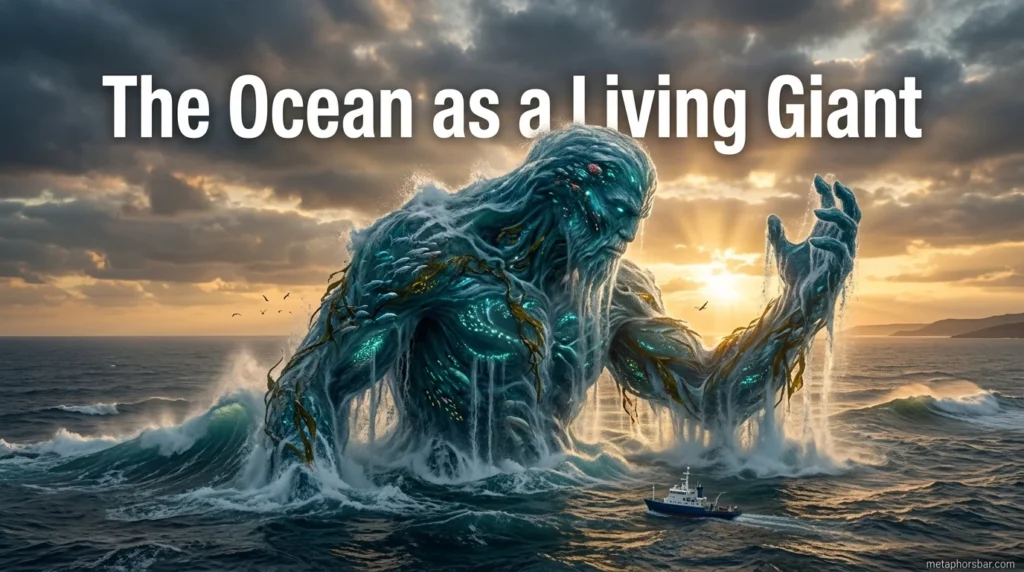
A plain sentence says, “The ocean was beautiful.” A metaphor says, “The ocean was a breathing giant, whispering secrets to the shore.” One describes. The other transports.
The Ocean as a Living Giant
Meaning and Explanation
This metaphor presents the ocean as something enormous, powerful, and alive. It emphasizes scale, movement, and presence. The sea is not passive here—it feels like a being with a will of its own.
This metaphor works especially well when you want to show awe, respect, or even fear. The ocean can feel protective one moment and overwhelming the next, much like a giant whose mood is hard to predict.
Example Sentence or Scenario
The ocean rose and fell like a living giant, steady in its breathing, ancient in its power.
Imagine standing on a cliff above the water. The waves crash below, and each one seems to carry a force older than memory. You do not simply look at the ocean—you feel watched by it.
Alternative Ways to Express It
- the ocean as a sleeping titan
- the sea as a breathing beast
- the waters as a mighty presence
- the waves as a giant’s heartbeat
Sensory or Emotional Details
This metaphor carries the roar of waves, the tremble of the ground, the vast blue body of water stretching beyond sight. Emotionally, it can feel humbling, thrilling, or slightly intimidating. It reminds us that the ocean is larger than our language can contain.
Mini Storytelling Touch
A fisherman once told his daughter that the sea was like a giant who never stopped dreaming. When she was young, she laughed at that. Years later, after a storm pulled the shoreline into chaos, she stood by the water and understood. The ocean had not become angry, exactly. It had simply reminded her that it was never small, never tame, never still.
Cultural Reference
Many cultures have treated the ocean as a living force—sometimes divine, sometimes dangerous, sometimes sacred. Myths of sea gods, sea monsters, and ocean spirits all come from the same human instinct: to describe the sea as something alive because it feels too powerful to be ordinary.
The Ocean as a Mirror of Emotion
Meaning and Explanation
This metaphor sees the ocean as reflecting the inner life of a person. Calm water can suggest peace, while stormy water can suggest anger, grief, confusion, or turmoil. The ocean becomes an emotional landscape, shifting with the heart.
This is especially useful in poetry, fiction, and reflective writing. It lets the sea stand in for feelings that may be too complicated to explain directly.
Example Sentence or Scenario
Her mood was like the ocean—quiet one hour, storm-lashed the next, with depths no one could fully see.
This can describe a grieving person, someone in love, or anyone whose emotions run deep beneath the surface. The ocean mirrors the human experience of visible change hiding hidden currents.
Alternative Ways to Express It
- the sea as a heart made visible
- water as a map of feeling
- waves as emotions in motion
- the ocean as a shifting soul
Sensory or Emotional Details
This image brings in silver light on water, dark swells under clouds, the rhythm of tides. Emotionally, it carries tenderness, complexity, and depth. It reminds readers that feelings are rarely flat; they move, return, and transform like the sea itself.
Literary Reference
Writers from many traditions have used the sea to reflect emotional states. In stories and poems, the ocean often becomes a second heart—one that beats in waves instead of blood. That is why it feels so natural in love poems, grief writing, and moments of self-discovery.
Mini Storytelling Touch
A woman who had stopped writing after heartbreak once sat on a beach at dusk. She watched the waves come and go, each one leaving a line in the sand before fading back into the dark. “That,” she later wrote, “is what healing feels like.” The ocean had not fixed her. It had simply given her a shape for what she already felt.
The Ocean as an Endless Archive of Secrets
Meaning and Explanation
This metaphor describes the ocean as a keeper of mysteries, memories, and hidden truths. Since much of the ocean remains unexplored, it naturally suggests depth, secrecy, and the unknown. What lies beneath the surface is often more mysterious than what can be seen above it.
This metaphor works well when talking about memory, history, hidden feelings, or things left unsaid.
Example Sentence or Scenario
The ocean was an endless archive of secrets, storing storms, shipwrecks, and stories no one had yet learned to tell.
You might use this in a story about lost objects, family history, forgotten love, or the passage of time. The ocean becomes not only a place, but a keeper of everything we cannot fully recover.
Alternative Ways to Express It
- the sea as a vault of memory
- the deep as a hidden library
- the waters as a chest of stories
- the ocean as a locked journal
Sensory or Emotional Details
This metaphor brings in darkness below the surface, the hush of deep water, the weight of things unseen. Emotionally, it can feel mysterious, solemn, or even sacred. It invites curiosity and respect.
Real-Life Example
Think about how people often return to the sea when they are trying to think clearly. There is something about standing before such a large unknown that makes our own secrets seem easier to face. The ocean does not answer directly, but it makes room for the questions.
Mini Storytelling Touch
An old coastal museum once displayed pieces of shipwreck wood, rusted keys, and faded maps. A child asked how so much could be lost in one place. The guide smiled and said, “The ocean keeps what the world forgets.” That sentence stayed with the child for years. The sea, after all, is not just water. It is memory with a pulse.
How to Choose the Right Metaphor for the Ocean
Different metaphors emphasize different parts of the sea’s character.
Use the ocean as a living giant when you want to express power, scale, awe, or danger. Use the ocean as a mirror of emotion when you want to reveal inner feelings, mood, or change, Use the ocean as an endless archive of secrets when you want to express mystery, memory, or hidden truth.
The best metaphor is the one that matches the feeling you want your reader to experience. The ocean is never only one thing, and your language does not have to be either.
Interactive Exercises: Practice Creating Your Own Ocean Metaphors
Exercise 1: Describe the Ocean Through Emotion
Choose one emotion: peace, fear, grief, hope, love, loneliness.
Finish this sentence:
“The ocean feels like ______ because ______.”
Example: “The ocean feels like patience because it waits, returns, and keeps moving even when no one is watching.”
Exercise 2: Sensory Mapping
Write five words connected to the ocean:
- one sound
- one color
- one texture
- one movement
- one mood
Then turn them into a metaphor.
Example: The ocean was the color of old glass, sounded like a low drum, felt like a cold hand on the skin, moved like a thought, and carried the mood of a secret.
Exercise 3: Story Starter
Begin a short paragraph with:
“The ocean was like…”
Let the image shape the tone. You can make it calm, haunting, romantic, or powerful.
Exercise 4: Social Media Caption Practice
Try turning an ocean metaphor into a caption or quote.
Examples:
- “I carry the ocean in my silence.”
- “The sea remembers what the shore forgets.”
- “Some feelings move like tides.”
Bonus Tips for Using Ocean Metaphors in Writing, Social Media, and Daily Life
In writing
Ocean metaphors are especially effective in poetry, fiction, memoir, and reflective essays. They can set mood fast and make a scene feel larger than life.
On social media
Short ocean metaphors work beautifully for beach photos, sunset posts, travel updates, or emotional reflections. A line like “Lost in the tide of my thoughts” can feel both simple and memorable.
In daily conversation
Metaphors can make your speech more vivid and expressive. Instead of saying “I have a lot on my mind,” you might say “My thoughts feel like waves tonight.”
In journaling
If you are processing emotions, the ocean can be a helpful symbol. Writing about your feelings as tides, currents, or depths can give you distance and clarity.
Avoid overfilling the page
One strong ocean image is often enough. Too many competing comparisons can muddy the water. Let the metaphor breathe.
FAQs
1. What is a metaphor for the ocean?
A metaphor for the ocean is a figurative comparison that describes the sea by relating it to something else, like a giant, a mirror, or an archive of secrets.
2. Why are ocean metaphors so popular?
Because the ocean is vast, powerful, and symbolic. It can represent emotion, mystery, freedom, and depth in a way that feels universal.
3. Can ocean metaphors be emotional?
Yes. The ocean can express peace, grief, longing, hope, fear, or transformation depending on the image you choose.
4. What is a simple ocean metaphor?
A simple example is: The ocean is a living giant. It is easy to picture and full of energy.
5. How do I create my own ocean metaphor?
Think about how the ocean feels to you, then compare it to something with a similar movement, mood, or emotional depth.
6. Are ocean metaphors only for poetry?
No. They also work in stories, essays, captions, speeches, journaling, and everyday conversation.
7. What makes a strong ocean metaphor?
A strong metaphor is vivid, emotionally fitting, and specific enough to help the reader see or feel the sea in a new way.
Conclusion
The ocean is too wide for a single meaning and too deep for a single sentence. It can be fierce and gentle, secret and revealing, comforting and terrifying. That is exactly why metaphors matter—they help us approach what feels too large to name.
Whether you see the ocean as a living giant, a mirror of emotion, or an endless archive of secrets, each metaphor opens a different window into its meaning. And perhaps that is the real power of the sea in language: it reminds us that depth is not something to fear, but something to explore.