
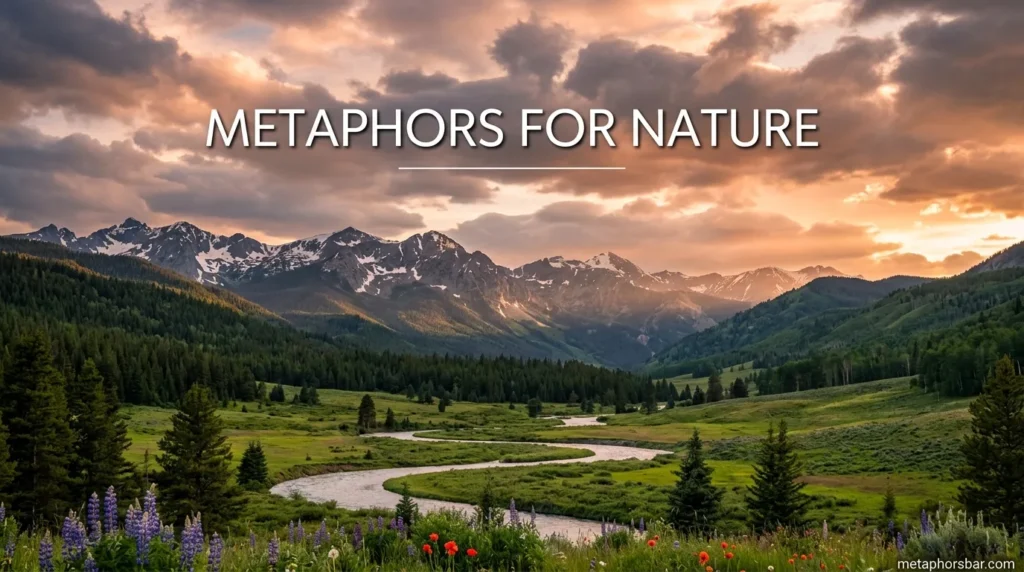
The forest didn’t feel silent—it felt awake.
Wind moved through the trees like a whispered conversation, bending branches into slow, graceful bows. Somewhere, water slipped over stones in a rhythm that sounded older than language itself. Sunlight filtered through leaves in broken gold patterns, as if the sky had spilled paint across the earth. Standing there, it was impossible to believe nature was just a “place.” It felt like something alive, breathing, watching, remembering.
Nature has always resisted simple description.
It is too vast, too layered, too emotionally rich to be captured by plain words alone. That is why writers turn to metaphors for nature—to translate forests, rivers, mountains, storms, and skies into living imagery that readers can feel, not just understand.
A forest might become a cathedral. A river might become a silver thread. A storm might become a roaring beast across the sky. Through metaphor, nature stops being scenery and becomes a presence.
Whether you are writing poetry, fiction, travel stories, captions, or reflective essays, metaphors for nature allow you to bring the natural world to life in powerful and unforgettable ways.
Metaphors for Nature: Why Natural Imagery Matters in Writing
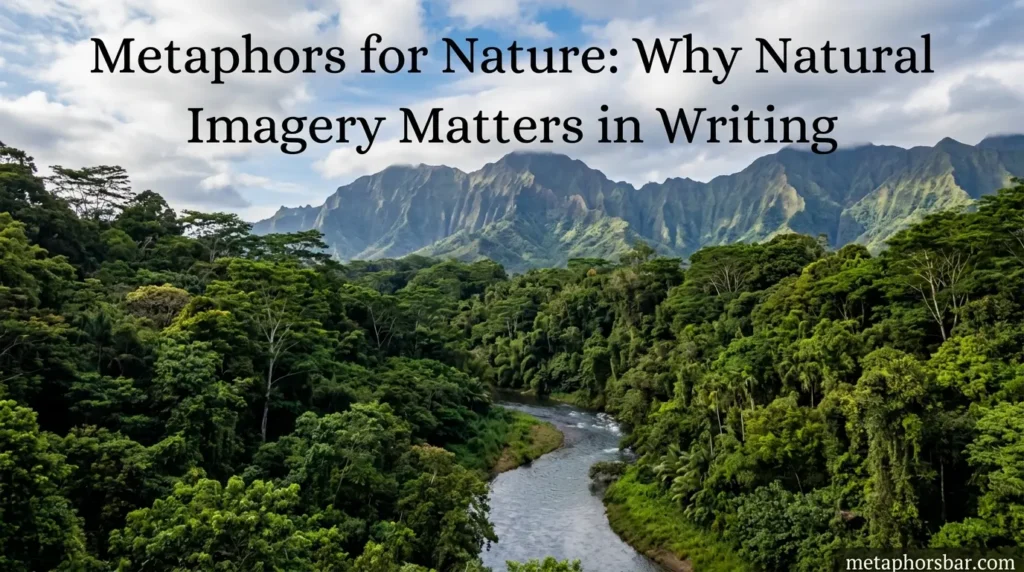
The emotional meaning behind nature metaphors
Nature is never just “background.” It often represents:
- life and growth
- change and transformation
- peace and stillness
- chaos and power
- mystery and depth
- healing and renewal
Metaphors help reveal these emotional layers by connecting natural elements to human experience.
Why readers connect with nature imagery
People instinctively respond to nature because they have experienced it:
- rain on their skin
- wind through open fields
- forests at dusk
- ocean waves crashing
- mountains rising in silence
These shared sensory memories make nature metaphors instantly powerful and relatable.
Compare:
- “The forest was beautiful.”
- “The forest stood like an ancient cathedral carved from green silence.”
The second version creates emotion, scale, and atmosphere.
Powerful Metaphors for Nature With Meanings and Examples
1. Nature is a living cathedral
Meaning and explanation
This metaphor emphasizes sacredness, awe, and quiet majesty. A cathedral is grand, echoing, and spiritual—just like forests, mountains, and natural landscapes often feel.
It works especially well for describing forests, mountains, and untouched wilderness.
Example sentence or scenario
“The forest stretched endlessly before them, a living cathedral where sunlight filtered through leaves like stained glass.”
Alternative ways to express it
- nature felt sacred and still
- the forest became a temple of green light
- mountains stood like silent guardians
- the earth whispered like a place of worship
Optional sensory or emotional details
Imagine:
- filtered sunlight through trees
- soft echoes of wind
- cool air filled with pine scent
- the feeling of being small yet peaceful
Mini storytelling touch
Many travelers describe entering deep forests or mountain valleys as stepping into something spiritual. Long before cities existed, humans often saw nature as sacred space—places where silence itself felt meaningful.
2. Nature is a breathing canvas
Meaning and explanation
This metaphor highlights constant movement, color, and change. Unlike a static painting, nature shifts with seasons, weather, and light.
It is perfect for describing landscapes that feel alive and ever-changing.
Example sentence or scenario
“At sunrise, the valley became a breathing canvas of gold, green, and mist.”
Alternative ways to express it
- the world painted itself anew each moment
- nature shifted like living artwork
- colors moved across the land
- the earth changed its brushstrokes constantly
Optional sensory or emotional details
Think of:
- shifting sunlight
- moving clouds
- changing seasons
- blooming flowers
- mist rolling across hills
Real-life example
Photographers often talk about “chasing light” because landscapes are never fixed. The same mountain looks entirely different in morning, noon, and sunset—just like a canvas being repainted continuously.
3. Nature is an ancient storyteller
Meaning and explanation
This metaphor emphasizes history, memory, and timelessness. Rivers carve valleys like written sentences. Trees hold decades in their rings. Mountains stand as silent witnesses.
Nature becomes a storyteller that speaks without words.
Example sentence or scenario
“The river curved through the land like an ancient storyteller tracing forgotten histories in water.”
Alternative ways to express it
- the earth remembers everything
- winds carried stories through valleys
- mountains kept silent records of time
- rivers whispered tales to the stones
Optional sensory or emotional details
Imagine:
- flowing water over rocks
- rustling leaves like whispers
- ancient trees with deep roots
- echoes in canyons
Literary or cultural reference
Many cultures treat nature as a keeper of memory—oral traditions often describe mountains, rivers, and forests as beings that “remember” human history across generations.
Creative Ways to Use Nature Metaphors in Writing
In poetry and lyrical writing
Nature metaphors create emotional depth and rhythm.
Examples:
- “The wind wrote poetry across the fields.”
- “The sky folded itself into shades of quiet blue.”
- “Rain stitched silver threads through the earth.”
These lines transform scenery into emotion.
In storytelling and fiction
Writers use nature metaphors to build atmosphere and mood.
Examples:
- “The desert stretched like a forgotten memory.”
- “The ocean breathed like a restless giant.”
- “The forest closed around them like a green secret.”
These comparisons make settings feel alive and meaningful.
In travel writing and personal reflection
Nature metaphors help express awe and emotional experience.
Examples:
- “The mountains felt like sleeping giants under the sky.”
- “The lake mirrored the world like a second reality.”
- “The sunrise poured hope across the horizon.”
These expressions turn travel into emotional storytelling.
Interactive Exercises for Practicing Nature Metaphors
Exercise 1: Compare nature to something unexpected
Choose one:
- ocean
- forest
- sky
- desert
- mountain
- river
Now compare it to:
- music
- memory
- architecture
- language
- emotion
- time
Example: “The forest spoke like a language only silence could understand.”
Exercise 2: Rewrite simple nature descriptions
Take plain sentences:
- “The forest was quiet.”
- “The river was flowing.”
- “The sky was beautiful.”
Rewrite them metaphorically:
- “The forest held its breath like a sleeping giant.”
- “The river carried time in its hands.”
- “The sky unfolded like a painted dream.”
Exercise 3: Describe a nature memory creatively
Think about:
Now describe it using metaphor.
Example: “The beach felt like a page where waves kept erasing and rewriting stories in sand.”
Bonus Tips for Using Nature Metaphors Effectively
Match the metaphor to the natural mood
Different nature images create different emotions:
- forest → mystery or peace
- ocean → depth or emotion
- mountains → strength or stillness
- sky → freedom or imagination
- storm → chaos or change
Choose based on emotional tone.
Use sensory richness
Strong nature metaphors include:
- sound (wind, rain, waves)
- sight (light, color, shadow)
- smell (earth, pine, ocean air)
- touch (wind, cold, heat)
This makes imagery immersive.
Keep metaphors grounded in clarity
Avoid overcomplicating natural imagery.
Instead of: “The forest was a quantum cathedral of temporal green echoes.”
Try: “The forest stood like a cathedral of green silence.”
Let nature reflect emotion
Nature metaphors are strongest when they mirror human feeling:
- calm → still lake
- confusion → tangled forest
- hope → sunrise
- sadness → falling rain
More Metaphors for Nature You Can Use
Nature is a green heartbeat
Perfect for life and vitality.
Nature is a book written in wind and stone
Ideal for storytelling and memory.
Nature is a slow-moving symphony
Great for harmony and rhythm.
Nature is a painter who never repeats a canvas
Excellent for change and variety.
Nature is a sleeping giant breathing in colors
Powerful for stillness and scale.
FAQs About Metaphors for Nature
1. What is a metaphor for nature?
A metaphor for nature is a symbolic comparison used to describe the natural world in a vivid, emotional, or imaginative way.
2. Why are nature metaphors important?
They help readers emotionally connect with landscapes, weather, and natural environments.
3. What are common metaphors for nature?
Examples include:
- nature as a cathedral
- nature as a canvas
- nature as a storyteller
- nature as a living being
4. Can nature metaphors describe emotions?
Yes. Nature is often used to reflect human feelings like peace, chaos, or renewal.
5. Are nature metaphors used in poetry?
Very often. Nature is one of the most common poetic themes.
6. How do I create original nature metaphors?
Observe nature closely, then compare it to human experiences like memory, music, or emotion.
7. Can nature metaphors be used in travel writing?
Absolutely. They help transform landscapes into emotional experiences.
Conclusion
Nature is never just scenery. It is movement, memory, silence, and story all at once. A forest is not only trees—it is a living cathedral of green light. A river is not only water—it is an ancient storyteller carving its history into the land. The sky is not only above us—it is a breathing canvas that changes with every passing moment.
That is why metaphors for nature are so powerful. They allow language to grow beyond description into experience. They help readers not only see the world, but feel it—its silence, its energy, its beauty, and its constant transformation.
Whether you are writing poetry, stories, travel reflections, or everyday descriptions, nature metaphors can bring depth, emotion, and wonder into your words. Because in the end, nature itself is already poetry—it simply waits for language to echo what it has always been saying.