
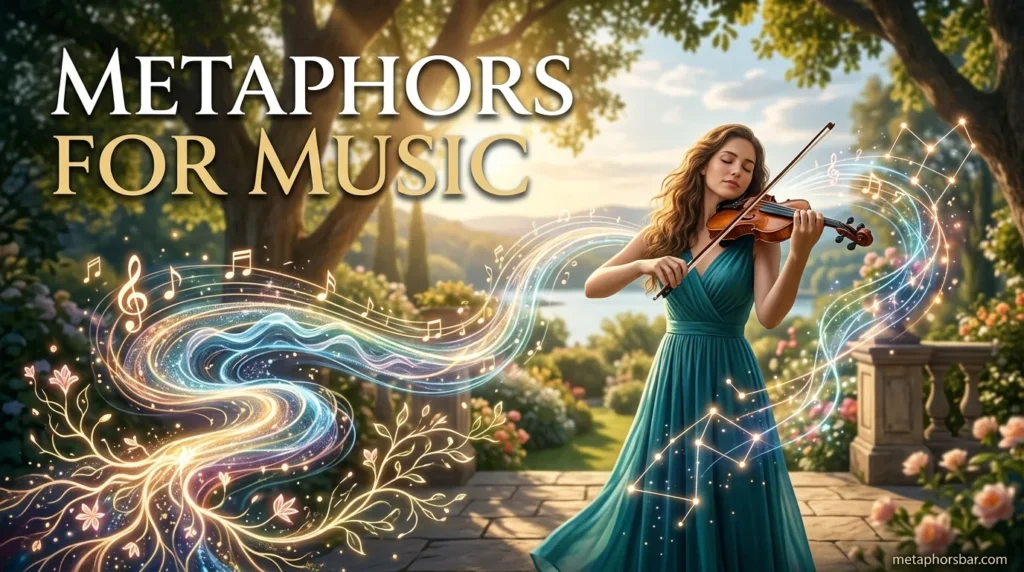
The first note didn’t just play—it arrived.
It slipped through the room like a thin ribbon of light, brushing against silence until silence gave way. The bass followed, steady and grounding, like footsteps on an empty street at midnight. Then the melody unfolded, soft at first, then rising, curling, spilling into the air like something alive remembering how to breathe.
Music never feels like “just sound.”
It feels like weather moving through emotion. It feels like memory finding rhythm, It feels like invisible stories being told inside the body.
That is why music is so often described through metaphors.
A song becomes a river. A melody becomes a flame. Rhythm becomes a heartbeat. Through metaphor, music transforms from something we hear into something we experience physically and emotionally.
Whether you are writing poetry, fiction, reviews, captions, or creative essays, metaphors for music help you translate sound into imagery readers can feel in their bones.
Metaphors for Music: Why Sound Imagery Matters in Writing
The emotional meaning behind music metaphors
Music is never just technical sound—it is emotional language. It often represents:
- joy and celebration
- sadness and longing
- memory and nostalgia
- love and connection
- chaos and energy
- peace and reflection
Metaphors help translate those invisible emotions into vivid experience.
Why readers connect with music imagery
Even people with no musical training understand music emotionally:
- a song that reminds them of someone
- a rhythm that makes them move
- a melody that brings tears unexpectedly
Compare:
- “The song was beautiful.”
- “The song flowed through the room like warm light through stained glass.”
The second version creates atmosphere, emotion, and sensory depth.
Powerful Metaphors for Music With Meanings and Examples
1. Music is a flowing river of sound
Meaning and explanation
This metaphor emphasizes movement, continuity, and emotional flow. Like a river, music never stays still—it travels, shifts, and carries listeners along its current.
It is especially powerful for melodies and emotional songs.
Example sentence or scenario
“The piano piece flowed through the hall like a river carving its way through silence.”
Alternative ways to express it
- the melody carried everything downstream
- sound moved like water through space
- music poured gently through the air
- rhythm drifted like a flowing stream
Optional sensory or emotional details
Imagine:
- soft waves of sound
- emotional currents rising and falling
- calm, reflective movement
- feeling carried without resistance
Mini storytelling touch
Listeners often describe emotional songs as something they “get lost in.” Like water pulling a drifting leaf, music can carry thoughts away from the present moment into memory or imagination.
2. Music is a fire that burns in rhythm
Meaning and explanation
This metaphor highlights energy, intensity, and passion. Fire symbolizes heat and transformation, just as music can ignite emotion and movement.
It is perfect for energetic genres like rock, jazz, or dance music.
Example sentence or scenario
“The drums struck like sparks, and soon the entire song became a fire that burned through the room.”
Alternative ways to express it
- rhythm ignited the atmosphere
- sound erupted like flame
- music danced like firelight in the dark
- energy blazed through the beat
Optional sensory or emotional details
Think of:
- pulsing heat
- fast movement
- glowing intensity
- bodies responding instinctively to rhythm
Real-life example
At concerts or festivals, people often describe feeling “lit up” or “on fire” with energy. The fire metaphor captures that shared emotional ignition between music and audience.
3. Music is a heartbeat of emotion
Meaning and explanation
This metaphor emphasizes rhythm, life, and emotional connection. The heartbeat is one of the most fundamental human rhythms, making it a powerful comparison for musical tempo and emotional grounding.
It works beautifully for intimate, emotional, or slow music.
Example sentence or scenario
“The soft bassline pulsed like a heartbeat beneath the singer’s voice.”
Alternative ways to express it
- rhythm matched the body’s pulse
- music throbbed like living emotion
- sound echoed human life itself
- melody breathed like a second heart
Optional sensory or emotional details
Readers may imagine:
- slow pulsing beats
- warmth in the chest
- synchronized breathing
- emotional intimacy and closeness
Literary or cultural reference
Many cultures connect drums with heartbeat rhythms because early humans used percussion to mimic life itself. Music often reflects this primal connection to being alive.
Creative Ways to Use Music Metaphors in Writing
In poetry and lyrical writing
Music metaphors create emotional rhythm even in words.
Examples:
- “Her voice was a lantern of sound in the dark.”
- “The guitar whispered like broken sunlight.”
- “Melodies stitched silence into something whole.”
These lines make sound visible and emotional.
In storytelling and fiction
Writers use music metaphors to build mood and character depth.
Examples:
- “The city hummed like a forgotten song.”
- “His laughter hit like a sudden drumbeat in quiet air.”
- “The room filled with music that felt like memory waking up.”
These comparisons make scenes more immersive.
In reviews and creative descriptions
Music writing often depends on metaphor to describe sound effectively.
Examples:
- “The track unfolds like a cinematic storm.”
- “The vocals float like smoke through a dim room.”
- “The chorus explodes like sunlight breaking clouds.”
These descriptions help readers “hear” the music.
Interactive Exercises for Practicing Music Metaphors
Exercise 1: Compare music to natural or physical forces
Choose one:
- river
- fire
- wind
- heartbeat
- lightning
- ocean
Now create a metaphor.
Example: “The violin sang like wind moving through tall grass at dusk.”
Exercise 2: Rewrite simple music descriptions
Take plain sentences:
- “The music was loud.”
- “The song was emotional.”
- “The rhythm was strong.”
Rewrite them metaphorically:
- “The music filled the room like rising storm clouds.”
- “The song broke open like a wound of memory.”
- “The rhythm struck like footsteps on stone.”
Exercise 3: Describe a song you love
Think about:
- a favorite track
- a concert memory
- background music in a moment
- a song tied to emotion
Now describe it metaphorically.
Example: “That song always feels like walking through a city made of light and echoes.”
Bonus Tips for Using Music Metaphors Effectively
Match metaphor to genre and mood
Different music needs different imagery:
- classical → river, air, architecture
- rock → fire, storm, explosion
- jazz → smoke, improvisation, conversation
- pop → brightness, color, light
Choose imagery that matches tone.
Use rhythm in your writing
Since music is rhythm, your sentences can reflect it:
- short, punchy lines for beats
- flowing sentences for melodies
- pauses for silence
This makes your writing feel musical.
Include sensory crossover
Strong music metaphors often connect:
- sound → touch (warm, sharp, soft)
- sound → sight (color, light)
- sound → movement (flow, pulse, dance)
This creates immersive description.
Avoid overloading imagery
One strong metaphor is more powerful than several competing ones.
Instead of: “The music was fire, water, wind, and lightning.”
Try: “The music moved through the room like a storm breaking open the sky.”
More Metaphors for Music You Can Use
Music is painted light in the air
Perfect for visual and emotional sound.
Music is a language without words
Ideal for universal emotional expression.
Music is smoke rising from memory
Great for nostalgia and reflection.
Music is a thread stitching silence together
Beautiful for harmony and structure.
Music is a storm that knows your name
Powerful for emotional intensity.
FAQs About Metaphors for Music
1. What is a metaphor for music?
A metaphor for music is a symbolic comparison used to describe sound, rhythm, or melody in vivid, imaginative ways.
2. Why are music metaphors useful?
They help translate auditory experiences into visual and emotional language.
3. What are common metaphors for music?
Examples include:
- music as a river
- music as fire
- music as a heartbeat
- music as wind or waves
4. Can music metaphors describe emotions?
Yes. Music is often used to represent emotional states like joy, sadness, or nostalgia.
5. Are music metaphors used in poetry?
Very often. Music and poetry share rhythm and emotional expression.
6. How do I create original music metaphors?
Think about how music makes you feel physically and emotionally, then compare it to movement, nature, or sensory experiences.
7. Can music metaphors be used in reviews?
Yes. They are essential for describing sound in music journalism and creative writing.
Conclusion
Music is invisible, yet it moves through us like something tangible. It flows like a river, burns like fire, and beats like a heart inside the silence. It is memory, motion, emotion, and rhythm woven together in sound.
That is why metaphors for music are so powerful. They allow us to describe what cannot be seen but deeply felt. They turn sound into imagery, rhythm into emotion, and melody into story.
Whether you are writing poetry, fiction, music reviews, or personal reflections, music metaphors help you capture the invisible language of feeling. Because in the end, music is not just heard—it is lived, carried, and remembered long after the final note fades into silence.