

The stomach answered before the mind did.
A faint tightening. A hollow echo somewhere beneath the ribs. The world outside continued as usual—voices, footsteps, distant traffic—but inside, something quieter grew louder. Not pain exactly. More like a question that refused to go away.
When hunger arrives, it rarely asks politely.
It grows, it pulls attention inward, it rewrites focus. And that is why writers often reach for metaphors for hunger—because hunger is never just physical. It can be desire, ambition, emotional longing, or even spiritual emptiness.
A metaphor turns that private sensation into something visible: a beast waking in the body, a fire in the stomach, a silence that demands filling. It helps readers feel need, not just understand it.
Whether you are writing fiction, poetry, essays, or expressive captions, metaphors for hunger allow you to describe both physical craving and emotional longing in powerful, relatable ways.
Metaphors for Hunger: Why Hunger Imagery Matters in Writing
The emotional layers behind hunger
Hunger can mean many things at once:
- physical need for food
- emotional emptiness
- desire for success
- craving for love or attention
- ambition that refuses to rest
- longing that feels endless
Because of this, hunger is one of the most flexible emotional metaphors in language.
Why readers connect with hunger metaphors
Everyone has experienced hunger in some form:
- missing a meal
- wanting something deeply
- feeling emotionally unfulfilled
That shared experience makes hunger metaphors instantly relatable.
Compare:
- “He was hungry.”
- “Hunger growled inside him like an animal pacing behind ribs.”
The second version gives hunger personality, motion, and emotional weight.
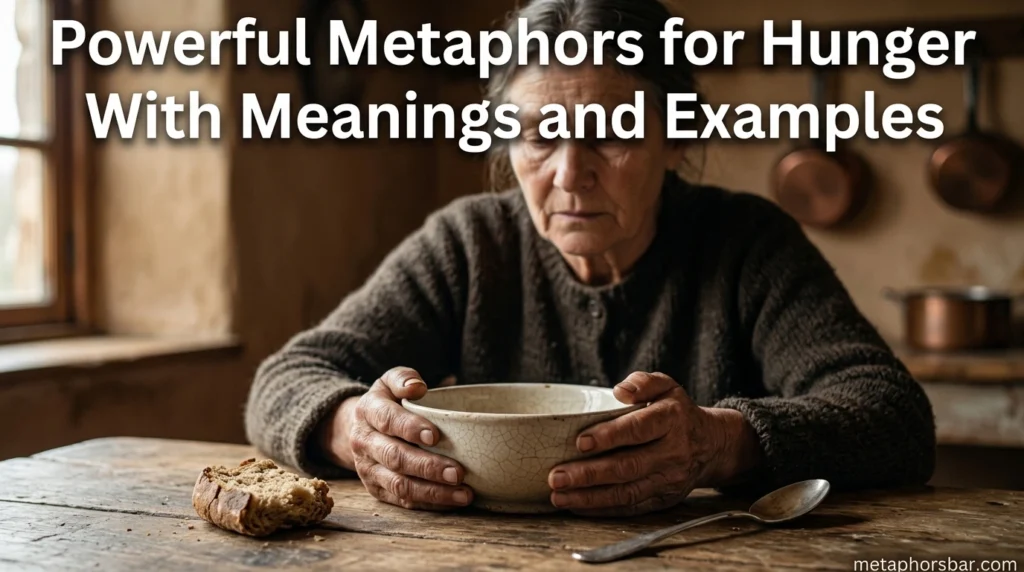
Powerful Metaphors for Hunger With Meanings and Examples
1. Hunger is a wild animal inside the body
Meaning and explanation
This metaphor emphasizes intensity, urgency, and instinct. Hunger is not calm—it feels alive, restless, and demanding. Comparing it to an animal suggests it cannot be ignored or reasoned with easily.
This works well for strong physical hunger or deep emotional craving.
Example sentence or scenario
“Hunger prowled inside him like a restless animal, pacing every corner of his thoughts.”
Alternative ways to express it
- hunger clawed at his focus
- need paced behind his ribs
- craving growled beneath thought
- emptiness hunted for relief inside him
Optional sensory and emotional details
Imagine:
- tightening stomach muscles
- restless shifting
- sharp awareness of absence
- mental distraction that grows louder
Mini storytelling touch
A traveler walking through a long desert road once described hunger not as weakness, but as something “walking beside him.” Each step felt like the animal inside him grew more impatient. By the time he reached the village, food wasn’t just relief—it felt like taming something wild.
2. Hunger is an empty room echoing inside
Meaning and explanation
This metaphor focuses on absence, space, and emotional emptiness. An empty room is not just “nothing”—it is a space that amplifies sound, loneliness, and silence. Hunger, especially emotional hunger, often feels like internal emptiness.
This metaphor is powerful for describing longing, sadness, or unmet desire.
Example sentence or scenario
“Her hunger wasn’t loud—it was an empty room inside her, echoing every thought she couldn’t fill.”
Alternative ways to express it
- hollow space within the chest
- silence that kept expanding
- inner vacancy waiting for meaning
- emptiness that echoed softly
Optional sensory and emotional details
This image brings:
- quiet loneliness
- emotional distance
- slow awareness of absence
- stillness that feels heavy
Literary or real-life reference
Many writers describe grief, loneliness, or longing using emptiness imagery because hunger and emotional absence often feel similar: both are shaped by what is missing rather than what is present.
3. Hunger is a fire that consumes from within
Meaning and explanation
This metaphor highlights intensity, urgency, and transformation. Fire can warm, but uncontrolled fire consumes. Hunger, especially desire or ambition, can feel like an internal burn that refuses to fade until it is satisfied.
This works well for ambition, passion, or strong craving.
Example sentence or scenario
“Hunger burned inside her like a fire that turned every distraction into ash.”
Alternative ways to express it
- desire smoldered beneath focus
- craving burned quietly but constantly
- need flickered like flame under skin
- ambition lit a restless fire inside
Optional sensory and emotional details
Readers may imagine:
- warmth spreading through chest
- restless energy
- urgency in thoughts
- inability to ignore internal drive
Mini storytelling touch
An athlete once described pre-competition hunger not as fear, but as “heat that wouldn’t settle.” That fire pushed him to train harder, move faster, and keep going when others stopped. Hunger, in this sense, becomes fuel.
Creative Ways to Use Hunger Metaphors in Writing
In poetry and expressive writing
Hunger metaphors create emotional depth beyond literal food imagery.
Examples:
- “His longing was a table set for someone who never arrived.”
- “She carried hunger like a second heartbeat.”
- “Desire grew in her like roots searching for water.”
These lines blend physical and emotional meaning.
In storytelling and fiction
Writers use hunger metaphors to show struggle, ambition, or emotional void.
Examples:
- “The city made him hungry—not for food, but for becoming someone.”
- “She moved through life with an emptiness that asked questions no one answered.”
- “His ambition paced inside him like a trapped animal.”
These metaphors deepen character motivation.
In motivational or reflective writing
Hunger can symbolize ambition and drive.
Examples:
- “Stay hungry for growth.”
- “Let your hunger shape your direction.”
- “Use emptiness as fuel, not defeat.”
These phrases are often used to inspire persistence.
Interactive Exercises for Practicing Hunger Metaphors
Exercise 1: Transform physical hunger into imagery
Take the sentence:
- “I am hungry.”
Now rewrite it using metaphor:
- “Hunger moved through me like a restless tide.”
- “My stomach spoke in quiet storms.”
- “Need paced inside me like a shadow that wouldn’t sit still.”
Try multiple versions.
Exercise 2: Turn emotional longing into metaphor
Think of:
- wanting success
- missing someone
- craving change
- feeling unfulfilled
Now describe it.
Example: “My longing felt like an empty table set for a guest who never arrives.”
Exercise 3: Choose a metaphor and expand it
Pick one:
- animal
- fire
- empty room
- storm
- desert
Now write 3–4 sentences expanding it into a short scene.
Example (fire): “Hunger burned low at first, like a small coal beneath thought. Then it grew. It shaped decisions, pulled attention, demanded movement.”
Bonus Tips for Using Hunger Metaphors Effectively
Match metaphor to type of hunger
Different meanings require different imagery:
- physical hunger → animal, fire, stomach imagery
- emotional hunger → empty room, void, silence
- ambition hunger → flame, storm, rising energy
Balance intensity with clarity
Too many dramatic images can weaken impact. One strong metaphor is enough.
Instead of: “Hunger was a fire, animal, storm, and ocean.”
Try: “Hunger burned through him like a fire that refused to die.”
Use sensory detail to ground abstraction
Add:
- stomach tension
- dryness in mouth
- distraction in thoughts
- heaviness or urgency
This makes metaphors believable.
Avoid clichés unless reshaped
“Hunger like a wolf” is common—but you can refresh it:
“Hunger paced like a wolf that had forgotten how to rest.”
More Metaphors for Hunger You Can Use
Hunger is a clock ticking inside the stomach
Perfect for urgency and anticipation.
Hunger is a shadow that follows thought
Great for distraction and persistence.
Hunger is a drum beating beneath skin
Ideal for rhythm and physical awareness.
Hunger is a storm gathering in silence
Useful for growing intensity.
Hunger is an unfinished sentence in the body
Beautiful for emotional or intellectual longing.
FAQs About Metaphors for Hunger
1. What is a metaphor for hunger?
A metaphor for hunger is a figurative comparison that describes physical or emotional craving in vivid, imaginative language.
2. Why are hunger metaphors used in writing?
They help express need, desire, and longing in a way that feels emotional and relatable.
3. Can hunger metaphors describe emotions?
Yes. Hunger is often used to represent emotional emptiness, ambition, or desire.
4. What are common hunger metaphors?
Examples include:
- hunger as fire
- hunger as an animal
- hunger as emptiness
- hunger as a storm
5. Are hunger metaphors used in poetry?
Very often. They help express longing, desire, and emotional intensity.
6. How do I create original hunger metaphors?
Think about how hunger feels physically or emotionally, then compare it to forces like fire, nature, space, or movement.
7. Can hunger metaphors be used for ambition?
Yes. Many motivational writers use hunger to symbolize drive and success.
Conclusion
Hunger is never just about food. It is a signal of absence, desire, and movement toward something needed. It can growl like an animal, burn like a fire, or echo like an empty room waiting to be filled.
That is why metaphors for hunger are so powerful—they turn invisible need into something readers can see, feel, and understand deeply. They give shape to craving, whether physical, emotional, or symbolic.
In writing, hunger metaphors help us express not only what we lack, but what moves us forward. Because sometimes hunger is not just a void—it is the beginning of wanting more.