
The kitchen light was still on long after dinner was cleared away. A mug sat cooling near the sink. Someone laughed in the next room, someone else folded laundry without being asked, and a child’s voice drifted down the hallway asking one more question before bed. Nothing about the moment was dramatic, and yet it felt full—full of memory, habit, comfort, friction, love.
That is family.
Family relationships are among the most layered, intimate, and complicated parts of human life. They can feel tender or tense, steady or stormy, simple or beautifully impossible. Because of that, plain language often falls short. Metaphors help us describe what family means in deeper, more memorable ways. They turn love into roots, care into stitching, conflict into weather, and belonging into home.
Metaphors for family relationships matter because they help writers, speakers, and everyday people express the emotional architecture of family life. Whether you are writing a poem, a memoir, a social caption, a speech, or simply trying to put your feelings into words, the right metaphor can make those relationships feel visible and alive.
Metaphors for Family Relationships: Why Family Imagery Matters in Writing
The emotional power of family metaphors
Family is not just a group of people living under one roof. It is history, inheritance, memory, protection, conflict, and love all braided together. A metaphor gives shape to those invisible forces.
Family relationships can symbolize:
- belonging
- support
- identity
- tradition
- tension
- growth
- resilience
- memory
A strong metaphor can hold several of these meanings at once.
Why readers connect with family imagery
Most readers carry family experiences of their own, whether warm, complicated, missing, or mixed. That makes family metaphors instantly relatable. A familiar image can unlock an entire emotional world.
Compare:
- “Our family is close.”
- “Our family is a quilt stitched together by many hands.”
The second version adds texture, care, and history. It lets the reader feel closeness rather than just understand it.
Powerful Metaphors for Family Relationships With Meanings and Examples
1. Family is a quilt stitched from many hands
Meaning and explanation
This metaphor emphasizes warmth, care, and shared effort. A quilt is made from different pieces, often collected over time, and sewn together into something that provides comfort and protection. In the same way, family is made from individual personalities, habits, memories, and sacrifices that create one shared emotional covering.
This metaphor works especially well when describing a family’s togetherness, traditions, and the way different people contribute in their own ways.
Example sentence or scenario
“Our family felt like a quilt stitched from many hands, each one adding something necessary, even when we did not always agree on the pattern.”
Alternative ways to express it
You could also say:
- family is a patchwork of love
- family is a blanket of shared care
- our lives are sewn together by memory
- family is warmth pieced from different stories
Optional sensory or emotional details
This image brings in the softness of fabric, the smell of old clothes and freshly washed blankets, the sight of patterned patches, and the comforting weight of something warm laid over tired shoulders. Emotionally, it feels tender, imperfect, and lovingly made.
Mini storytelling touch
Many families have one object that becomes part of their emotional memory: a blanket passed down from a grandmother, a baby quilt made by an aunt, a throw blanket always found on the same sofa. It may be frayed, faded, or mismatched, but that only makes it more beloved. Like family, it is held together not by perfection but by care.
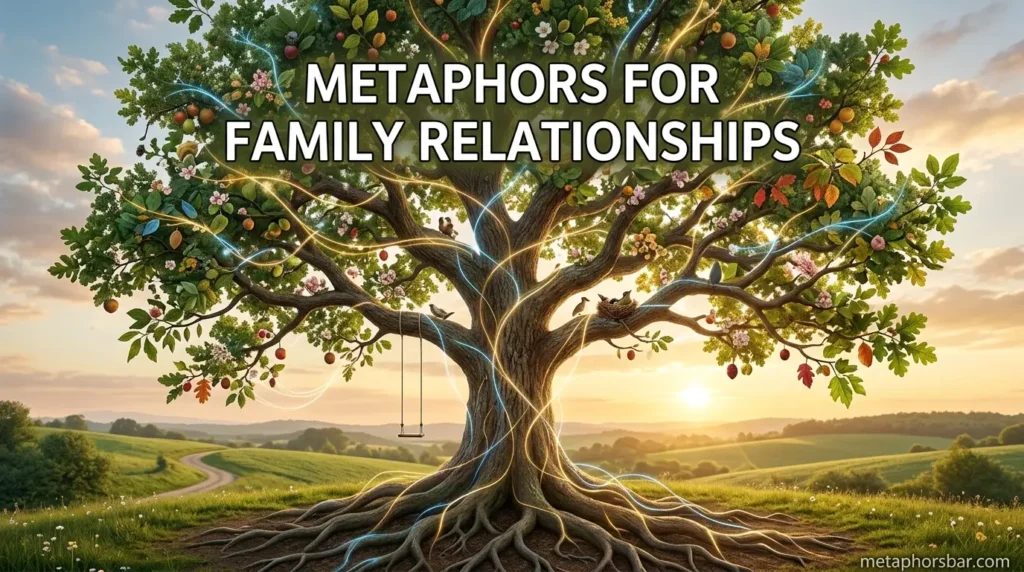
2. Family is a tree with deep roots and reaching branches
Meaning and explanation
This is one of the most enduring metaphors for family relationships because it captures ancestry, growth, and continuity. The roots symbolize heritage, origin, and the people who came before. The branches symbolize children, generations, and future possibilities. The trunk represents strength and support, the center that holds everything together.
This metaphor is especially useful when discussing family history, generational bonds, or resilience across time.
Example sentence or scenario
“Our family was like a tree with deep roots, weathering storms together while its branches kept reaching toward new seasons.”
Alternative ways to express it
You could also say:
- family is a living lineage
- our family grows from the same roots
- we are branches of the same tree
- family is rooted strength
Optional sensory or emotional details
This metaphor carries the smell of soil after rain, the rough texture of bark, the shade beneath wide branches, and the steady feeling of being grounded. It can feel ancestral, protective, and quietly majestic.
Literary or cultural reference
The tree of life appears in many cultures and traditions because trees naturally symbolize connection across time. Families, like trees, do not grow in straight lines. They twist, split, bend, and flourish in different directions while remaining part of the same living system.
3. Family is a house with many rooms
Meaning and explanation
This metaphor highlights individuality within unity. A house contains different rooms, each with its own purpose and atmosphere, just as each family member carries a different role, mood, or personality. Yet all the rooms belong to the same structure.
This metaphor is especially effective for describing family dynamics, privacy, closeness, and the emotional architecture of home.
Example sentence or scenario
“Our family was a house with many rooms—some bright with laughter, some quieter, some full of old arguments, but all of them part of the same home.”
Alternative ways to express it
You could also say:
- family is a home of many voices
- each of us is a room in the same house
- we live inside the same emotional walls
- family is a building of shared memories
Optional sensory or emotional details
This image includes the sound of creaking floorboards, the smell of cooking drifting from the kitchen, the softness of lamplight in a hallway, and the feeling of moving through different moods under one roof. It can feel warm, complex, lived-in, and deeply real.
Real-life example
Anyone who has lived in a busy household knows that each room can hold a different energy. The kitchen might be loud and communal, the bedroom quiet and private, the living room full of conversation, the hallway full of passing thoughts. That is exactly how family often feels: one structure, many emotional spaces.
Creative Ways to Use Metaphors for Family Relationships in Writing
In poetry and memoir writing
Family metaphors help you write with tenderness and nuance. They allow you to describe affection, conflict, memory, and belonging without sounding overly literal.
You might write:
- “My mother’s voice was the thread that mended our winters.”
- “My father was the beam holding the room together.”
- “Sibling love is a storm that always knows how to come home.”
These images make family feeling intimate and lasting.
In storytelling and fiction
Metaphors can reveal the hidden structure of family scenes. A family dinner may feel like a weather system, a wedding may feel like a circle reopening, a childhood home may feel like a body full of memory.
You might say:
- “The house breathed with old laughter.”
- “Their silence had grown roots.”
- “The family sat together like instruments in an unfinished song.”
These comparisons create atmosphere and emotional depth.
In social media captions and family posts
Metaphors can make a simple post feel heartfelt and memorable.
You could write:
- “Home is made of people, not walls.”
- “A family is a garden that survives every season.”
- “Rooted in love, growing through time.”
These phrases work well for Mother’s Day, Father’s Day, reunions, birthdays, and everyday appreciation.
Interactive Exercises for Practicing Family Metaphors
Exercise 1: Finish the sentence with an image
Try completing these prompts:
“My family is like a ______.” “Sibling relationships are like ______.” “Home feels like ______.” “Love in our family is like ______.”
You might choose images such as:
- quilt
- tree
- house
- river
- nest
- lighthouse
For example: “My family is like a tree whose roots hold even when the wind rises.”
Exercise 2: Turn a plain sentence into a metaphor
Take simple statements like:
- “My family supports me.”
- “We have different personalities.”
- “Home is important to me.”
Now rewrite them with metaphor:
- “My family is the floor beneath my feet when life feels unsteady.”
- “We are different rooms in the same house, each with its own light.”
- “Home is the place where my heart puts down its bags.”
Exercise 3: Describe a family memory through metaphor
Think of a memory: a holiday meal, a road trip, a difficult argument, a quiet evening, a shared celebration. Now describe it with one strong image.
For example: “That holiday dinner felt like a quilt stretched across generations, warm and a little uneven, but holding us all together.”
Bonus Tips for Using Metaphors for Family Relationships Effectively
Match the metaphor to the relationship
Different family bonds may call for different images. A nurturing parent-child relationship might fit a shelter or tree. Sibling relationships might feel like weather, dance, or a tug-of-war. Grandparents may feel like archives, roots, or old songs. Let the image reflect the bond honestly.
Use tenderness and complexity together
Family relationships are rarely simple. The strongest metaphors often hold both comfort and conflict, both closeness and distance. A house can have many rooms, not all of them tidy. A tree can grow through storms. A quilt can have patches from different hands and still be beautiful.
Add sensory detail
Family writing becomes more vivid when it includes:
- the smell of dinner
- the sound of overlapping voices
- the warmth of an old blanket
- the creak of a familiar staircase
- the light in a kitchen window at night
These details make the metaphor feel lived-in and true.
Avoid idealizing too much
Not every family is soft, safe, or peaceful. A useful metaphor can acknowledge strain, distance, grief, or healing without losing beauty. Honesty gives the imagery depth.
More Metaphors for Family Relationships You Can Use
Family is an orchestra
Each voice plays a different part, but together they create one shared sound.
Family is a river
It changes shape over time yet remains connected by motion and memory.
Family is a campfire
It gathers people, gives warmth, and needs tending to stay alive.
Family is a map
It shows where you come from and sometimes where you are still trying to go.
Family is an anchor
It can represent stability, grounding, and emotional support.
FAQs
1. What is a metaphor for family relationships?
A metaphor for family relationships is a creative comparison used to describe the emotional, social, and personal bonds within a family.
2. Why are family metaphors useful?
They help explain complex emotions like love, belonging, conflict, and memory in a vivid, relatable way.
3. What are common metaphors for family?
Popular examples include:
- family as a tree
- family as a quilt
- family as a house
- family as a river
- family as an orchestra
4. Can family metaphors describe both love and conflict?
Yes. Family metaphors are especially useful because they can hold both warmth and tension in the same image.
5. Are family metaphors good for poetry and memoir?
Absolutely. They add emotional depth and sensory richness to personal writing.
6. How do I create original family metaphors?
Think about what family feels like in practice—shared routines, histories, roles, and emotions—and compare those qualities to objects, landscapes, or systems with similar dynamics.
7. Can family metaphors be used in everyday conversation?
Yes. They can make messages, speeches, captions, and reflections feel more meaningful and expressive.
Conclusion
Family relationships are never just one thing. They are laughter in one room, silence in another, and memory everywhere. They are old stories retold at dinner, differences that somehow fit under the same roof, and love that can be messy, steady, and lifelong all at once.
That is why metaphors for family relationships are so valuable. They help us speak about belonging, history, support, and complexity in a language that feels human and alive. A family can be a quilt stitched from many hands, a tree with deep roots, a house full of rooms, or any number of images that carry the truth of shared life.
Whether you are writing poetry, family stories, captions, or reflections, these metaphors can help your words feel warmer, clearer, and more emotionally resonant. After all, family is not just something we describe. It is something we carry—like roots, like fabric, like a house full of light.