
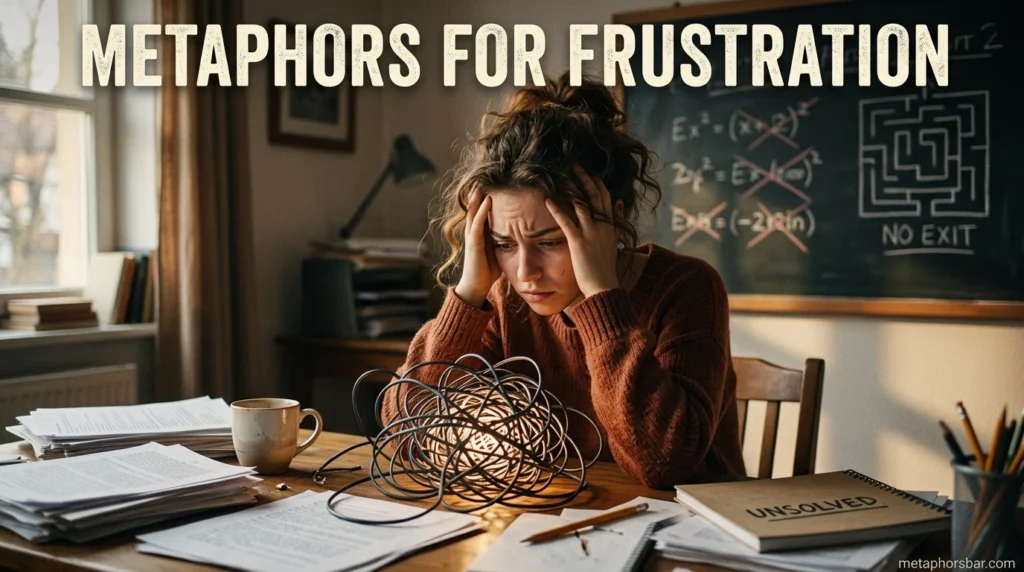
The pen stopped moving mid-sentence.
Not because the thought was gone—but because it refused to come out the right way. The cursor blinked like it was mocking the delay. Somewhere nearby, a clock ticked with exaggerated patience, each second stretching tighter than the last.
Frustration doesn’t always explode.
Sometimes it tightens. Sometimes it loops, Sometimes it sits in the chest like a knot that refuses to loosen no matter how many times you try to breathe around it.
That is why metaphors for frustration matter in writing. Frustration is not just irritation—it is blocked energy, delayed progress, misunderstood effort, and emotional pressure looking for release. A metaphor gives that invisible pressure a shape: a jammed door, a buzzing wire, a storm trapped in glass.
When you use metaphors for frustration, you turn a private emotional struggle into something readers can see, feel, and understand instantly.
Metaphors for Frustration: Why Emotional Pressure Needs Imagery in Writing
The layered emotion behind frustration
Frustration often includes:
- impatience
- confusion
- anger
- helplessness
- mental overload
- blocked progress
Because it is such a mixed emotion, literal description often feels too weak.
Why readers connect with frustration metaphors
Everyone has experienced:
- technology not working
- plans failing
- being misunderstood
- trying repeatedly without success
That shared experience makes frustration metaphors instantly relatable.
Compare:
- “She felt frustrated.”
- “Frustration tightened around her thoughts like a rope pulled too quickly from both ends.”
The second version creates tension you can almost feel physically.
Powerful Metaphors for Frustration With Meanings and Examples
1. Frustration is a knot tightening inside the mind
Meaning and explanation
This metaphor highlights entanglement, restriction, and increasing pressure. A knot becomes tighter the more you struggle, symbolizing how frustration often worsens when effort increases without resolution.
It is especially effective for mental overload or repeated failure.
Example sentence or scenario
“Every attempt only made it worse—frustration twisted inside her thoughts like a knot tightening with every pull.”
Alternative ways to express it
- thoughts tangled into a tightening loop
- emotion knotted under pressure
- mind tied in impossible knots
- frustration tightened like a clenched rope
Optional sensory and emotional details
This metaphor can include:
- mental heaviness
- tightening chest sensation
- repetitive thinking loops
- inability to “untangle” solutions
Mini storytelling touch
A student revising the same problem for hours keeps erasing and rewriting, each attempt making the answer feel further away. The more she tries, the more tangled it becomes—until the problem is no longer just academic, but emotional. That is frustration as a knot: effort that tightens instead of freeing.
2. Frustration is a storm trapped inside a glass jar
Meaning and explanation
This metaphor emphasizes intensity with no release. A storm wants to move, crash, and express itself—but inside a jar, it is contained, shaking violently without escape.
It is ideal for suppressed anger or blocked expression.
Example sentence or scenario
“Frustration raged inside him like a storm trapped in a glass jar—loud, shaking, but unable to break free.”
Alternative ways to express it
- emotion bottled under pressure
- anger circling without release
- tension sealed inside silence
- inner storm with nowhere to go
Optional sensory and emotional details
Imagine:
- pressure building without outlet
- silent internal chaos
- trembling restraint
- emotional overheating
Literary or real-life reference
Many psychological descriptions of stress compare suppressed emotions to “pressure systems.” Like weather, emotions seek release—and when blocked, they intensify internally.
3. Frustration is a machine that keeps jamming at the same point
Meaning and explanation
This metaphor highlights repetition, failure, and mechanical repetition of effort without progress. It suggests trying again and again with the same result, like a broken system refusing to function.
It works well for technical problems, routines, or repetitive emotional cycles.
Example sentence or scenario
“Each attempt felt the same—frustration turned the task into a machine that kept jamming at the exact same place.”
Alternative ways to express it
- effort stuck in a repeating loop
- process failing at the same step
- mind running into the same wall
- broken rhythm of trying
Optional sensory and emotional details
This image includes:
- repetitive failure
- growing impatience
- mechanical exhaustion
- emotional fatigue from repetition
Mini storytelling touch
A writer deletes and rewrites the same paragraph ten times. Each version feels slightly better, but still wrong. The screen becomes less like a page and more like a looped attempt at escape. That repetition transforms creativity into frustration.
Creative Ways to Use Frustration Metaphors in Writing
In storytelling and fiction
Frustration metaphors deepen character realism.
Examples:
- “His frustration pressed against silence like water against a sealed door.”
- “She moved through the task like a machine stuck in the same broken cycle.”
- “Every word felt tangled before it reached the page.”
These lines show emotion without naming it directly.
In poetry and expressive writing
Frustration becomes rhythm, tension, and imagery.
Examples:
- “My thoughts are wires crossed in the dark.”
- “Impatience taps its foot inside my chest.”
- “Nothing opens, no matter how gently I turn it.”
Poetry thrives on emotional pressure made visible.
In reflective or motivational writing
Frustration can be reframed as growth pressure.
Examples:
- “Frustration is progress waiting for clarity.”
- “Every stuck moment is a signal, not an ending.”
- “Pressure means movement is trying to happen.”
These lines help shift perspective.
Interactive Exercises for Practicing Frustration Metaphors
Exercise 1: Turn frustration into metaphor
Start with:
- “I feel frustrated.”
Rewrite it:
- “Frustration tightened its grip around my thoughts.”
- “My mind felt like a locked door with the key turning but never opening.”
- “Impatience buzzed beneath my skin like static.”
Try multiple variations.
Exercise 2: Choose a metaphor system and expand it
Pick one:
- knot
- storm
- machine
- wall
- traffic jam
- broken clock
Now write a short paragraph.
Example (traffic jam): “My thoughts lined up like cars stuck in endless traffic. No movement, no change—just waiting. Frustration grew with every second of stillness.”
Exercise 3: Describe a real moment through metaphor
Think of a frustrating moment:
- technology failing
- misunderstanding
- delay
- repeated mistake
Now rewrite it metaphorically.
Example: “The screen froze again, and so did my patience, like time itself had decided to pause without permission.”
Bonus Tips for Using Frustration Metaphors Effectively
Match metaphor intensity to situation
Small frustration:
- “a minor knot in thought”
Strong frustration:
- “a storm trapped inside pressure”
Avoid over-stacking imagery
Too many metaphors weaken impact.
Instead of: “Knot, storm, fire, machine…”
Use: “Frustration tightened like a knot that refused to loosen.”
Use physical sensation to anchor emotion
Add:
- tightening chest
- heat in face
- repetitive motions
- restlessness
This grounds abstraction.
Let frustration evolve in writing
Frustration can build:
- knot → storm → release
This creates narrative movement.
More Metaphors for Frustration You Can Use
Frustration is a door that almost opens but never clicks
Perfect for near-success failure.
Frustration is a buzzing wire with no outlet
Great for mental overstimulation.
Frustration is a looped path with no exit
Useful for repetitive struggle.
Frustration is sand slipping through clenched hands
Ideal for loss of control.
Frustration is a paused engine refusing to restart
Strong mechanical imagery.
FAQs About Metaphors for Frustration
1. What is a metaphor for frustration?
A metaphor for frustration is a figurative comparison that describes emotional tension, impatience, or blockage in vivid imagery.
2. Why are frustration metaphors useful?
They help express emotional pressure in a way that readers can visualize and feel.
3. What are common metaphors for frustration?
Examples include:
- frustration as a knot
- frustration as a storm
- frustration as a machine breaking down
- frustration as a wall
4. Can frustration metaphors be used in storytelling?
Yes. They are especially effective for character development and emotional scenes.
5. How do I create original frustration metaphors?
Think about what frustration feels like physically or mentally, then compare it to systems, nature, or movement.
6. Are frustration metaphors always negative?
They express difficulty, but they can also lead to growth or resolution in writing.
7. Can frustration metaphors improve emotional writing?
Yes. They make invisible tension visible and more relatable.
Conclusion
Frustration is not silent—it is pressure without release, motion without progress, thought without clarity. It tightens, loops, and builds until it demands expression.
That is why metaphors for frustration matter. They turn invisible struggle into something tangible: a knot tightening in the mind, a storm trapped in glass, a machine stuck in repetition.
In writing, these metaphors do more than describe emotion—they reveal it. They let readers feel the tension, recognize it, and understand it.
Because sometimes frustration is not just a feeling to escape—it is a language waiting to be spoken clearly.