
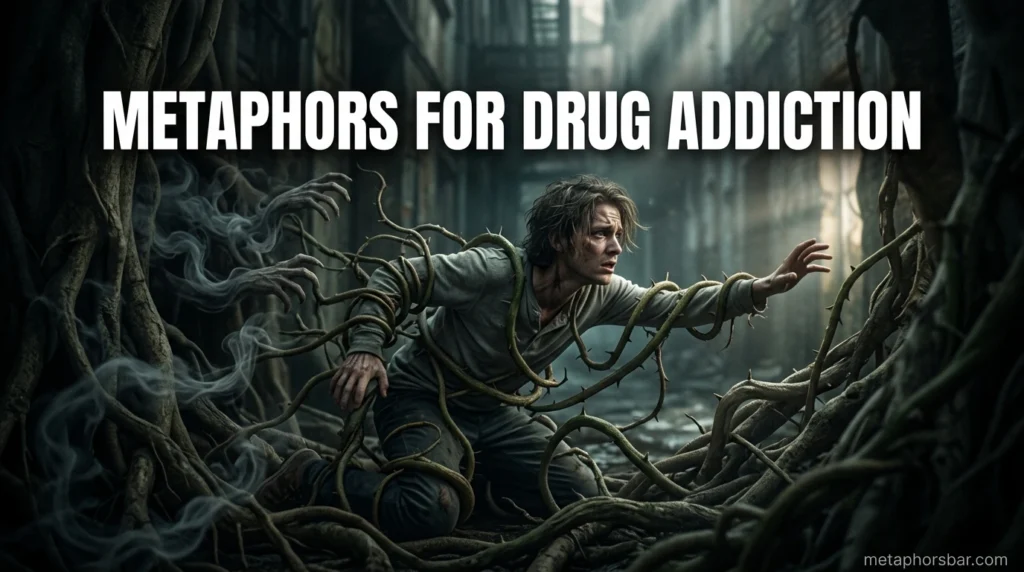
The room looks ordinary from the outside.
A chair slightly out of place. A phone face-down on the table. A window half-open, letting in a thin slice of daylight that doesn’t quite reach the corners. Nothing appears unusual—yet something in the air feels looped, heavy, repetitive, like a story that keeps restarting from the same broken point.
Drug addiction is often described in clinical terms: dependence, relapse, withdrawal. But those words alone rarely carry the emotional weight of the experience. Metaphors help bridge that gap. They translate an invisible struggle into images people can feel—chains, storms, hunger, gravity, shadows.
Used responsibly, metaphors for addiction are not about romanticizing or simplifying the issue. They are about making the emotional reality understandable: the pull, the cycle, the loss of control, and the difficulty of breaking free.
Language, in this case, becomes a tool for empathy, awareness, and human connection.
Metaphors for Drug Addiction: Why Imagery Matters in Understanding Addiction
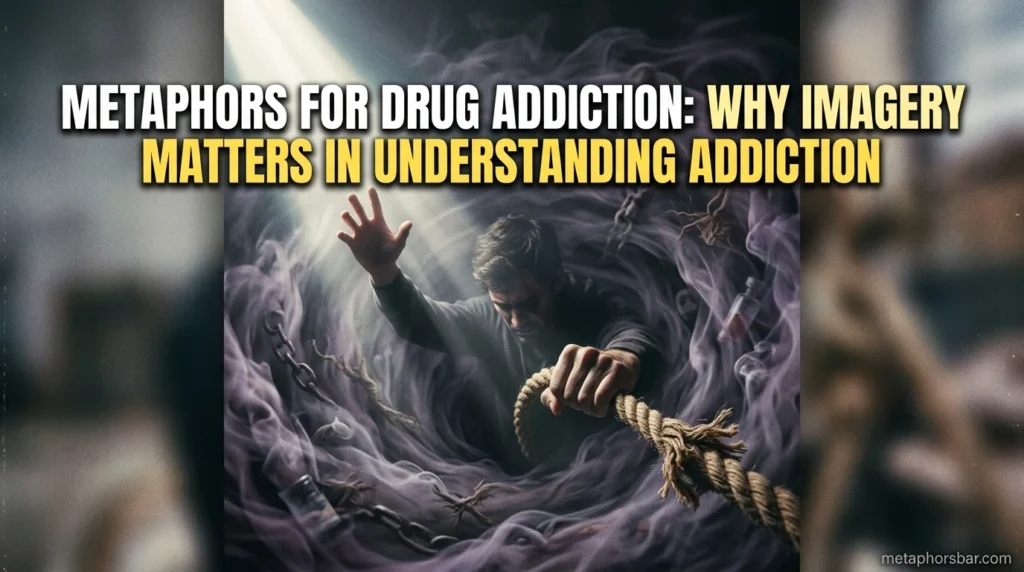
Addiction as a cycle rather than a moment
One of the hardest things to understand about addiction is that it is not a single choice—it is a repeating pattern. That is why metaphors often involve loops, traps, or systems that restart.
Addiction can include:
- craving
- relief
- regret
- withdrawal
- repetition
A metaphor helps capture that ongoing cycle in a way that plain explanation often cannot.
Why metaphors matter in discussing addiction
Metaphors:
- help reduce stigma by increasing understanding
- allow writers to express emotional complexity
- make abstract psychological experiences tangible
- encourage empathy instead of judgment
Compare:
- “He struggled with addiction.”
- “He was caught in a revolving door that never stayed open long enough to step out.”
The second version doesn’t simplify the struggle—it makes it visible.
Powerful Metaphors for Drug Addiction With Meaning and Examples
1. Addiction is a chain that tightens with every step
Meaning and explanation
This metaphor emphasizes restriction, dependency, and the illusion of movement. Chains suggest both connection and captivity. The more a person moves within the cycle of addiction, the tighter the chain can feel—not because escape is impossible, but because repetition strengthens the pattern.
This metaphor is often used to describe physical dependence, emotional attachment, or psychological conditioning.
Example sentence or scenario
“He told himself he was free, but addiction was a chain that tightened with every return, each link forged from habit and need.”
Alternative ways to express it
- addiction as invisible shackles
- dependency as tightening rope
- habit that binds more with repetition
- craving as a lock that resets itself
Optional sensory and emotional details
This metaphor can include:
- heaviness in limbs
- restricted movement
- mental pressure
- emotional fatigue
- tension between desire and resistance
Mini storytelling touch
Imagine someone trying to walk away. At first, the steps feel possible. Then something pulls back—not violently, but persistently. Each return doesn’t just repeat the past; it reinforces it. The chain isn’t just holding them—it is being rewritten stronger each time.
2. Addiction is a storm that keeps circling back to the same shore
Meaning and explanation
This metaphor captures the emotional turbulence and recurring nature of addiction. A storm suggests chaos, intensity, and lack of control. But the key detail here is repetition—it doesn’t move on; it returns.
This is especially useful for describing relapse cycles or emotional instability tied to addiction.
Example sentence or scenario
“Recovery felt close at times, but addiction was a storm that kept circling back to the same fragile shore.”
Alternative ways to express it
- emotional weather that never settles
- relapse as returning stormfront
- craving as waves crashing again and again
- chaos that revisits familiar ground
Optional sensory and emotional details
This metaphor often includes:
- thunder-like urgency (craving)
- calm before relapse
- emotional turbulence
- exhaustion after repeated cycles
- moments of false peace
Cultural or literary reference
Storm imagery is often used in literature to represent inner conflict—especially in works that explore addiction, grief, or mental health. The storm does not just destroy; it also returns, reminding us that healing is not linear.
3. Addiction is a mirror that distorts every reflection
Meaning and explanation
This metaphor focuses on identity and perception. Addiction can alter how a person sees themselves and the world around them. A mirror suggests self-awareness, but a distorted mirror reflects a changed or unreliable image.
It is especially powerful when describing shame, self-image, or loss of identity.
Example sentence or scenario
“In the grip of addiction, he no longer saw himself clearly—the mirror had learned to lie, bending his reflection into something unrecognizable.”
Alternative ways to express it
- identity blurred by habit
- self-image fractured glass
- perception warped by dependency
- truth reflected through distortion
Optional sensory and emotional details
This metaphor can evoke:
- confusion about identity
- emotional disconnection
- shame or guilt
- fragmented self-awareness
- internal conflict
Mini storytelling touch
A person looks in the mirror and expects familiarity. Instead, they see someone slightly altered—tired, distant, unfamiliar. Over time, the mirror seems to change shape, not because it truly does, but because perception has been altered by repetition and dependency.
Creative and Responsible Ways to Use Addiction Metaphors in Writing
In storytelling and fiction
Metaphors can deepen emotional realism without sensationalizing addiction.
Examples:
- “He moved through the day like someone following a chain he couldn’t see.”
- “The craving arrived like weather that refused to leave the map.”
- “Her reflection no longer matched the memory of herself.”
These lines focus on experience, not glorification.
In educational or awareness writing
Metaphors can help explain addiction to broader audiences.
Examples:
- “Addiction is a looped pattern, not a single mistake.”
- “Recovery is not a straight road but a shifting landscape.”
- “Craving is a signal, not a command.”
This helps promote understanding and empathy.
In reflective or healing-focused writing
Metaphors can support emotional processing when used gently.
Examples:
- “I am learning to loosen the chain, link by link.”
- “The storm is passing through, not defining me.”
- “I am relearning my reflection.”
This framing supports growth and recovery language.
Interactive Exercises for Writing Addiction Metaphors
Exercise 1: Replace labels with imagery
Rewrite these sentences:
- “He is addicted.”
- “She struggles with relapse.”
- “They are in recovery.”
Try metaphorical versions:
- “He is caught in a cycle that pulls him back like tidewater.”
- “Relapse arrives like weather returning to familiar skies.”
- “Recovery is learning to walk without invisible weight.”
Exercise 2: Choose a metaphor system
Pick one:
- chains
- storms
- mirrors
- loops
- shadows
- gravity
Now write a paragraph.
Example (gravity): “Addiction felt like gravity with a stronger pull than intention. Every attempt to rise was met with quiet resistance, as if the ground remembered him more than the sky did.”
Exercise 3: Write a “moment of awareness”
Describe a turning point using metaphor.
Example: “That moment felt like a crack in the storm clouds—small, uncertain, but real enough to suggest the weather could change.”
Bonus Tips for Using Addiction Metaphors Responsibly
Avoid romanticizing the struggle
Metaphors should clarify, not beautify suffering. Avoid framing addiction as glamorous or poetic in a way that diminishes harm.
Focus on cycles, not identity
Instead of defining a person as addiction, describe the experience as something they move through.
Better:
- “caught in a loop”
- “navigating a storm”
Ground metaphors in human experience
Use relatable physical or emotional sensations:
- weight
- weather
- motion
- reflection
- repetition
This keeps imagery accessible and respectful.
Balance darkness with possibility
Even difficult metaphors can include movement toward change:
- loosening chains
- clearing skies
- repairing reflection
More Metaphors for Drug Addiction You Can Use
Addiction is a broken compass
It points in directions that feel urgent but lead back to the same place.
Addiction is a looping hallway with no new doors
Every turn feels familiar, even when it shouldn’t.
Addiction is a shadow that walks slightly ahead of intention
It moves before thought can catch up.
Addiction is a tide that erases footprints
Each attempt to leave is softened by return.
Addiction is a whisper that grows louder when ignored
It thrives in silence and repetition.
FAQs
1. What is a metaphor for drug addiction?
It is a figurative comparison used to describe the emotional and behavioral patterns of addiction in symbolic terms.
2. Why use metaphors when talking about addiction?
They help explain complex emotional and psychological experiences in a way that is easier to understand and empathize with.
3. What are common addiction metaphors?
Common ones include:
- chains
- storms
- loops
- shadows
- gravity
4. Can metaphors help reduce stigma?
Yes. They encourage understanding by focusing on experience rather than judgment.
5. Should addiction metaphors be positive or negative?
They should be honest and respectful, reflecting reality without glorification.
6. Can metaphors be used in recovery writing?
Yes. They are often used to describe healing, progress, and emotional change.
7. How do I create original addiction metaphors?
Think about repetition, control, dependency, and emotional cycles, then compare them to physical systems like weather, gravity, or machinery.
Conclusion
Drug addiction is not a simple story, and it cannot be captured by simple words. It is repetition and resistance, loss and longing, clarity and distortion all happening at once.
That is why metaphors for drug addiction matter. They turn invisible struggles into visible patterns: chains that tighten, storms that return, mirrors that distort, and loops that repeat.
Used carefully, these metaphors do more than describe—they help us understand, empathize, and see the human being behind the experience. And sometimes, understanding is the first quiet step toward change.