
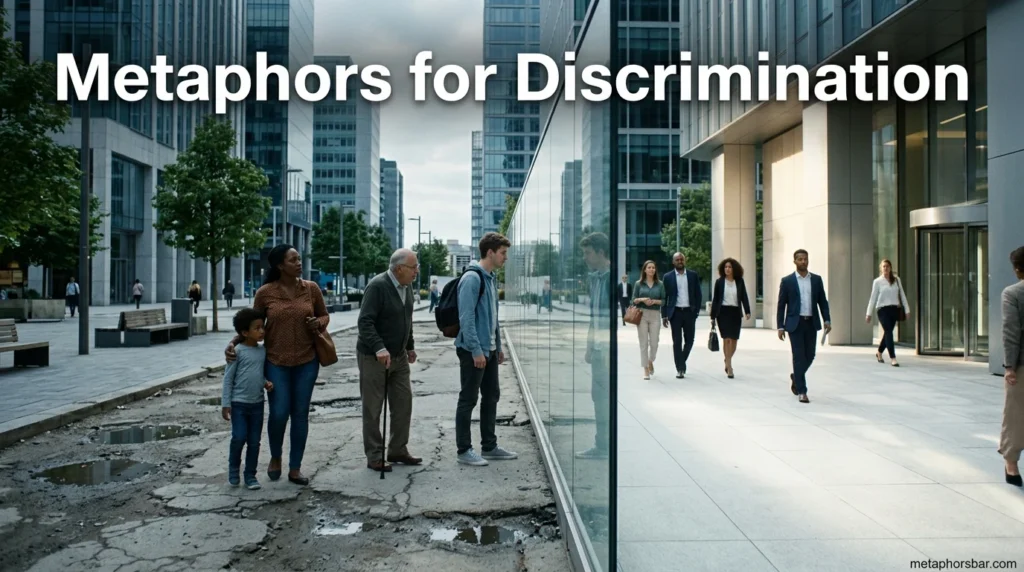
The classroom was quiet. Sunlight fell across the desks like warm honey. But one boy sat alone. No one would share a book with him. No one picked him for games. It was not loud. No one shouted. No one said cruel words. But the silence felt heavy. It pressed on his chest like a stone.
That is how discrimination often feels. It does not always scream. Sometimes it whispers. Sometimes it hides behind rules, habits, or old fears. But it hurts just the same.
Discrimination means treating someone unfairly because of who they are. It can be about race, religion, gender, age, disability, language, or background. It builds walls between people, It makes some feel small, It tells them, “You do not belong.”
Metaphors help us understand big ideas like this. A metaphor compares one thing to another. It paints a picture in the mind. When we use metaphors for discrimination, we make the problem easier to see, feel, and explain.
In this article, you will learn three strong metaphors for discrimination. You will see what they mean. You will read short stories and examples, You will try simple exercises. By the end, you will have new words to talk about fairness, kindness, and justice.
Let’s begin.
What Are Metaphors for Discrimination? (Simple Guide to Figurative Language)
A metaphor says one thing is another thing. It does not use “like” or “as.” Instead of saying, “Discrimination is unfair,” you might say, “Discrimination is a wall.”
The wall is not real. But the feeling is real.
Metaphors for discrimination help us:
- Explain unfair treatment in clear ways
- Show how bias affects people
- Speak up with strong images
- Write better essays, speeches, and posts
Writers and leaders have used metaphors to talk about justice for years. In his famous speech at the I Have a Dream, Martin Luther King Jr. spoke of a “lonely island of poverty” in a sea of wealth. That image helped people feel the gap between fairness and injustice.
Metaphors turn facts into feelings. And feelings move people.
Metaphor #1: Discrimination Is a Wall
Imagine a tall brick wall. It stands between two groups of people. On one side, doors are open. On the other side, doors are locked.
Meaning and Explanation
When we say “discrimination is a wall,” we mean it blocks people. It keeps them out. It stops them from reaching jobs, schools, or friendships.
A wall divides. It separates. It says, “Stay where you are.”
Example Sentence or Scenario
“Even though she had good grades, discrimination was a wall that kept her from getting the job.”
In a real-life story, many families in the past were not allowed to buy homes in certain areas. The rules acted like a wall. The wall was not made of bricks. It was made of laws and fear.
Another Way to Say It
- Discrimination is a barrier
- Discrimination is a locked gate
- Discrimination builds fences
- Bias creates closed doors
Sensory or Emotional Details
Think of cold stone under your hands. You try to climb. Your fingers slip. The wall feels hard and high. On the other side, you hear laughter. But you cannot see it.
That is how exclusion feels.
Mini Story
A girl wants to join the school debate team. She loves to speak. But some students whisper, “People like her don’t belong here.” No rule says she cannot join. Yet she feels a wall in front of her. She stands still. She almost turns back.
Then a teacher steps in and says, “This team is for everyone.” The wall cracks. A door opens.
Walls can be built. But they can also be broken.
Metaphor #2: Discrimination Is a Poison in the Soil
Now picture a garden. The soil looks rich and dark. Seeds are planted. But something is wrong. The plants grow weak. Some do not grow at all.
The soil is poisoned.
Meaning and Explanation
When we say “discrimination is a poison in the soil,” we mean it harms the whole community. It does not just hurt one person. It damages trust, teamwork, and hope.
Poison spreads. It sinks deep. It is often unseen.
Example Sentence or Scenario
“Racism is a poison in the soil of our city. Until we remove it, true peace cannot grow.”
If a company treats women unfairly, the work culture suffers. People feel unsafe. Talented workers leave. The whole workplace becomes tense. The poison spreads.
Another Way to Say It
- Bias is a toxic root
- Prejudice is a disease in the system
- Discrimination infects society
- Hatred is rot in the ground
Sensory or Emotional Details
Imagine the smell of damp earth. It seems fresh. But beneath it lies a sour scent. Leaves turn yellow. Flowers droop. The garden that could be bright feels tired and gray.
That is what unfairness does to a group.
Cultural or Literary Note
In many stories, poisoned land stands for broken morals. When leaders act unjustly, the land in the tale often suffers. It is a symbol. When people are treated unfairly, the spirit of the place weakens too.
Healing the soil takes time. It needs care, truth, and brave action.
Metaphor #3: Discrimination Is a Heavy Chain
Close your eyes. Imagine metal chains around your wrists. They are cold. They are tight, They slow your steps.
You can move. But not freely.
Meaning and Explanation
When we say “discrimination is a heavy chain,” we mean it limits freedom. It holds people back. It reduces chances and choices.
Chains are tools of control. They send a message: “You cannot go far.”
Example Sentence or Scenario
“For many years, unfair laws were heavy chains around their dreams.”
A student may want to study science. But others laugh at her because of her background. Their words feel like chains. She begins to doubt herself. She stops trying.
Another Way to Say It
- Bias is a weight on the shoulders
- Prejudice is a cage
- Discrimination is a shackle
- Injustice ties people down
Sensory or Emotional Details
Hear the clink of metal. Feel the pull on your arms. Each step feels harder than the last. Your heart wants to run. But your body is slowed.
That is the weight of being judged before being known.
Mini Story
A boy moves to a new country. He speaks with an accent. Some classmates mock him. He stops raising his hand in class. He once loved to speak. Now silence wraps around him like chains.
But one friend listens. One teacher praises his ideas. Slowly, link by link, the chain loosens.
Why Using Metaphors for Discrimination Matters in Writing and Speech
Facts tell us what happened. Metaphors tell us how it feels.
When you say, “Discrimination is wrong,” people agree. When you say, “Discrimination is a wall that keeps children from their dreams,” people picture it.
Metaphors:
- Make speeches more powerful
- Help children understand big ideas
- Add emotion to essays
- Create strong social media messages
Writers, teachers, and leaders use simple images to talk about hard truths. Clear words reach more hearts.
Tip: How to Create Your Own Metaphors for Discrimination
Here is one simple tip:
Think of a Feeling First
Ask yourself: What does discrimination feel like?
Does it feel:
- Heavy?
- Cold?
- Sharp?
- Dark?
- Silent?
Then match that feeling with an object.
If it feels cold, maybe it is “an icy wind.” If it feels sharp, maybe it is “a hidden thorn,” If it feels dark, maybe it is “a shadow over the sun.”
Example
Feeling: Loneliness Object: Desert
Metaphor: “Discrimination is a desert where voices dry up.”
Alternative ways to express it:
- Bias leaves people stranded
- Prejudice is a dry land with no shelter
When you match feelings with images, your writing becomes alive.
Interactive Exercise
Let’s try it together.
Exercise 1: Fill in the Blank
- Discrimination is a __________ that keeps people apart.
- Prejudice is a __________ that spreads fear.
- Bias is a __________ on someone’s heart.
Write your answers. Do not worry about being perfect.
Exercise 2: Short Story Prompt
Write five sentences about a child who faces unfair treatment. Use one metaphor to describe the feeling.
Example starter: “On the first day at school, Amir felt invisible. Discrimination was a shadow that followed him…”
Exercise 3: Social Media Practice
Write a short post (under 50 words) using one metaphor.
Example: “Racism is a wall. Let’s build bridges instead.”
Keep it clear. Keep it kind, Keep it strong.
Using Metaphors to Talk About Racism, Sexism, and Other Forms of Bias
Discrimination comes in many forms:
- Racism
- Sexism
- Ageism
- Ableism
- Religious bias
The metaphor can stay the same. The focus can change.
For racism: “Racism is a stain that mars our shared history.”
Sexism: “Sexism is a cracked ceiling over women’s dreams,”
For ageism: “Age bias is a closed door to wisdom.”
Each image helps us see the problem in a new way.
Bonus Tips for Writing About Discrimination on Blogs, Essays, and Social Media
Here are simple tips you can use today:
1. Keep Words Easy
Short sentences are strong. Clear words reach more people.
2. Use One Strong Image
Do not mix too many metaphors at once. Pick one. Stay with it.
3. Add a Human Story
Even one small story makes your message real.
4. End with Hope
If discrimination is a wall, talk about breaking it. If it is poison, talk about healing, If it is a chain, talk about freedom.
Hope invites action.