
A house after divorce can feel strangely loud in its quietness. A chair sits in the corner where two people once shared their morning coffee. A mug remains in the cupboard, a scarf hangs on a hook, and the air itself seems to remember what used to live there. Divorce is often described in legal terms, but emotionally, it is something else entirely: a breaking, a reshaping, a long and uneven return to self.
That is why metaphors for divorce matter. They give language to an experience that can be difficult to name directly. Divorce can be grief, release, rupture, relief, confusion, and rebuilding all at once. A thoughtful metaphor can help writers and readers understand the emotional landscape without flattening it. It can turn a painful ending into an image that feels honest, human, and easier to hold.
Whether you are writing a memoir, a poem, a story, a journal entry, or a reflective caption, divorce metaphors can help you describe separation with nuance, depth, and care.
Why Metaphors for Divorce Matter in Writing and Reflection
Divorce Is More Than an Ending
Divorce is often spoken about as a single event, but lived experience rarely fits into one sentence. It can feel like a door closing, a bridge collapsing, a season changing, or a map being redrawn. The emotional reality is layered, and metaphor gives those layers shape.
Metaphors Help Readers Feel the Experience
A plain sentence may say, “Their marriage ended.” A metaphor can say, “Their marriage ended like a ship splitting in rough water, each side drifting toward a different shore.” The second version does not just inform; it allows the reader to feel the distance, tension, and motion involved.
Metaphors Can Carry Both Pain and Hope
Some divorce metaphors emphasize loss. Others emphasize freedom or renewal. Both are valid. The best metaphor matches the emotion you want to express—whether that emotion is grief, release, uncertainty, or healing.
Metaphors for Divorce and Emotional Separation: Understanding the Concept
Why metaphors for divorce matter in communication and healing
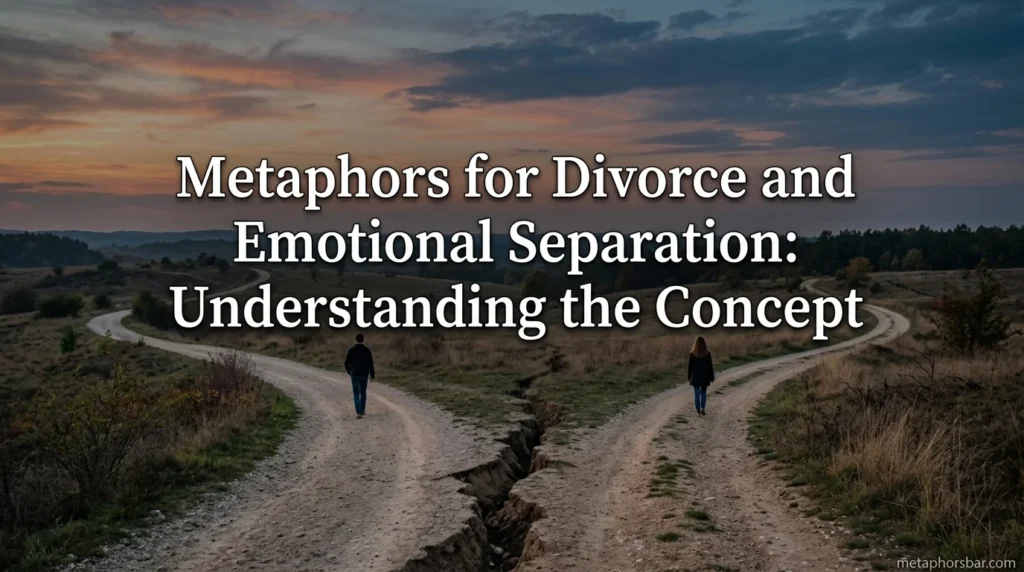
Divorce is rarely just a legal process—it is an emotional earthquake that reshapes identity, memory, and future expectations. Yet language often struggles to hold its weight. That’s where metaphors step in.
When someone says “my marriage ended,” it states a fact. But when they say “it felt like the ground split beneath me,” it reveals lived experience. Metaphors for divorce help people express grief, confusion, relief, or transformation in a way that feels human and relatable.
They matter because they:
- Give shape to overwhelming emotions
- Help people process loss safely through language
- Make writing, storytelling, and conversation more expressive
- Build empathy between listeners and speakers
In literature, therapy, and everyday conversations, divorce metaphors become emotional bridges—connecting what is felt inside to what can be understood outside.
Metaphor 1: Divorce as a Collapsing House
Meaning and emotional interpretation
One of the most powerful metaphors for divorce is the image of a collapsing house. A marriage is often seen as a home built over time—brick by brick with trust, routines, shared dreams, and emotional shelter. When divorce happens, it can feel like that structure slowly gives way.
This metaphor reflects:
- Loss of stability and emotional security
- The feeling of memories still “living in the rooms”
- The shock of something once solid becoming ruins
Example sentence or scenario
“It wasn’t just a breakup—it was like watching my entire house collapse while I was still inside, dust filling every memory I had.”
Alternative expressions
- “The foundation cracked beyond repair.”
- “The home we built turned into rubble.”
- “Our marriage became an empty shell of what it was.”
Mini storytelling touch
A woman once described her divorce after 15 years of marriage as walking through a house she no longer owned. Every corner whispered a different version of her past life—laughter in the kitchen, silence in the bedroom, arguments echoing down the hallway. The house was still standing, but it no longer felt like hers.
Sensory and emotional layer
The smell of old furniture, the echo of footsteps, the sight of untouched wedding photos—all become fragments of a once-living structure.
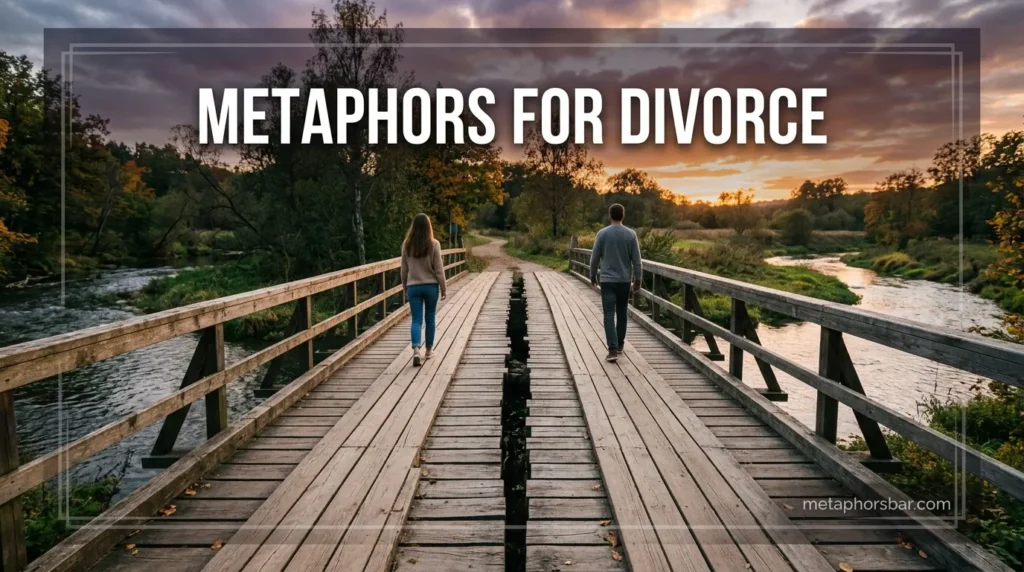
Metaphor 2: Divorce as a Broken Bridge
Meaning and emotional interpretation
Another common metaphor for divorce is a broken bridge. A relationship is often imagined as a bridge connecting two lives, two futures, and two emotional worlds. When divorce happens, that connection doesn’t simply fade—it fractures.
This metaphor highlights:
- The sudden interruption of connection
- The inability to return to what once was
- The space left between two separated lives
Example sentence or scenario
“We used to meet in the middle of everything. Now there’s just a broken bridge hanging over silence.”
Alternative expressions
- “The connection between us collapsed mid-way.”
- “We drifted to opposite shores.”
- “The path back to each other disappeared.”
Mini storytelling touch
In a cultural sense, many folk stories describe lovers separated by rivers or mountains after fate intervenes. Similarly, divorce can feel like standing on one side of a canyon, seeing the other person clearly—but no longer having a way across.
Sensory and emotional layer
The imagined sound of rushing water below, the wind between two cliffs, and the visual distance that grows heavier than words.
Metaphor 3: Divorce as Changing Seasons
Meaning and emotional interpretation
Not all divorce metaphors are violent or destructive. Some are gentle and cyclical, like changing seasons. A marriage may represent a long summer or a shared climate, but divorce becomes the arrival of autumn—or even winter.
This metaphor expresses:
- Natural emotional transition rather than sudden destruction
- The idea of endings as part of life cycles
- Space for renewal and growth after loss
Example sentence or scenario
“It wasn’t an ending—it was a season changing, even though I wasn’t ready for winter.”
Alternative expressions
- “Our love moved through its seasons.”
- “The warmth slowly faded into distance.”
- “What we had naturally turned into something different.”
Mini storytelling touch
A writer once compared her divorce to watching leaves fall from a tree she had tended for years. She didn’t hate the tree. She just realized it no longer bloomed in the same way—and that letting go was part of its natural rhythm.
Sensory and emotional layer
Cool air replacing warmth, fading sunlight, and the quiet stillness of change settling into daily life.
Creative Practice: Using Divorce Metaphors in Writing and Reflection
Interactive exercises for emotional expression
Try these exercises to explore your own or fictional experiences:
- Metaphor Mapping Exercise Write the word “divorce” in the center of a page. Around it, list objects (house, storm, bridge, season, ocean). Expand each into a short metaphor.
- Emotional Translation Practice Take a sentence like “I felt sad after the divorce” and transform it into imagery:
- “The sadness sat in me like an unfinished room.”
- Perspective Shift Writing Rewrite the same metaphor from two perspectives:
- One of loss
- One of growth
This helps reveal emotional complexity rather than one-dimensional meaning.
Bonus Tips for Using Divorce Metaphors in Writing, Social Media, and Daily Life
How to make metaphors more powerful and natural
- Keep them simple but emotionally precise
- Avoid overloading one sentence with too many images
- Use sensory details (sound, texture, weather, space)
- Match metaphor tone with emotional intent (soft, harsh, reflective)
- Let metaphors evolve across paragraphs rather than repeating the same one
Practical uses
- Writing: Enhance memoirs, poetry, or storytelling
- Social media: Express emotional experiences in relatable language
- Therapy journaling: Process feelings in symbolic form
- Speeches or conversations: Communicate complex emotions gently
FAQs About Metaphors for Divorce
1. Why are metaphors used to describe divorce?
They help express emotional experiences that are difficult to explain literally.
2. What is the most common metaphor for divorce?
Common ones include broken homes, broken bridges, storms, and changing seasons.
3. Are divorce metaphors always negative?
No. Some metaphors focus on renewal, growth, and transition rather than loss.
4. Can metaphors help with emotional healing?
Yes. They allow people to process feelings indirectly and safely through imagery.
5. How can I create my own divorce metaphors?
Start by comparing your emotions to objects, nature, or physical spaces.
6. Are divorce metaphors used in literature?
Yes, many authors use them in poetry, memoirs, and novels to express emotional depth.
7. Can I use divorce metaphors in everyday conversation?
Absolutely. They can make emotional communication more empathetic and clear.
Conclusion
Divorce is more than an ending—it is a shift in emotional architecture. Through metaphors, we turn invisible feelings into something we can see, touch, and understand.
Whether it is a collapsing house, a broken bridge, or a changing season, each image offers a different way to hold the experience. Some metaphors carry grief. Others carry acceptance. A few even carry the quiet beginning of healing.
In the end, metaphors do not erase pain—but they give it shape. And sometimes, shape is the first step toward understanding.