
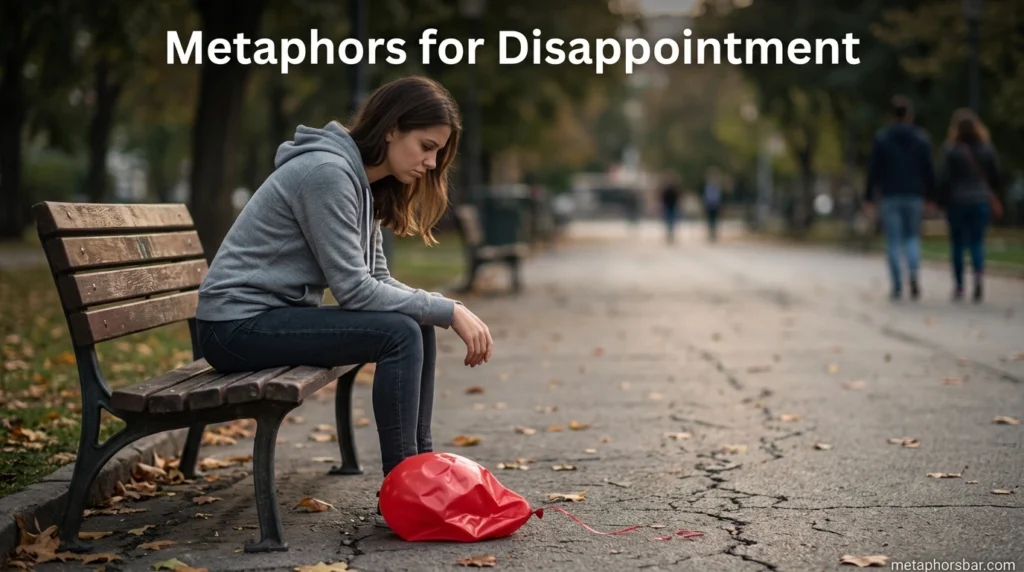
Metaphors for Disappointment and Emotional Meaning in Everyday Life
Why metaphors for disappointment help us understand emotional setbacks
Disappointment often arrives quietly—but it lingers loudly.
It might be the silence after a promised call that never comes, the empty inbox after waiting for news, or the sinking feeling when effort doesn’t meet outcome. These moments are small fractures in expectation, yet they can feel strangely heavy.
Metaphors for disappointment help us translate that invisible weight into something we can see, touch, and emotionally understand. Instead of saying “I felt bad,” we say “it felt like my hopes deflated.” That shift matters.
They are useful because they:
- Turn emotional confusion into relatable imagery
- Help writers and speakers communicate deeper feelings
- Make personal reflection easier and more expressive
- Build empathy in storytelling and conversation
In literature, music, and even everyday speech, disappointment is rarely described directly—it is felt through images.
Metaphor 1: Disappointment as a Deflated Balloon

Meaning and emotional interpretation
One of the most common metaphors for disappointment is a deflated balloon. A balloon represents anticipation, joy, and rising excitement. It is light, floating, full of possibility—until something changes.
When it deflates, everything collapses inward.
This metaphor reflects:
- Sudden loss of excitement or energy
- Expectations shrinking after being inflated
- Emotional heaviness replacing lightness
Example sentence or scenario
“I was so excited about the trip, but when it got canceled, I felt like a balloon slowly losing air in an empty room.”
Alternative ways to express it
- “My excitement deflated instantly.”
- “The joy drained out of me.”
- “My expectations collapsed like air leaving a balloon.”
Mini storytelling touch
A student once waited all semester for a scholarship result. He imagined the acceptance letter arriving, imagined telling his family, imagined a new future. When the rejection email came, he described it simply: “It was like someone quietly let the air out of everything I was holding.”
Sensory and emotional details
The imagined sound of a slow hiss, the sight of something shrinking in your hands, the feeling of lightness turning into dull weight.
Metaphor 2: Disappointment as Rain on a Parade
Meaning and emotional interpretation
Another powerful metaphor for disappointment is rain on a parade. A parade symbolizes celebration, progress, and public joy. It is loud, colorful, and full of movement. Rain arriving unexpectedly changes everything.
This metaphor highlights:
- Sudden interruption of happiness
- External forces disrupting plans
- Contrast between joy and letdown
Example sentence or scenario
“We had planned a perfect outdoor celebration, but the weather changed everything—it felt like life itself decided to rain on our parade.”
Alternative ways to express it
- “The moment got washed out.”
- “Happiness was interrupted mid-celebration.”
- “Something spoiled the joy at its peak.”
Mini storytelling touch
In many cultural festivals, sudden rain is seen as both a blessing and a disruption. Similarly, disappointment often carries duality—it doesn’t erase the joy entirely, but it interrupts the moment you were meant to remember happily.
Imagine a street filled with music, flags waving, children laughing—and then clouds rolling in. The rhythm doesn’t stop immediately, but it slows. That slowing is what disappointment feels like.
Sensory and emotional details
Wet pavement, fading music, droplets mixing with laughter, and the smell of rain overpowering celebration.
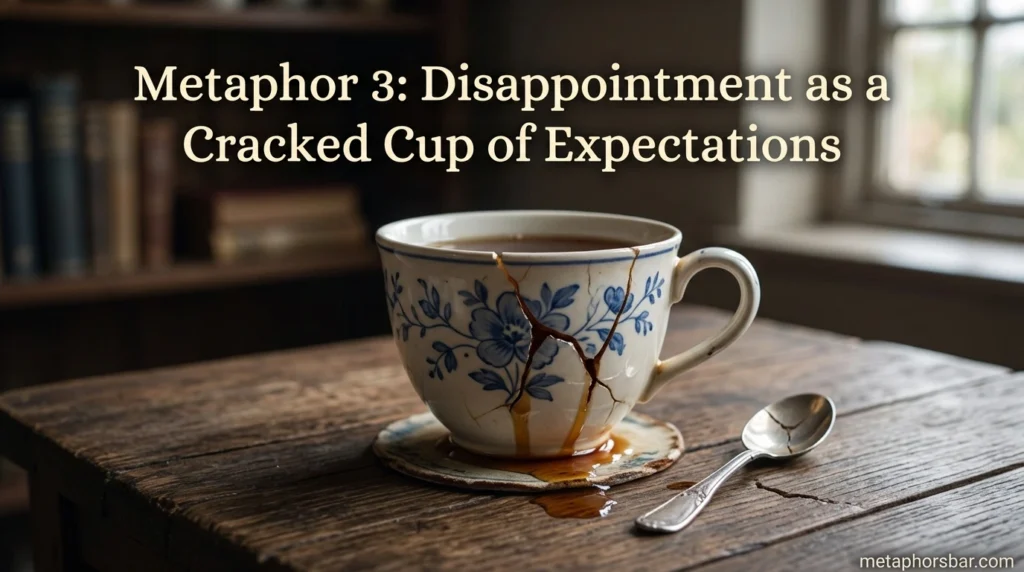
Metaphor 3: Disappointment as a Cracked Cup of Expectations
Meaning and emotional interpretation
A cracked cup of expectations is a quieter, more reflective metaphor. A cup is meant to hold something valuable—tea, water, warmth, comfort. But when it is cracked, it cannot hold what it was designed for.
This metaphor represents:
- Broken expectations that still try to “hold on”
- Emotional leakage over time rather than sudden loss
- The fragility of hope
Example sentence or scenario
“It wasn’t a dramatic failure, just small letdowns one after another—like trying to pour hope into a cracked cup.”
Alternative ways to express it
- “My expectations couldn’t hold themselves together.”
- “Hope kept slipping through the cracks.”
- “It was a quiet, ongoing letdown.”
Mini storytelling touch
A writer once described submitting manuscript after manuscript, each rejection slightly softer than the last—but still painful. She said, “At some point, I realized I wasn’t pouring dreams into a cup anymore. I was pouring them into something already broken.”
Unlike sudden disappointment, this metaphor captures the slow erosion of optimism.
Sensory and emotional details
The sound of dripping water, the feeling of something leaking despite effort, and the visual of hairline cracks spreading unnoticed.
Interactive Exercises for Metaphors for Disappointment
Creative prompts to explore emotional expression
Try these exercises to turn feelings into imagery:
- Emotion-to-Object Mapping Write “disappointment” in the center of a page. Around it, list objects (balloon, rain, cup, candle, phone screen, roadblock). Turn each into a metaphor sentence.
- Rewrite the Moment Take a real disappointing moment and rewrite it using metaphor only:
- Literal: “I didn’t get the job.”
- Metaphorical: “The door I was waiting for stayed closed, even after I knocked for weeks.”
- Sensory Expansion Exercise Choose one metaphor and describe it using all five senses (sound, sight, smell, touch, taste).
These exercises help transform abstract emotions into vivid storytelling tools.
Bonus Tips for Using Metaphors for Disappointment in Writing and Daily Life
How to make emotional imagery more powerful and natural
- Use simple, familiar objects for stronger emotional connection
- Avoid overloading sentences with multiple metaphors
- Match metaphor tone to emotional depth (soft, sharp, reflective)
- Add sensory detail to make metaphors feel alive
- Let metaphors evolve across paragraphs instead of repeating the same image
Practical uses
- Writing: Enhance poetry, essays, and storytelling
- Social media: Express emotions in relatable, aesthetic language
- Journaling: Process emotional setbacks more clearly
- Communication: Share feelings without sounding overly direct
FAQs About Metaphors for Disappointment
1. What are metaphors for disappointment?
They are symbolic comparisons used to express feelings of letdown in vivid, relatable ways.
2. Why do people use metaphors for disappointment?
Because emotions like disappointment are easier to understand when described through imagery.
3. What is a common metaphor for disappointment?
A deflated balloon, rain on a parade, and broken expectations are widely used examples.
4. Can metaphors help in emotional healing?
Yes, they help people process feelings indirectly and reflect more deeply on experiences.
5. How can I create my own metaphor for disappointment?
Think of objects that lose function, collapse, or change suddenly and connect them to emotions.
6. Are metaphors used in literature for disappointment?
Yes, many writers use weather, objects, and physical imagery to show emotional letdowns.
7. Can I use metaphors in everyday speech?
Absolutely—they make communication more expressive and emotionally engaging.
Conclusion
Disappointment is a quiet visitor in human life—it doesn’t always shout, but it lingers in corners of thought and memory.
Through metaphors like a deflated balloon, rain on a parade, or a cracked cup of expectations, we give shape to what might otherwise feel invisible. These images do not erase disappointment, but they make it understandable, shareable, and even creatively useful.
In the end, metaphors remind us of something simple yet powerful: even when expectations fall short, language still has the ability to rise beautifully around them.