
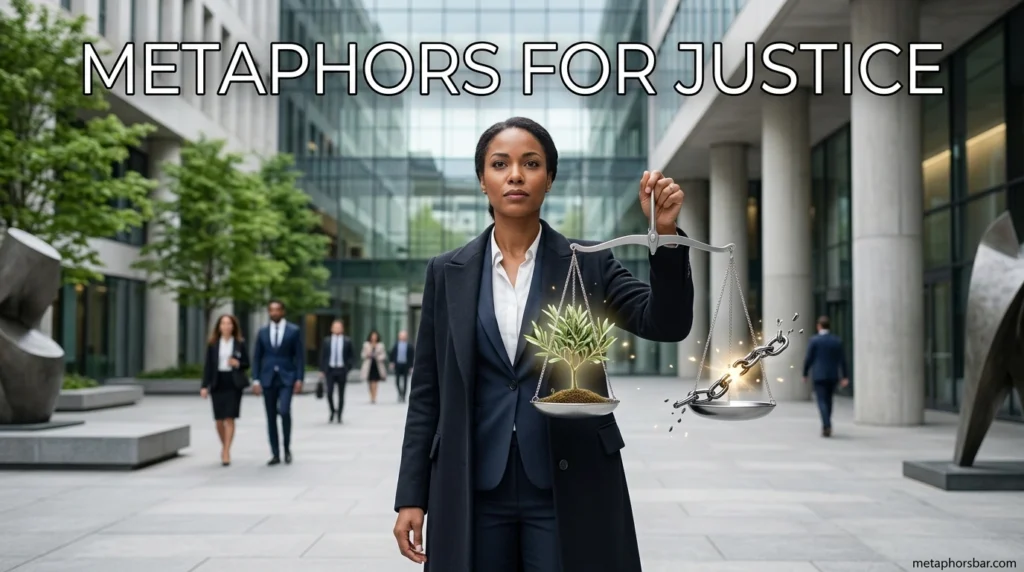
The first thing you notice in a courtroom is often not the verdict, but the weight of the room. The hush before a decision. The scratch of a pen. The sharp breath of someone waiting to be heard. Justice is not only a legal idea; it is an emotional one, a human one. It can feel like balance restored, truth uncovered, or a long-delayed light finally switching on.
That is why metaphors for justice matter so much. Justice is one of those concepts that people recognize deeply but struggle to define with precision. Is it fairness? Accountability? Mercy? Protection? Equality? The truth is that justice can be all of those things depending on the moment. A strong metaphor helps us see it, feel it, and remember it.
Whether you are writing a speech, crafting an essay, developing a story, teaching figurative language, or reflecting on society, metaphors for justice can give your words structure, depth, and power.
Why Metaphors for Justice Matter in Writing and Reflection
They Turn an Abstract Idea into Something Visible
Justice is invisible until it is acted out. We know it when we feel it: in laws, in decisions, in consequences, in fairness restored. A metaphor gives justice a shape the mind can hold.
They Reveal Different Kinds of Justice
Justice can be balancing, corrective, protective, or guiding. Metaphors help distinguish between these shades without flattening them into a single definition.
They Make Moral Language More Memorable
A sentence like “justice matters” is true, but “justice is a river that keeps finding its way” has movement, texture, and staying power.
Three Powerful Metaphors for Justice
1. Justice as Scales
Meaning and Explanation
The scales are one of the oldest and most recognizable symbols of justice. They represent balance, equal weighing, and impartial judgment. In this metaphor, justice is not rushed, tilted, or biased. It is measured carefully, with each side given attention.
This metaphor is especially useful when talking about fairness, law, and making decisions that require objectivity.
Example Sentence or Scenario
Justice stood like scales in the center of the room, weighing every voice before making a decision.
This image works well in legal writing, speeches, debates, and stories where fairness is the main focus.
Alternative Ways to Express It
- balanced like a pair of scales
- weighing both sides equally
- a careful measure of truth
- even-handed judgment
- fairness held in balance
Sensory and Emotional Details
You can picture polished brass scales glinting under a courtroom lamp, each side waiting to settle. Emotionally, the image feels deliberate, calm, and serious. It suggests that no side should be ignored.
Mini Storytelling Touch
A teacher once told her students that fairness in a classroom was “like scales that must never tip simply because one voice is louder.” Years later, one of those students remembered that lesson while serving on a committee. The image had stayed with him because it made fairness feel measurable and real.
Literary and Cultural Reference
In Greek mythology and many legal traditions, scales symbolize the weighing of truth and consequence. Lady Justice, often depicted holding scales, remains one of the most enduring images of fairness in Western culture.
2. Justice as a River
Meaning and Explanation
A river flows onward, shaping the land as it moves. It can be gentle or forceful, quiet or powerful, but it rarely stops. As a metaphor, justice as a river suggests inevitability, movement, and the way truth eventually finds its course.
This metaphor works especially well when describing justice that is delayed but not denied. It captures the idea that wrongs may resist correction for a time, yet truth keeps moving beneath the surface.
Example Sentence or Scenario
Justice was a river slowly carving its path through stone, impossible to stop forever.
This metaphor is especially effective in essays or stories about social change, historical wrongs, or long-awaited accountability.
Alternative Ways to Express It
- a current toward truth
- a flowing force of fairness
- a stream that keeps moving
- justice wearing down stone
- a tide returning to shore
Sensory and Emotional Details
Imagine water moving over rocks, steadily wearing away resistance. Hear the rush of current, feel the coolness in the air, and picture the land slowly changing shape. Emotionally, this metaphor carries patience, persistence, and a quiet kind of hope.
Mini Storytelling Touch
A reporter once described a community’s fight for accountability after years of silence as “a river that refused to dry up.” Even when progress seemed slow, people kept speaking, gathering, and pushing for change. That is one of the deepest truths of the river metaphor: justice may move slowly, but it keeps moving.
Real-Life Example
Many civil rights movements and public campaigns for reform feel river-like. Change often does not arrive all at once. It gathers force, redirects resistance, and keeps flowing until the landscape changes.
3. Justice as a Compass
Meaning and Explanation
A compass does not create the road, but it shows direction. It helps a traveler orient themselves when the path is unclear. As a metaphor, justice as a compass suggests moral guidance, ethical direction, and the ability to stay aligned when choices become complicated.
This metaphor is especially useful when discussing leadership, law, decision-making, or personal integrity.
Example Sentence or Scenario
Justice was the compass guiding her choices, even when the map of the situation was unclear.
This image works beautifully when describing someone trying to do what is right in morally difficult circumstances.
Alternative Ways to Express It
- a moral north
- a guide toward what is right
- a steady point of direction
- an inner map of fairness
- a tool for finding the ethical path
Sensory and Emotional Details
Imagine standing in fog with only a compass in your hand. The world may be unclear, but there is still a direction to follow. Emotionally, this metaphor feels steady, thoughtful, and principled. It suggests that justice is not only about punishment or law; it is about knowing where to turn.
Mini Storytelling Touch
A judge once described a difficult case as one in which “the law gave me the tools, but justice gave me the direction.” That distinction matters. A compass does not remove difficulty, but it helps a person keep moving with purpose.
Literary or Cultural Reference
Compasses often symbolize guidance in literature, voyages, and hero stories. When applied to justice, they suggest that fairness is not only a destination but also a way of traveling.
How to Choose the Right Metaphor for Justice
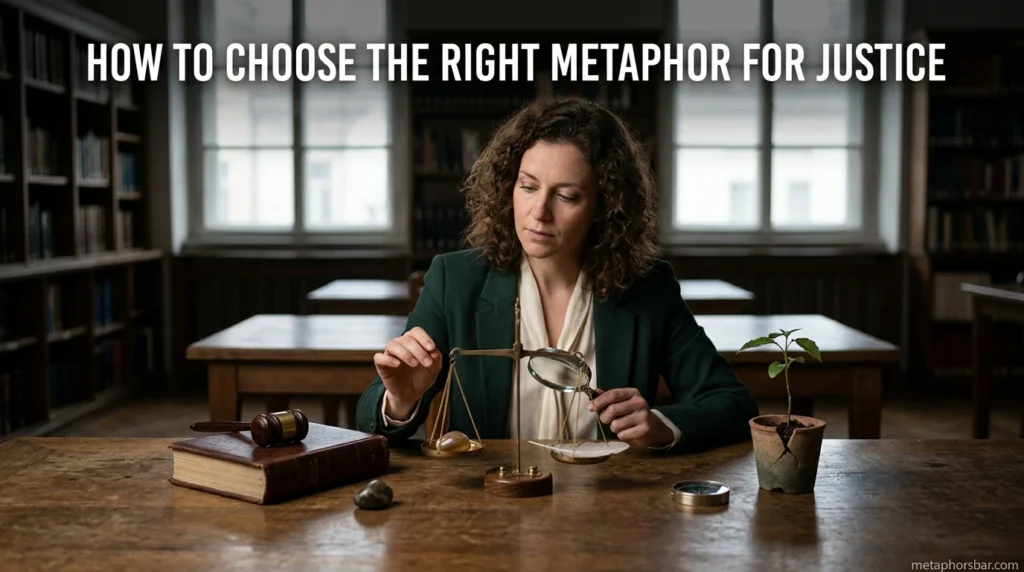
Use the Scales When You Want to Emphasize Balance
Choose this image when your focus is fairness, equal judgment, or impartiality. It works especially well in legal and ethical contexts.
Use the River When You Want to Emphasize Persistence
This metaphor is best when justice feels delayed but unstoppable, especially in historical, social, or personal narratives.
Use the Compass When You Want to Emphasize Direction
Select this image when justice is about guidance, values, and making decisions in uncertain conditions.
The best metaphor depends on which part of justice you want to highlight. Justice can balance, flow, and guide—sometimes all at once.
Interactive Exercises for Practicing Metaphors for Justice
Exercise 1: Complete the Sentence
Finish this prompt three different ways:
“Justice is like ______ because ______.”
Try one version that feels legal, one that feels emotional, and one that feels hopeful.
Example: “Justice is like a compass because it helps people find the right direction when the path is unclear.”
Exercise 2: Sensory Mapping
Think of a justice-related moment—a fair decision, a courtroom scene, a protest, a family dispute, or a personal boundary.
Write down:
- one sound
- one object
- one texture
- one movement
- one emotion
Then turn those details into a metaphor.
Exercise 3: Story Starter
Write a short paragraph beginning with:
“Justice moved like…”
Let the image shape the scene. You can make it calm, dramatic, hopeful, or reflective.
Exercise 4: Social Media or Speech Practice
Turn one of your metaphors into a short quote, post, or speech line.
Examples:
- “Justice is balance, not bias.”
- “Truth flows like a river, even when blocked.”
- “A compass of justice keeps us from wandering too far from what is right.”
Bonus Tips for Using Metaphors for Justice in Writing, Social Media, and Daily Life
In Essays and Articles
Metaphors can make complex discussions about law, ethics, and fairness more vivid and persuasive. They help readers engage with ideas that might otherwise feel abstract.
In Speeches
Justice metaphors can give a speech moral weight and emotional clarity. They make calls for fairness feel more memorable.
In Creative Writing
Use these metaphors to shape characters, conflicts, and themes. A story about injustice becomes richer when justice is described as a force, a tool, or a journey.
In Social Media
Short metaphorical lines can make advocacy and reflection more compelling:
- “Justice is a river that remembers.”
- “Fairness must balance, not tilt.”
- “Let justice be our compass.”
Keep It Precise
Justice is a serious, layered concept. Choose metaphors carefully so they support the meaning you want, rather than making it sound too vague or too sentimental.
FAQs
1. What is a metaphor for justice?
A metaphor for justice is a figurative comparison that describes justice using another image, such as scales, a river, or a compass.
2. Why are metaphors for justice useful?
They help make a complex moral and legal idea easier to understand, visualize, and remember.
3. What is a simple metaphor for justice?
A simple example is: Justice is a pair of scales. It clearly suggests balance and fairness.
4. Can metaphors for justice be used in speeches?
Yes. They are often very effective in speeches, especially when discussing fairness, law, accountability, or social change.
5. How do I create my own metaphor for justice?
Think about what justice does—balances, guides, corrects, or moves—and compare it to something with similar qualities.
6. Are these metaphors only for legal contexts?
No. They can also be used in writing about relationships, community, history, ethics, and personal values.
7. What makes a strong metaphor for justice?
A strong metaphor is clear, morally resonant, and easy to imagine. It should help the reader feel the weight and purpose of justice.
Conclusion
Justice is one of humanity’s oldest ideals, yet it remains deeply alive in every generation. We seek it in courts, in communities, in families, and in ourselves. We want fairness that holds steady, truth that keeps moving, and direction that does not lose its moral center.
The scales remind us that justice must balance. The river reminds us that it persists. The compass reminds us that it guides. Together, these images reveal that justice is not a single moment or a single rule—it is a living principle that shapes how we live with one another.
So when you write about justice, do not settle for plain explanation alone. Choose an image that carries its weight. Let your words balance, flow, and point toward truth. Because sometimes the clearest way to speak of justice is through a metaphor that helps people see it, feel it, and remember why it matters.