
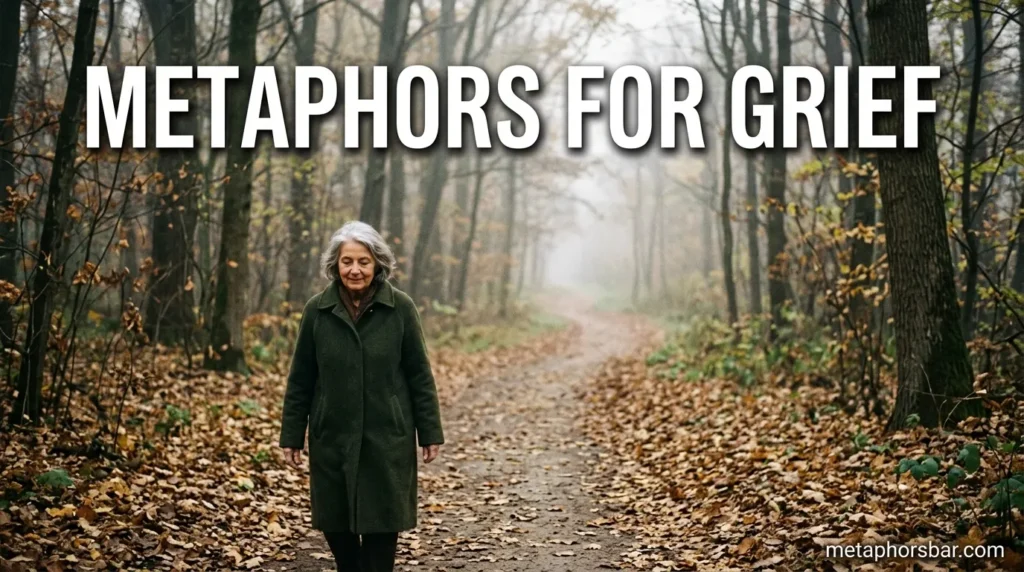
The room changes after loss. Even if nothing physical moves, everything feels slightly out of place—like a chair has been pulled back from the table and never returned. A familiar song can suddenly sound like a doorway to another life. The kettle still boils, the clock still ticks, the light still comes through the window, but grief has a way of making ordinary things feel foreign, as though they belong to a world that has shifted a few inches to the left.
That is why metaphors for grief matter so much. Grief is one of the most profound human experiences, and yet it is often difficult to describe directly. It is not only sadness. It can be emptiness, longing, shock, fatigue, love with nowhere to go, or the slow acceptance that life has been altered. Metaphors help us give grief a shape. They let us speak the unspeakable, or at least approach it with language that is honest, tender, and alive.
Whether you are writing poetry, a memoir, a eulogy, a journal entry, or a social media post about loss, grief metaphors can make your words more vivid, compassionate, and emotionally true.
Why Metaphors for Grief Matter in Writing and Reflection
They make an invisible pain visible
Grief often lives inside the body and mind in ways others cannot see. A metaphor can translate that hidden ache into an image that readers can recognize and feel.
They capture grief’s complexity
Grief is not one thing. It can be heavy, numb, sharp, quiet, recurring, and even loving. A strong metaphor can hold several of those feelings at once without flattening them.
They make writing more human
When grief is described with care, it becomes relatable rather than abstract. Readers who have experienced loss feel less alone, and readers who have not can still understand the shape of the emotion.
Three Powerful Metaphors for Grief
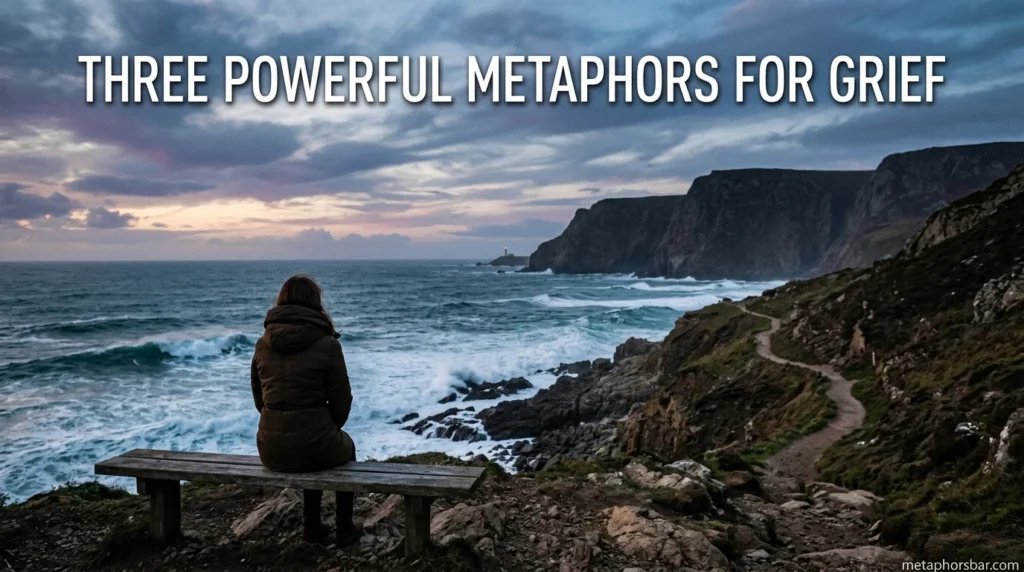
Grief as an Ocean
Meaning and explanation
An ocean is vast, deep, and constantly moving. It can be calm one moment and stormy the next. Comparing grief to an ocean captures its scale, unpredictability, and the way it can come in waves. Sometimes grief feels like drowning; other times it is a slow swell under the surface that returns without warning.
This metaphor is especially useful because grief rarely arrives in a straight line. It comes and goes. It recedes and returns, It has tides.
Example sentence or scenario
Her grief was an ocean—some days quiet enough to breathe beside, other days rising suddenly and swallowing the whole shore.
This metaphor works well in stories about mourning, long-term loss, or any experience where emotion is large enough to feel endless.
Alternative ways to express it
- a sea of sorrow
- waves of mourning
- a tide that keeps returning
- deep waters of loss
- a storm-tossed shoreline
Sensory and emotional details
You can hear the low rush of water, feel the pull of a current, taste salt in the air, and imagine standing at a shore where the horizon disappears. Emotionally, this metaphor feels immense, changeable, and hard to contain. It suggests that grief is not simply a moment—it is a landscape.
Mini storytelling touch
A man once described losing his wife by saying, “At first I thought grief was a single wave, but it turned out to be an ocean I had to learn to live beside.” That line is powerful because it reflects the truth many mourners discover: grief is not one crash. It is a tide with many returns.
Literary or cultural reference
Oceans often symbolize the vastness of emotion in literature and poetry. They are used again and again because they can hold both beauty and danger, just as grief can hold both love and pain.
Grief as Winter
Meaning and explanation
Winter is cold, quiet, and stripped down. Trees stand bare. Light comes later. The world seems to pause. As a metaphor, winter captures grief’s stillness, heaviness, and emotional coldness. It can describe the numbness that often follows loss, when even ordinary tasks feel slow and distant.
This metaphor is particularly effective when grief feels like a season rather than a single event. It suggests that the heart, like the land, may need time before it can bloom again.
Example sentence or scenario
After the funeral, grief settled over him like winter, turning every familiar room into a place of silence and frost.
This works well when writing about the early stages of loss, emotional shutdown, or the quiet period after a loved one is gone.
Alternative ways to express it
- a season of frost
- an emotional snowfall
- bare branches of sorrow
- a long cold season
- a world under ice
Sensory and emotional details
You can feel cold air on your face, hear the crunch of snow underfoot, and see a pale landscape with little movement. Emotionally, this metaphor feels still, lonely, and suspended. It suggests that grief can cover everything with quiet and make the future seem far away.
Mini storytelling touch
A woman who lost her mother once said that for months afterward, she felt “stuck in a winter that didn’t belong to the calendar.” Spring came and went outside her window, but inside, everything remained frozen. That is the power of the winter metaphor—it captures not just sadness, but the way grief can change your sense of time.
Literary or cultural reference
Winter often symbolizes loss, endings, and endurance in literature. Yet it also carries the possibility of spring. That dual meaning makes it a deeply resonant metaphor for grief.
Grief as a Heavy Coat
Meaning and explanation
A heavy coat protects you from the cold, but it also weighs on your shoulders. It slows you down. It is something you carry everywhere, whether you want to or not. As a metaphor for grief, the heavy coat captures how loss can feel like a burden that stays close to the body, moving with you through daily life.
This metaphor is especially useful when grief is not dramatic but persistent. It can describe the way mourning alters everyday routines without fully stopping life.
Example sentence or scenario
She wore her grief like a heavy coat, carried with her into every room, every errand, every conversation.
This image is powerful for describing grief that becomes part of the person’s daily life rather than a separate event.
Alternative ways to express it
- a weight on the shoulders
- a coat stitched with sorrow
- a layer of mourning
- a garment of loss
- a burden that never quite comes off
Sensory and emotional details
You can imagine thick fabric pressing down, damp wool on the shoulders, and the ache of carrying something too heavy for too long. Emotionally, this metaphor feels practical, intimate, and exhausting. It reminds us that grief is often not only felt in the heart, but carried in the body.
Mini storytelling touch
After losing his brother, a teacher returned to work and tried to act normal. He could still smile, still teach, still answer questions, but he said grief felt like a coat he could not remove, even on warm days. That image stays because it is so accurate: grief often remains with us in ways that cannot be hidden.
Literary or cultural reference
Clothing in literature often symbolizes identity and emotional state. A heavy coat is fitting for grief because it suggests both protection and burden—a way of surviving cold weather, even when the weather is emotional.
How to Choose the Right Metaphor for Grief
Use the ocean when grief feels vast and recurring
This metaphor is best when the loss feels enormous, unpredictable, or cyclical. It is especially useful for mourning that comes and goes in waves.
Use winter when grief feels still, cold, or numbing
Choose this image when you want to emphasize emotional quiet, emptiness, or the sense that life has slowed down.
Use the heavy coat when grief feels like a daily burden
This metaphor works when grief is carried through ordinary life—when it does not stop you, but it changes the weight of everything you do.
The best metaphor depends on the shape grief takes in the moment you are trying to describe. Sometimes it is a storm. Sometimes it is a season, Sometimes it is simply what you wear to survive the day.
Interactive Exercises to Practice Metaphors for Grief
Exercise 1: Complete the sentence
Finish this prompt in three different ways:
“My grief felt like ______ because ______.”
Try one answer that feels physical, one that feels emotional, and one that feels poetic.
Example: My grief felt like winter because everything around me kept moving while something inside me remained frozen.
Exercise 2: Sensory mapping
Think of a grief experience—real or imagined—and write down:
- one sound
- one texture
- one color
- one weather image
- one bodily sensation
Then turn those details into a metaphor.
For example: Grief sounded like wind in an empty hallway, felt like rough wool, looked like gray fog, moved like tides, and sat on my chest like a heavy coat.
Exercise 3: Story starter
Begin a short paragraph with:
“Grief was like…”
Let the image guide the tone. You can make it quiet, raw, reflective, or restrained.
Exercise 4: Journaling or caption practice
Try writing a one-line reflection:
- “Some grief comes in waves.”
- “Winter lives in the heart too.”
- “I carry my sorrow like a coat I did not choose.”
Bonus tips for using grief metaphors in writing, social media, and daily life
In writing
Use grief metaphors in memoirs, poetry, fiction, and essays to give shape to pain without overstating it. The image can carry the emotional depth for you.
In social media
If you are writing something personal and reflective, a careful metaphor can communicate loss with grace and honesty. It can be more expressive than plain explanation while still feeling respectful.
In journaling
Metaphors can help you process grief by making it easier to name. Writing “My grief is an ocean” or “I am in winter” can clarify how the loss feels in your life right now.
In conversations
Sometimes a metaphor opens the door to deeper understanding. It can help others grasp your experience without requiring a long explanation.
Keep the image truthful
The strongest grief metaphors are the ones that honor the reality of loss. Choose the image that truly fits the feeling, not the one that sounds most polished.
FAQs
1. What is a metaphor for grief?
A metaphor for grief is a figurative comparison that describes grief using another image, such as an ocean, winter, or a heavy coat.
2. Why are metaphors for grief useful?
They help make a deeply emotional and often invisible experience easier to understand and express.
3. What is a simple metaphor for grief?
A simple example is: Grief is winter. It suggests coldness, stillness, and a season that must be endured.
4. Can grief metaphors be used in poetry?
Yes. They are especially effective in poetry because they can hold complex emotions in compact and vivid language.
5. How do I create my own grief metaphor?
Think about what grief feels like physically, emotionally, or temporally, then compare it to something with similar qualities or movement.
6. Are grief metaphors only for loss of a person?
No. They can also describe grief over a relationship, dream, identity, place, or any meaningful loss.
7. What makes a strong grief metaphor?
A strong metaphor is vivid, emotionally honest, and easy to picture. It should help the reader feel the grief, not just understand it.
Conclusion
Grief is one of the most universal and private human experiences. It can be vast like an ocean, still like winter, or heavy like a coat we never chose to wear. That is why metaphors matter: they give grief a shape we can recognize, carry, and sometimes speak aloud.
The ocean reminds us that grief comes in waves. Winter reminds us that it can feel cold and suspended. The heavy coat reminds us that loss is often something we carry through ordinary days. Together, these images offer a language for sorrow that is honest, tender, and deeply human.
So when you write about grief, do not stop at the obvious. Let it move, freeze, or weigh down your language. A good metaphor cannot remove pain, but it can make it visible enough to hold—and that can be the beginning of healing.