
The first signs of growth are often nearly invisible. A green shoot pushing through dark soil. A child’s handwriting becoming straighter and steadier over time. A person who used to shrink back from life suddenly speaking with quiet confidence. Growth is rarely loud at the beginning. It happens in layers, beneath the surface, where patience and effort are doing their private work.
That is why metaphors for growth matter so much. Growth is one of those ideas that feels easy to recognize but hard to capture with plain language. It can mean healing, learning, maturity, resilience, transformation, or the slow unfolding of potential. A strong metaphor helps us see growth not as an abstract idea, but as something living, visible, and full of motion.
Whether you are writing a poem, a personal essay, a speech, a social media caption, or simply reflecting on your own life, metaphors for growth can bring depth, warmth, and clarity to your words.
Why Metaphors for Growth Matter in Writing and Everyday Life
They make change visible
Growth is often gradual, which makes it easy to overlook. Metaphors give change shape, turning something internal into an image the reader can picture.
They add emotional depth
A good metaphor can show not just that someone changed, but how that change felt—gentle, difficult, hopeful, painful, or empowering.
They make writing more memorable
Readers may forget a definition, but they often remember an image. A growth metaphor can stay with them long after the page is turned.
Three Powerful Metaphors for Growth
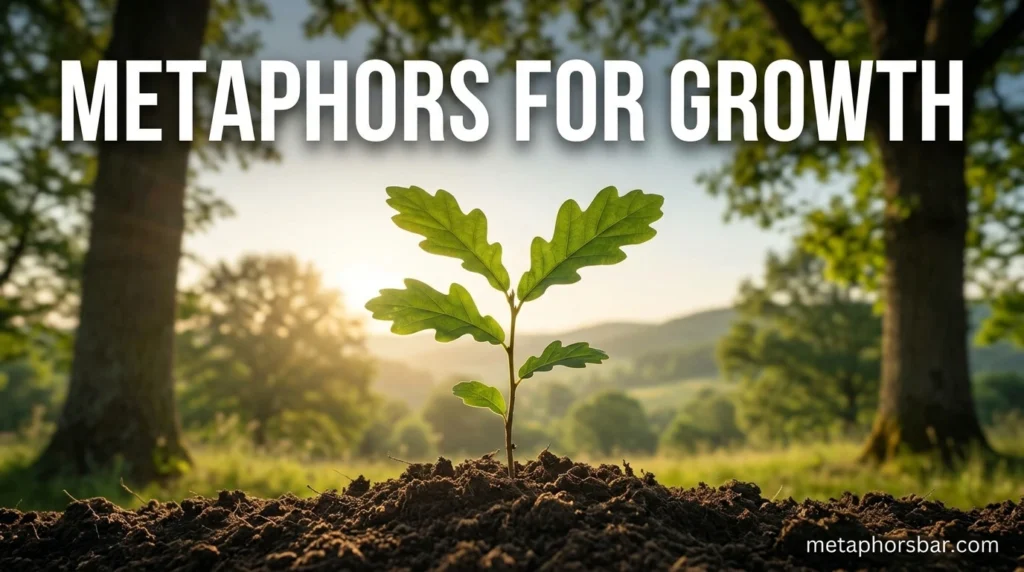
1. Growth as a Seed Becoming a Tree
Meaning and explanation
One of the most enduring metaphors for growth is the seed. A seed looks small, simple, and easy to overlook, yet it holds the promise of something much larger. It must be planted, watered, and given time before it becomes a tree. This makes it a perfect image for personal development, learning, or healing.
This metaphor emphasizes potential, patience, and the fact that important growth often begins quietly. A tree does not appear overnight, and neither do confidence, wisdom, or resilience.
Example sentence or scenario
Her confidence was a seed buried deep in winter soil, but with time and care, it grew into something strong and unmistakable.
This metaphor is ideal for writing about childhood, education, self-discovery, healing after hardship, or any process where progress takes time.
Alternative ways to express it
- a sprout of possibility
- a root of strength
- a sapling of hope
- a tree rising from hidden beginnings
- a garden of becoming
Sensory and emotional details
You can almost feel the damp soil, smell the earth after rain, and picture the tiny green shoot pushing upward toward the light. Emotionally, this metaphor feels patient, hopeful, and deeply alive.
Mini storytelling touch
A teacher once told a struggling student, “You are not behind; you are underground.” Years later, that student said those words changed everything. The seed metaphor is powerful because it reminds us that growth can be real even when it is not yet visible.
Literary or cultural reference
Trees often symbolize wisdom, endurance, and legacy in literature and cultural traditions. Many stories use them to represent growth because they transform small beginnings into lasting presence.
2. Growth as Climbing a Mountain
Meaning and explanation
A mountain climb is steep, difficult, and slow, but each step brings a person higher than before. This metaphor highlights effort, perseverance, and the rewarding nature of hard-won progress. It is especially useful when growth requires challenge, discipline, or courage.
Unlike the seed metaphor, which feels gentle and organic, the mountain emphasizes struggle and determination. It reminds us that growth can demand strength, not just time.
Example sentence or scenario
Every setback became another ridge on the mountain of her growth, difficult to climb but worth the effort.
This works well for stories about overcoming fear, training, recovery, education, or any situation where the person must keep going despite fatigue.
Alternative ways to express it
- scaling new heights
- a slow ascent
- a climb toward wisdom
- a summit earned step by step
- rising through challenge
Sensory and emotional details
Imagine sharp air, tired legs, the scrape of boots on stone, and the view getting wider with every step. Emotionally, this metaphor feels strenuous, brave, and triumphant.
Mini storytelling touch
A man once described learning to live after a major loss as “climbing a mountain with no clear summit.” At first the road felt impossible. But eventually he realized that each difficult step changed him. He was not just trying to get somewhere; he was becoming someone stronger along the way.
Real-life example
Athletes, entrepreneurs, and students often use this metaphor because it captures the long, exhausting, but deeply meaningful nature of progress.
3. Growth as a River Changing Course
Meaning and explanation
A river is always moving. It bends, widens, narrows, and changes depending on the landscape around it. This makes it a beautiful metaphor for growth because it emphasizes adaptability, movement, and ongoing transformation.
This image is especially useful when growth is not linear. Sometimes people grow by changing direction, letting go, or flowing around obstacles rather than forcing their way through them.
Example sentence or scenario
His growth was like a river, never still, always finding a new way forward around whatever blocked the path.
This metaphor works well for writing about identity, healing, creativity, or life transitions where flexibility matters more than perfection.
Alternative ways to express it
- a flowing stream of becoming
- a current of change
- a winding path of water
- growth shaped by the land
- a river learning its way
Sensory and emotional details
You can hear water over stone, see light flashing on the surface, and feel the constant motion beneath the calm. Emotionally, this metaphor feels adaptive, reflective, and quietly powerful.
Mini storytelling touch
A woman once changed careers twice and worried she had failed at finding her “true path.” Later she realized she had not been lost at all. “I was a river,” she said. “I just kept meeting new landscapes.” That is the beauty of this metaphor—it honors the idea that growth sometimes means changing course.
Literary and cultural reference
Rivers often symbolize life, time, and transformation in poetry and mythology. They appear again and again because they mirror the way growth rarely stays in one place.
How to Choose the Right Metaphor for Growth
Use the seed when growth feels quiet and potential-filled
If you want to emphasize the beginning of something, the seed is the best choice. It works especially well when the growth is hidden, patient, or delicate.
Use the mountain when growth feels challenging and earned
Choose this metaphor when the process requires determination, courage, and effort. It is a good match for struggle and resilience.
Use the river when growth feels fluid and changing
This metaphor is ideal when growth is about adaptation, movement, or learning to move with life instead of against it.
The best metaphor depends on the kind of growth you want to describe. Some growth is planted, some is climbed, and some is simply followed as it flows.
Interactive Exercises for Practicing Metaphors for Growth
Exercise 1: Complete the sentence
Finish this prompt in three different ways:
“My growth is like ______ because ______.”
Try one answer that feels gentle, one that feels hard-earned, and one that feels unexpected.
Example: My growth is like a river because it keeps moving even when the path changes.
Exercise 2: Sensory mapping
Think about a time when you grew in some meaningful way. Write down:
- one sound
- one texture
- one color
- one image from nature
- one emotion
Then turn those details into a metaphor.
For example: Growth sounded like rain on leaves, felt like rough soil in my hands, looked like spring green, moved like a river around stone, and carried the emotion of hope.
Exercise 3: Story starter
Begin a paragraph with:
“Growth felt like…”
Let the metaphor guide the mood. It can be slow, joyful, painful, or triumphant.
Exercise 4: Caption or reflection prompt
Try writing a short line for a journal entry or social media post:
- “I am still becoming.”
- “Growth is a seed with patience.”
- “Every mountain step counts.”
- “Some growth flows quietly.”
Bonus tips for using metaphors for growth in writing, social media, and daily life
In writing
Use growth metaphors in essays, fiction, poetry, and personal reflections to make change feel real and emotionally layered. They are especially useful when describing character development.
On social media
A short metaphor can turn a simple caption into something memorable. A line like “Still growing like a tree in spring” can feel warm and reflective without sounding forced.
In journaling
Metaphors can help you understand your own progress. If you are in a slow season, asking “Am I a seed, a mountain climber, or a river today?” can make your experience easier to name.
In conversation
Metaphors can help people talk about growth more honestly. Instead of saying “I’ve changed,” you might say “I’ve been climbing my own mountain” or “I’m finally starting to bloom.”
Keep the imagery truthful
The strongest metaphor is the one that fits your real experience. Growth is not always pretty, and that is part of what makes these images meaningful.
FAQs About Metaphors for Growth
1. What is a metaphor for growth?
A metaphor for growth is a figurative comparison that describes growth using another image, such as a seed, mountain, or river.
2. Why are metaphors for growth useful?
They help make change, progress, and development easier to visualize and emotionally connect with.
3. What is a simple metaphor for growth?
A simple example is: Growth is a seed becoming a tree. It suggests patience, potential, and transformation over time.
4. Can growth metaphors be used in poetry?
Yes. They are especially effective in poetry because they naturally carry symbolism, movement, and emotional depth.
5. How do I create my own metaphor for growth?
Think about what growth feels like—slow, hard, fluid, or hidden—and compare it to something with similar qualities.
6. Are growth metaphors only for personal development writing?
No. They can also be used in stories, speeches, captions, leadership writing, and reflective essays.
7. What makes a strong metaphor for growth?
A strong metaphor is vivid, truthful, and emotionally resonant. It should help the reader feel the process of becoming.
Conclusion
Growth is one of the most beautiful and complex parts of being human. It can be quiet like a seed, difficult like a mountain, or fluid like a river. It rarely happens all at once, and it often reveals itself only in hindsight.
That is why metaphors matter so much—they help us see growth in forms we can understand, remember, and feel. The seed reminds us that potential begins small. The mountain reminds us that progress can be earned step by step. The river reminds us that change does not always move in straight lines.
So when you write about growth, do not settle for plain explanation alone. Let the image breathe. Let it root, rise, or flow. Because sometimes the best way to describe becoming is through a metaphor that keeps growing with you.