
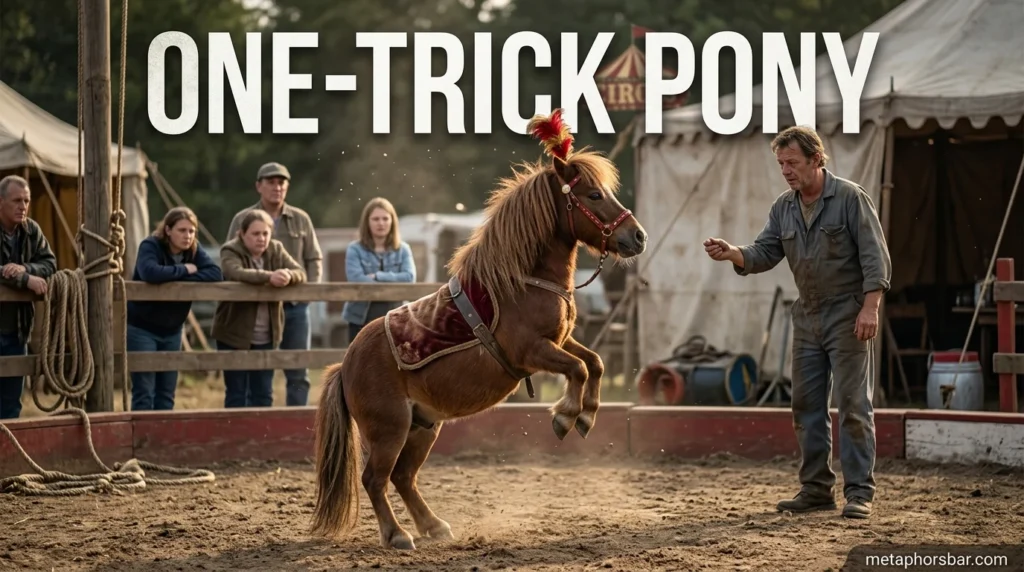
People often get confused by one trick pony because it sounds like a literal phrase, but it is actually an idiom. It is also easy to mix up the spelling: should it be one trick pony, one-trick pony, or one trick-pony? That matters in everyday writing, speaking, exams, and professional communication because idioms can change the tone of your message. Used correctly, the phrase makes your English sound natural and expressive. Used incorrectly, it can look awkward or unclear.
The good news is that this expression is easy to learn once you understand what it means and how it works in a sentence. In modern English, one-trick pony usually means a person, thing, company, or idea that can do only one thing well, or is useful in only one limited way. In this article, you will learn the meaning, correct spelling, grammar rules, pronunciation, sentence examples, common mistakes, and simple memory tips so you can use it confidently.
What Does “One-Trick Pony” Mean?
A one-trick pony is something or someone that has only one main skill, feature, or strength and does not offer much beyond that. The phrase is often used in a slightly critical way, but not always harshly.
Simple meaning
- a person with only one useful skill
- a product or tool that does only one thing well
- a business, idea, or performer with limited range
- something that becomes repetitive or predictable
Examples
- He is a good singer, but some people think he is a one-trick pony.
- The app is useful, but it feels like a one-trick pony because it only does one job.
- The company was successful at first, but then it started to look like a one-trick pony.
Comparison table: basic meaning
| Phrase | Meaning | Tone |
| one-trick pony | someone or something with only one useful skill or function | informal, slightly critical |
| versatile person | someone with many skills | positive |
| all-rounder | a person who can do many things well | positive |
| specialist | someone with deep skill in one area | neutral/positive |
A very important note
The phrase does not always mean “bad.” A one-trick pony can still be effective at that one thing. The problem is that it is limited.
For example:
- A calculator is a one-trick pony, but that one trick may be exactly what you need.
- A singer known only for one type of song may be called a one-trick pony.
So the phrase usually suggests limited range, not complete failure.
Correct Spelling: One Trick Pony or One-Trick Pony?
The most common and preferred written form is:
- one-trick pony
This hyphenated form is standard in edited English, especially when the phrase is used as a fixed idiom or as an adjective before a noun.
Spelling options
| Form | Status | Example | Notes |
| one-trick pony | preferred / standard | He is a one-trick pony. | most natural in careful writing |
| one trick pony | informal / less standard | He is a one trick pony. | sometimes seen, but less polished |
| one trick-pony | incorrect | He is a one trick-pony. | not standard English |
Why the hyphen matters
The hyphen helps readers see that the phrase belongs together as one fixed idea. It improves clarity, especially in formal or published writing.
Correct examples
- She was called a one-trick pony by the critics.
- This machine is a one-trick pony.
- The brand became known as a one-trick pony.
Incorrect examples
- She was called a one trick pony by the critics.
- This machine is a one trick-pony.
- The brand became known as a one trick-pony.
Quick spelling tip
If you are writing for school, work, a blog, or an exam, the safest choice is usually one-trick pony.
Grammar Rules: How the Phrase Works in Sentences
Although one-trick pony is an idiom, it still follows grammar rules like any other noun phrase.
Main grammar pattern
The phrase often works as a noun:
- He is a one-trick pony.
- The app is a one-trick pony.
- That company is a one-trick pony.
It can also work as an attributive adjective-like phrase before a noun:
- a one-trick pony act
- a one-trick pony strategy
- a one-trick pony app
Grammar comparison table
| Use | Example | Function |
| noun phrase | He is a one-trick pony. | describes a person |
| modifier before noun | It is a one-trick pony product. | describes the noun that follows |
| plural noun phrase | They are one-trick ponies. | more than one person or thing |
Plural form
The plural is usually:
- one-trick ponies
Examples:
- Some early social media tools were considered one-trick ponies.
- The band became known as a group of one-trick ponies.
Subject-verb agreement examples
- The singer is a one-trick pony.
- The singers are one-trick ponies.
- The app was a one-trick pony.
- The apps were one-trick ponies.
Important grammar note
Because it is an idiom, the phrase should usually stay in its fixed order:
- one-trick pony
Do not rearrange the words unless you are using a very specific creative style.
Pronunciation and Style
Pronunciation
The phrase is usually pronounced like this:
- wun trik poh-nee
Stress tends to fall naturally on the main words:
- one
- trick
- pony
How it sounds in conversation
It sounds informal, expressive, and slightly critical. It is common in:
- casual speech
- reviews
- opinion writing
- business commentary
- media writing
Style comparison table
| Phrase | Tone | Best use |
| one-trick pony | informal, slightly negative | conversation, reviews, commentary |
| versatile | neutral/positive | formal and everyday writing |
| limited in scope | formal | academic or professional writing |
| specialized | neutral | technical or professional writing |
Style tip
If you are writing something formal, you may want to use a clearer and less idiomatic phrase such as:
- limited in scope
- only useful for one task
- specialized in one area
But if you want your writing to sound lively or conversational, one-trick pony works very well.
British vs American English: Is There a Difference?
There is no major British vs American English difference in the meaning or spelling of one-trick pony.
What stays the same
- meaning
- spelling
- pronunciation
- grammar use
Examples in both varieties
- The show felt like a one-trick pony.
- The software is a one-trick pony.
- The athlete is not a one-trick pony.
Comparison table
| Feature | British English | American English |
| spelling | one-trick pony | one-trick pony |
| meaning | limited to one skill or use | limited to one skill or use |
| usage | common in informal and media writing | common in informal and media writing |
Practical takeaway
You do not need two different rules here. The phrase works the same way in both British and American English.
Sentence Examples: Correct and Incorrect Usage
Examples make idioms much easier to remember. Here are clear sentence patterns for one-trick pony.
Correct examples
- The singer is talented, but some critics call him a one-trick pony.
- This software is useful, but it is a one-trick pony.
- The company does one thing well, but it still feels like a one-trick pony.
- She is not a one-trick pony; she can write, edit, and teach.
- The gadget is a one-trick pony, but that one trick is impressive.
More real-life examples
- The magician’s act was exciting, but after the third time, it felt like a one-trick pony.
- The website is a one-trick pony because it only helps users do one task.
- He is no one-trick pony; he plays music, writes songs, and produces videos.
Incorrect examples
- The singer is a one trick pony.
- The singer is one-trick pony.
- The singer is a one-trick ponies.
- The singer is a one-trick-pony.
Correct vs incorrect table
| Incorrect | Correct |
| He is a one trick pony. | He is a one-trick pony. |
| They are one-trick pony. | They are one-trick ponies. |
| It feels like one trick-pony. | It feels like a one-trick pony. |
| She is one-trick pony. | She is a one-trick pony. |
A useful pattern
You can often use the phrase after be:
- is a one-trick pony
- was a one-trick pony
- are one-trick ponies
- became a one-trick pony
You can also use it after verbs like:
- seem
- appear
- become
- look
Examples:
- The product seems like a one-trick pony.
- The company became a one-trick pony over time.
- The app looks like a one-trick pony.
Common Mistakes Learners Make
Because the phrase is informal and idiomatic, learners often make small but noticeable mistakes.
1: Dropping the hyphen
- Wrong: one trick pony
- Better: one-trick pony
2: Using the phrase literally
Some learners think it refers to a real pony with one trick. It does not. It is figurative language.
3: Using the plural incorrectly
- Wrong: one-trick ponys
- Right: one-trick ponies
4: Changing the word order
- Wrong: trick one pony
- Right: one-trick pony
5: Using it too formally
The idiom is natural in conversational English, but in a highly formal report, a clearer description may be better.
Common mistakes table
| Wrong sentence | Correct sentence |
| The app is a one trick pony. | The app is a one-trick pony. |
| They are one-trick ponys. | They are one-trick ponies. |
| He is one-trick pony. | He is a one-trick pony. |
| The product is a trick one pony. | The product is a one-trick pony. |
Easy memory tips
- Think one skill only.
- Think one good thing, but not much else.
- Remember the hyphen in one-trick pony.
- Remember the plural ponies, not ponys.
FAQs About One-Trick Pony
Is “one-trick pony” a compliment or an insult?
It is usually a mild criticism. It suggests that someone or something has only one useful skill or function. But it is not always harsh.
Can I use “one-trick pony” for a machine or app?
Yes. It is very common for tools, products, apps, and software that do only one thing.
Examples:
- The app is a one-trick pony.
- The machine is a one-trick pony.
Can I use it for a person?
Yes. It can describe a person with only one recognizable skill.
Examples:
- He is a one-trick pony on stage.
- She is not a one-trick pony; she has many talents.
Is “one-trick pony” formal?
No. It is more informal and conversational. It is fine in reviews, blog posts, speeches, and discussions.
What is a good synonym?
Depending on the context, you could use:
- limited
- narrow in scope
- specialized
- only useful for one thing
- not very versatile
What is the plural of pony in this phrase?
The plural is ponies.
- one-trick pony
- two one-trick ponies
Is the phrase common in American and British English?
Yes. It is used in both, though it is more common in informal writing and media than in academic writing.
Can I say “a one-trick pony” and “one-trick pony” without “a”?
Usually, yes, depending on the sentence.
- He is a one-trick pony.
- The company became one-trick pony-like in its focus.
But the most natural form in standard sentences is a one-trick pony.
Conclusion
The idiom one-trick pony means someone or something that does only one thing well, or has only one useful skill or function. It is often used in a slightly critical way, but it can also be light, playful, and descriptive. The standard written form is usually one-trick pony, with hyphens, and the plural is one-trick ponies.
Here is the easiest way to remember it:
- one = limited to one main thing
- trick = the single useful skill or feature
- pony = the image of a small performer or tool that does only one act
So write:
- He is a one-trick pony.
- The app is a one-trick pony.
- They are one-trick ponies.
If you remember only one thing, remember this: one-trick pony is a fixed idiom for something with only one useful skill, and the hyphenated spelling is usually the safest choice. That simple rule will help you use it clearly and confidently in school, work, writing, and everyday conversation.