
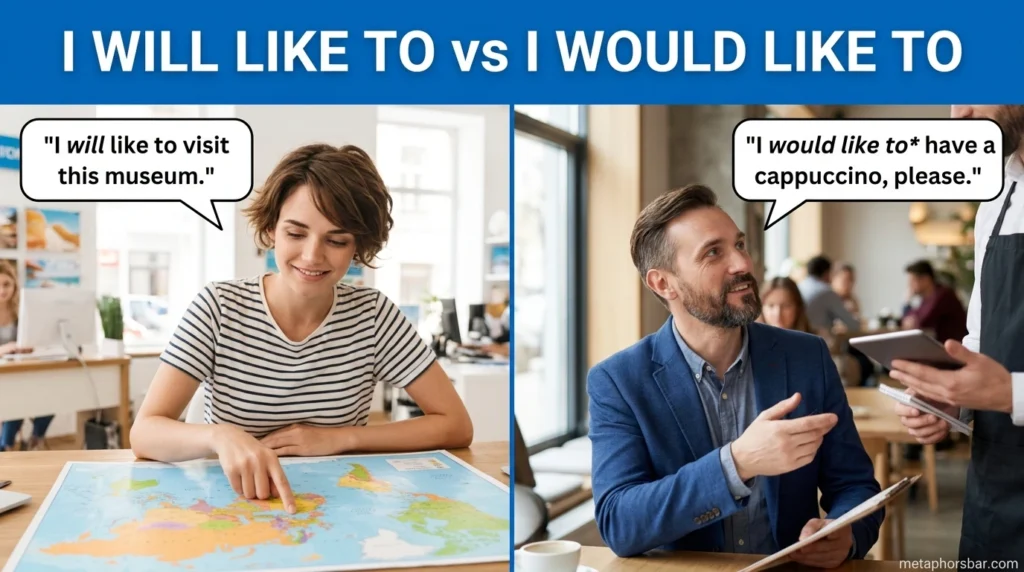
English learners often get confused by i will like to vs i would like to because the two phrases look very similar, and both seem to express a desire to do something. But in real English, they do not work the same way. One phrase sounds natural, polite, and standard. The other often sounds awkward or incorrect in everyday writing, speaking, exams, and professional communication.
This matters because small grammar choices can change how polite, confident, or fluent your English sounds. If you are writing an email, answering in an interview, speaking to a teacher, or completing an exam, choosing the correct form helps you sound more natural and more professional.
The short answer is this: “I would like to” is the correct and natural phrase in most situations. “I will like to” is usually not the right choice when you want to express a wish, request, or preference. In this article, you will learn the meaning, grammar rules, correct usage, sentence examples, common mistakes, and easy ways to remember the difference.
What Do “I Will Like To” and “I Would Like To” Mean?
Before choosing the correct form, it helps to understand what each phrase is trying to express.
“I would like to”
This is a polite way to say:
- I want to…
- I wish to…
- I prefer to…
- I am interested in doing something
Examples:
- I would like to order tea.
- I would like to speak with the manager.
- I would like to learn Spanish.
This phrase is very common in:
- formal speech
- polite requests
- business communication
- interviews
- customer service
- written English
“I will like to”
This phrase suggests a future situation in which you will like something. In theory, it can exist, but it is rarely used in the way learners intend.
For example, if you say:
- I will like to join the team.
Most native speakers would think this sounds wrong or unnatural if you mean a request, plan, or polite desire.
Simple meaning table
| Phrase | Usual meaning | Tone | Common use |
| I would like to | polite desire / request | polite, natural | everyday speech, formal writing |
| I will like to | future liking, if used at all | awkward in many contexts | rarely used for requests or intentions |
The key idea
If you want to express:
- a wish
- a request
- a preference
- a polite statement
use I would like to.
Which One Is Correct in Everyday English?
In most situations, I would like to is the correct and preferred form.
Correct examples
- I would like to book a table.
- I would like to know your opinion.
- I would like to apply for the job.
- I would like to leave early today.
Usually incorrect or unnatural examples
- I will like to book a table.
- I will like to know your opinion.
- I will like to apply for the job.
- I will like to leave early today.
Why “would” works better
The word would makes the sentence softer and more polite. It is one of the most common ways to express a polite request or desire.
Compare:
- I want to speak to you.
- I would like to speak to you.
The second sentence is more polite and more formal.
Side-by-side comparison table
| Situation | Better phrase | Example |
| making a polite request | I would like to | I would like to ask a question. |
| expressing preference | I would like to | I would like to have coffee. |
| speaking in a formal setting | I would like to | I would like to thank you. |
| trying to express future liking | very uncommon | I will like the new job, once I start it. |
Important note
In some rare contexts, I will like may be used when someone is talking about a future feeling, not a request.
Example:
- I think I will like the new apartment.
Even here, many speakers would still prefer:
- I think I will like the new apartment.
- I think I would like the new apartment.
But when you add to and use it as a phrase of desire or intention, I would like to is the correct one.
Grammar Rules Behind the Difference
This is mostly a lesson about modal verbs and politeness.
What “would” does
Would is often used to:
- make a statement more polite
- talk about a hypothetical situation
- express a wish or preference
- soften a request
Examples:
- I would like some tea.
- She would like to visit Paris.
- We would like to help you.
What “will” does
Will is usually used for:
- future actions
- promises
- decisions made at the moment of speaking
- predictions
Examples:
- I will call you tomorrow.
- She will arrive at 5 p.m.
- We will help you later.
Why “I will like to” sounds wrong
When you say I will like to, you are mixing the future marker will with the polite desire pattern like to, and that combination does not sound natural in standard English.
Compare:
- I will go.
- I would like to go.
The first is a simple future statement.
The second is a polite expression of desire.
Grammar comparison table
| Word | Main function | Common effect |
| will | future, promise, decision, prediction | direct |
| would | polite request, preference, hypothetical idea | soft, polite |
Sentence patterns
Would like to
- Subject + would like to + base verb
Examples:
- I would like to leave now.
- She would like to join us.
- They would like to speak with you.
Will
- Subject + will + base verb
Examples:
- I will leave now.
- She will join us.
- They will speak with you.
Simple rule
If you are expressing a wish, request, or polite preference, use would like to.
If you are stating a future action, use will.
Sentence Examples: Correct and Incorrect Usage
Examples make this topic much easier to understand.
Correct examples with “I would like to”
- I would like to ask a question.
- I would like to reserve a room.
- I would like to speak with you privately.
- I would like to know more about the course.
- I would like to leave at 6 p.m.
More natural real-life examples
- I would like to thank everyone for their support.
- I would like to work in marketing.
- I would like to make an appointment.
- I would like to try the chicken pasta.
- I would like to finish my homework before dinner.
Incorrect or unnatural examples
- I will like to ask a question.
- I will like to reserve a room.
- I will like to speak with you privately.
- I will like to know more about the course.
- I will like to leave at 6 p.m.
Correct vs incorrect table
| Incorrect | Correct |
| I will like to speak to the manager. | I would like to speak to the manager. |
| I will like to order lunch. | I would like to order lunch. |
| I will like to join the team. | I would like to join the team. |
| I will like to ask for help. | I would like to ask for help. |
Another helpful comparison
- I will like = future liking, possibly about a feeling later
- I would like to = polite expression of desire right now
Example:
- I think I will like the movie.
This is possible if you are predicting your future feeling.
But:
- I will like to watch the movie.
This sounds unnatural if you mean “I want to watch the movie.”
Common Mistakes Learners Make
This topic is small, but the mistakes are very common.
Mistake 1: Using “will” when you need politeness
- Wrong: I will like to speak to the doctor.
- Right: I would like to speak to the doctor.
Mistake 2: Translating directly from another language
Many learners think a literal translation of “I will like to” sounds fine. But English does not use it that way in polite requests.
Mistake 3: Using “will like to” in formal settings
In interviews, emails, and customer service, I would like to sounds more professional.
Mistake 4: Confusing “I would like” with “I’d like”
These are the same in meaning.
- I would like to = full form
- I’d like to = contracted form
Both are correct.
Mistake 5: Thinking “would” means the past here
In this phrase, would like to is not usually about the past. It is a polite form used in the present.
Common mistakes table
| Wrong sentence | Better sentence |
| I will like to ask something. | I would like to ask something. |
| I will like to make a reservation. | I would like to make a reservation. |
| I will like to leave now. | I would like to leave now. |
| I will like to apply for the role. | I would like to apply for the role. |
Easy correction trick
If your sentence sounds like:
- a request
- a wish
- a polite offer
- a preference
then would is usually the right choice.
British vs American English: Is There a Difference?
For this pair, there is no major British vs American English difference. Both varieties use I would like to in the same way.
British English
- I would like to speak to the manager.
- I would like to book a table.
American English
- I would like to speak to the manager.
- I would like to book a table.
Comparison table
| Feature | British English | American English |
| correct polite form | I would like to | I would like to |
| informal contraction | I’d like to | I’d like to |
| “I will like to” for requests | not natural | not natural |
Practical takeaway
This is not a regional spelling issue. The same rule applies in both forms of English. The safe, natural choice is:
- I would like to
Pronunciation and Style
Pronunciation
- I would like to is often spoken as I’d like to in casual conversation.
- The phrase sounds softer and more polite than I want to or I will.
Examples:
- I would like to speak with you.
- I’d like to speak with you.
Both mean the same thing.
Style differences
I would like to can sound:
- polite
- formal
- respectful
- professional
It is a good choice for:
- emails
- interviews
- customer service
- speaking to strangers or superiors
- essays and exam writing
Comparison table: tone
| Phrase | Tone | Best use |
| I would like to | polite, neutral, formal | professional and everyday speech |
| I’d like to | polite, conversational | casual speaking and writing |
| I want to | direct | informal or strong statements |
| I will like to | awkward in most cases | rarely useful |
Style tip
If you want to sound:
- respectful → use I would like to
- natural and friendly → use I’d like to
- direct → use I want to (but this can sound less polite)
FAQs About I Will Like To vs I Would Like To
Is “I will like to” ever correct?
Only in a very limited and literal future sense, such as predicting a future feeling, and even then it often sounds awkward if followed by to. For polite requests or intentions, I would like to is the correct form.
Is “I would like to” more polite than “I want to”?
Yes. I would like to is softer and more polite.
Can I say “I’d like to”?
Yes. It is the contracted form of I would like to, and it is very common in speech.
Which one should I use in an interview?
Use I would like to or I’d like to. Both are natural and polite.
What is the difference between “I would like to” and “I want to”?
- I would like to = polite and softer
- I want to = direct and stronger
Can I use “I will like to” in a formal email?
No, not if you mean a request, wish, or preference. Use I would like to.
Is “would like to” grammatically correct?
Yes. It is one of the most useful and common polite structures in English.
What is the easiest way to remember the rule?
If you are being polite or expressing a desire, choose would like to.
Conclusion
The difference between I will like to and I would like to is simple once you understand the meaning and grammar. In most cases, I would like to is the correct and natural phrase for expressing a wish, preference, or polite request. It sounds respectful, fluent, and professional. I will like to is usually not the right choice when you mean “I want to” or “I wish to.”
Here is the easiest way to remember it:
- will = future, direct, prediction
- would = polite, soft, respectful
So write:
- I would like to ask a question.
- I would like to apply for the job.
- I would like to speak with you.
Not:
- I will like to ask a question.
- I will like to apply for the job.
- I will like to speak with you.
If you remember only one thing, remember this: when you want to sound polite in English, “I would like to” is the phrase you should trust. It is one of the most useful expressions for students, job seekers, professionals, and everyday speakers.