
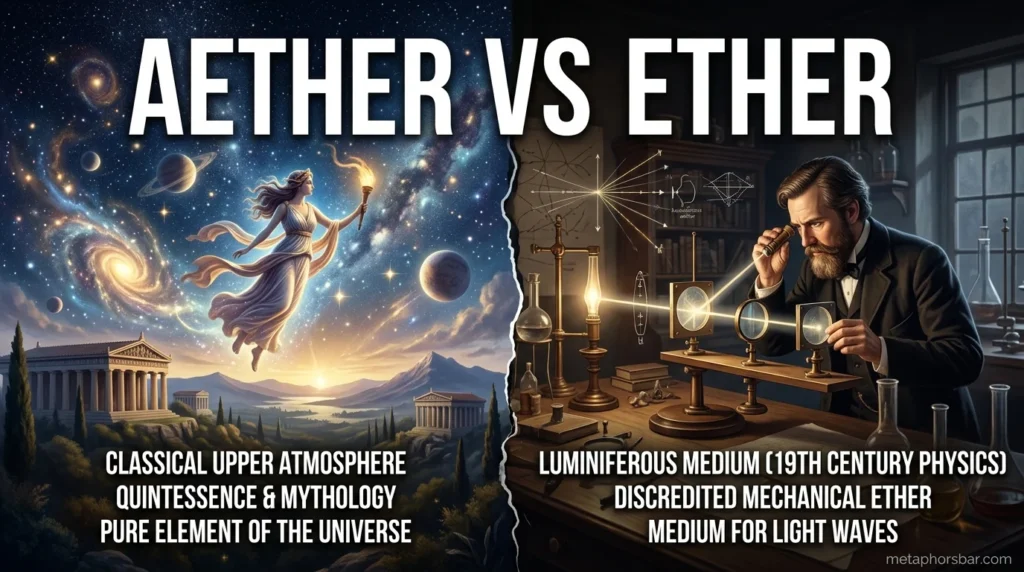
People often get confused about aether vs ether because the two words look almost identical, sound similar, and both feel old or technical. In everyday writing, speaking, exams, or professional communication, that can be a problem if you use the wrong one or if you are not sure which spelling fits your meaning. Some learners see ether in science, while others see aether in fantasy, philosophy, or older literature. That overlap makes the pair easy to mix up.
The good news is that the difference is not hard once you know it. In modern English, ether usually refers to the chemical substance, while aether is an older, more literary or historical spelling that can refer to the upper air, the heavens, or a more poetic idea of the sky. In this article, you will learn the meaning, correct usage, spelling differences, grammar rules, pronunciation, sentence examples, common mistakes, and simple memory tips so you can use both words with confidence.
What Do “Aether” and “Ether” Mean?
The first step is to understand that these words do not always mean the same thing, even though they are related historically.
Ether
In modern English, ether most commonly means:
- a chemical compound used in science and medicine in historical contexts
- a general term in older science for a medium believed to carry light or waves
- in some literary or metaphorical writing, the air or invisible space above us
Aether
Aether is usually the older, more classical spelling of the same “upper air” idea. It often appears in:
- mythology
- philosophy
- poetry
- fantasy writing
- historical or literary references
Simple meaning table
| Word | Main modern meaning | Typical context |
| ether | chemical substance; sometimes a literary or scientific term | science, chemistry, older literature |
| aether | upper air, heavens, or poetic invisible space | mythology, poetry, fantasy, philosophy |
Important note
In everyday modern English, ether is more common than aether. But aether still appears when a writer wants a more classical, mystical, or literary feeling.
A very simple way to think about it
- ether = the usual modern spelling
- aether = the older or more literary spelling
That is the basic distinction most learners need.
Which Spelling Is Correct: Aether or Ether?
The answer depends on the meaning you want.
Use ether when:
- you mean the chemical substance
- you are writing modern scientific English
- you are using the standard modern spelling
- you want the most common and familiar form
Examples:
- The laboratory used ether in the experiment.
- Ether was once used as an anesthetic.
- The reaction involved ether compounds.
Use aether when:
- you are writing about the classical “upper air”
- you want a poetic, mythological, or fantasy tone
- you are referring to older philosophical or literary usage
Examples:
- The stars seemed to shine through the aether.
- The poet spoke of the aether above the earth.
- The novel described energy flowing through the aether.
Comparison table: spelling differences
| Form | Status | Best use |
| ether | modern and standard | science, chemistry, general use |
| aether | older or literary | poetry, mythology, fantasy, classical style |
Which one is more common?
Ether is more common in general English. If you are not sure, ether is usually the safer choice.
Correct and incorrect examples
| Incorrect | Correct |
| The chemistry lesson used aether. | The chemistry lesson used ether. |
| The poet wrote about ether in the heavens. | The poet wrote about aether in the heavens. |
| She read aether in a modern science article. | She read ether in a modern science article. |
Quick rule
If the sentence is about science, choose ether.
If it is about classical, poetic, or mystical sky imagery, choose aether.
Grammar Rules and Word Forms
Both aether and ether are nouns. That means they can be the subject or object of a sentence, and they can be modified by adjectives.
Noun use
Examples:
- Ether is a chemical compound.
- Aether is often used in poetic writing.
Adjectives with these words
- volatile ether
- clear ether
- luminous aether
- celestial aether
Plural form
These words are usually uncountable or used as mass nouns in modern contexts, but plural forms can appear in special or technical cases.
- ethers = multiple chemical ethers
- aethers = extremely rare, literary, or theoretical plural use
Grammar comparison table
| Word | Part of speech | Common form | Example |
| ether | noun | often uncountable or technical plural ethers | Ether is used in chemistry. |
| aether | noun | rare plural aethers | The aether filled the poem’s sky. |
Common grammar patterns
- be + ether/aether
- use + ether
- speak of + aether
- filled with + aether
Examples:
- Ether was once widely discussed in chemistry.
- The sky was imagined as aether in old philosophy.
- The author used aether as a symbol of mystery.
Important grammar note
Do not treat these words like verbs or adjectives unless you are using them in a creative or specialized way. In standard usage, they are nouns.
Real-Life Sentence Examples
Seeing the words in context makes the difference much clearer.
Correct examples with ether
- Ether was historically used as an anesthetic.
- The chemistry lab stored ether carefully.
- Scientists discussed ether in early experiments.
- The solvent contained ether compounds.
Correct examples with aether
- The poet wrote of light drifting through the aether.
- In the fantasy novel, magic moved through the aether.
- Ancient thinkers imagined the heavens as aether.
- The story placed the gods above the aether.
More natural examples
- Modern science writing: “The report explains how ether compounds behave.”
- Literary writing: “She walked beneath the glowing aether of the stars.”
Comparison table: usage by context
| Context | Better word | Example |
| chemistry | ether | Ether is a chemical solvent. |
| medicine history | ether | Ether was once used in surgery. |
| poetry | aether | The moon rose through the aether. |
| fantasy | aether | Energy flowed through the aether. |
| philosophy/history | aether | The ancients imagined aether above the earth. |
Correct vs incorrect examples
| Incorrect | Correct |
| Ether floated above the stars in the poem. | Aether floated above the stars in the poem. |
| The lab used aether in the chemical test. | The lab used ether in the chemical test. |
| The fantasy world spoke of ether as divine air. | The fantasy world spoke of aether as divine air. |
| She studied aether in chemistry class. | She studied ether in chemistry class. |
Practical note
If you are writing a school paper, report, or science-related text, ether is usually the better choice. If you are writing fiction, poetry, or mythological description, aether may be the more expressive choice.
British vs American English: Is There a Difference?
There is no major British vs American English difference in the basic meaning of these words. However, ether is the standard modern spelling in both varieties when referring to the chemical substance or scientific usage.
In both British and American English
- ether = the standard scientific spelling
- aether = more literary, historical, or classical
Comparison table
| Feature | British English | American English |
| scientific spelling | ether | ether |
| literary spelling | aether | aether |
| meaning difference | none | none |
| common modern use | ether | ether |
Style note
Some British or American writers may prefer aether in fantasy or classical-style writing, but this is a matter of tone, not regional grammar.
Practical takeaway
You do not need to learn separate rules for British and American English here. The choice is mainly about context and style.
Pronunciation and Style
Pronunciation
These words are very similar in speech.
- ether is often pronounced like EE-ther
- aether is also often pronounced like EE-ther
In many accents, they sound nearly identical, which is why learners may not hear the spelling difference.
Why pronunciation can be confusing
Because they sound alike, speakers may use them interchangeably in conversation. But in writing, the context decides which spelling is correct.
Style difference
- ether sounds modern, scientific, and standard.
- aether sounds classical, poetic, mystical, or old-fashioned.
Comparison table: style choices
| Word | Tone | Best use |
| ether | modern, technical, standard | science and general usage |
| aether | poetic, ancient, literary | fantasy, poetry, philosophy |
Style tip
If you are aiming for clarity, use ether.
If you are aiming for atmosphere, imagery, or a classic feel, use aether.
Example contrast
- Scientific: “The compound ether was used in the experiment.”
- Poetic: “The stars shimmered in the aether.”
Both are correct, but they create very different impressions.
Common Mistakes Learners Make
Because the words look and sound alike, learners often mix them up.
1: Using aether in modern science writing
- Wrong: The lab tested the aether compound.
- Right: The lab tested the ether compound.
2: Using ether in poetic or mythological writing where aether fits better
- Wrong: The gods moved through the ether above the earth.
- Right: The gods moved through the aether above the earth.
3: Thinking they are completely unrelated
They are related historically, so the meaning overlap can be important. But their modern usage differs.
Mistake 4: Using the wrong tone
If you are writing a fantasy novel, ether may sound too technical.
If you are writing a chemistry paper, aether may sound too mystical.
Mistake 5: Confusing spelling because they sound similar
Because both are pronounced almost the same way, spelling mistakes are common.
Common mistakes table
| Wrong sentence | Correct sentence |
| The poem described ether in the sky. | The poem described aether in the sky. |
| The experiment used aether as a solvent. | The experiment used ether as a solvent. |
| She studied aether in chemistry. | She studied ether in chemistry. |
| The novel used ether as a magical force. | The novel used aether as a magical force. |
Easy memory tip
Think:
- ether = earth science and chemistry
- aether = air, ancient, atmosphere, artistic writing
That is not a perfect rule, but it helps many learners remember the difference.
FAQs About Aether vs Ether
Is “ether” the correct modern spelling?
Yes. In modern English, ether is the standard spelling for the chemical and scientific term.
Is “aether” wrong?
No. Aether is correct in literary, historical, mythological, or classical contexts.
Are aether and ether the same word?
Historically, they are closely related. In modern English, they are often treated as different forms for different contexts.
Which one should I use in school writing?
If you mean chemistry or science, use ether. If you are quoting literature or using poetic language, aether may be appropriate.
Why do both words sound the same?
Because English pronunciation often does not clearly distinguish them in many accents. Spelling and context matter more than sound.
Can I use “aether” in fantasy writing?
Yes. It is very common in fantasy, science-fiction, and magical worldbuilding.
Can I use “ether” in poetry?
Yes, but it may sound more technical or modern. If you want a mystical or classical feeling, aether is often better.
Which spelling is better for SEO?
That depends on your audience and topic. For science, ether is likely the better search term. For literary or fantasy topics, aether may be more relevant.
Conclusion
The difference between aether and ether is easy once you focus on context. In modern English, ether is the standard spelling for the chemical and scientific term. Aether is the older, more literary, poetic, or mythological form that refers to the upper air, heavens, or a mystical invisible space.
Here is the simplest way to remember it:
- ether = modern, scientific, standard
- aether = older, poetic, classical, mystical
So write:
- Ether was used in the chemistry lab.
- The poem spoke of the aether above the world.
- Scientists studied ether.
- Fantasy writers may describe magic flowing through the aether.
If you remember only one thing, remember this: use ether for science and aether for poetry or classical imagery. That simple rule will help you choose the right word in writing, reading, and professional communication with confidence.