
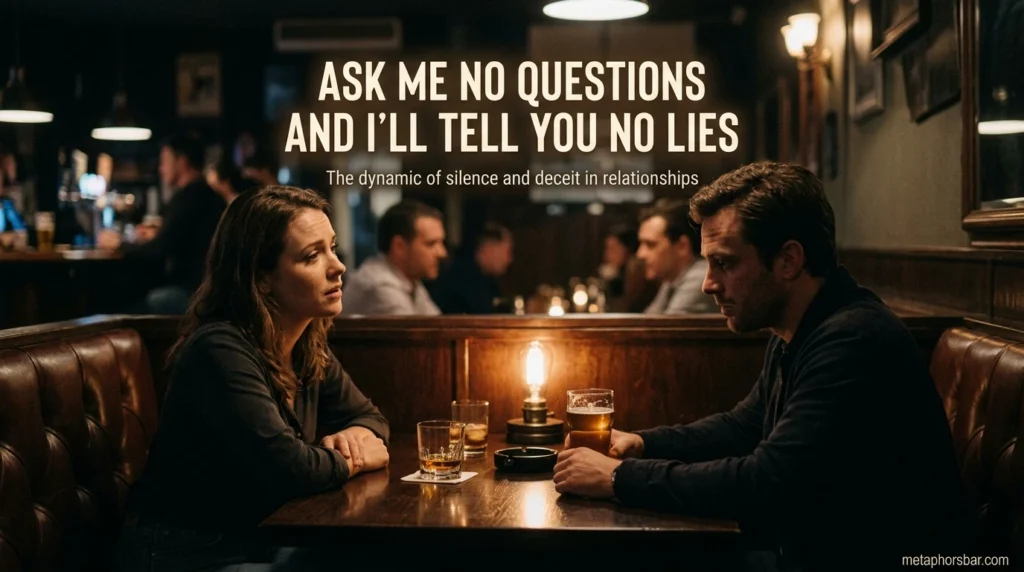
People often get confused by ask me no questions and I’ll tell you no lies because it sounds like a warning, a joke, and a proverb all at once. It is not a literal sentence you would use in every conversation, and it can sound old-fashioned if you have never heard it before. That is exactly why learners wonder what it means, when to use it, and whether it is appropriate in everyday writing, speaking, exams, or professional communication.
This expression matters because English is full of fixed phrases that carry tone as well as meaning. If you understand this one well, you will be better at reading literature, understanding spoken English, and using idiomatic expressions naturally. In this article, you will learn the meaning, grammar, usage, pronunciation, common mistakes, and simple examples so you can use the phrase confidently and correctly.
What Does “Ask Me No Questions and I’ll Tell You No Lies” Mean?
The phrase ask me no questions and I’ll tell you no lies means:
- if you do not ask, I will not answer dishonestly
- I may choose not to answer at all
- sometimes, silence is safer than speaking
- the speaker does not want to explain or reveal more
In simple words, it often means:
- “Do not ask me, and I will not have to lie.”
- “I would rather not discuss this.”
- “If you do not question me, there will be no problem.”
Basic meaning table
| Phrase | Meaning | Tone |
| ask me no questions and I’ll tell you no lies | do not ask, and I will not be forced to lie or explain | cautious, witty, old-fashioned |
| no comment | I will not answer | neutral, modern |
| I’d rather not say | I do not want to explain | polite, guarded |
| let’s not discuss it | avoid the topic | direct, conversational |
What the phrase suggests
The speaker may be:
- hiding something
- avoiding a difficult topic
- being playful or dramatic
- refusing to give details
- suggesting that silence is better than a false answer
Example in simple English
If someone asks too many personal questions, another person might say this phrase to mean:
- “Please don’t push me, because I don’t want to answer.”
It can sound humorous, but it can also sound defensive or secretive depending on the situation.
Where Does the Phrase Come From?
This expression is an old English proverb. It has been used for a long time in speech and writing, and it often appears in literature, storytelling, and informal conversation.
Why it became popular
People have always faced situations where:
- they did not want to answer a question
- they wanted to avoid lying
- they preferred silence over explanation
The proverb captures that idea in a sharp, memorable way.
Why the phrase sounds old-fashioned
It uses:
- a formal rhythm
- a contracted future form: I’ll
- a proverb-like structure
- a slightly dramatic tone
That is why it can sound literary, traditional, or even humorous in modern English.
Origin summary table
| Feature | Explanation |
| form | proverb / fixed expression |
| style | old-fashioned, witty, protective |
| meaning | avoid questions to avoid lies or uncomfortable answers |
| modern use | storytelling, speech, humor, caution |
Important note
You do not usually break the phrase apart and use it as a normal sentence. It works best as a fixed expression, especially when you want to sound expressive or clever
Correct Usage in Real Life
This phrase is not as common in everyday conversation as no comment or I’d rather not say, but it still appears in certain situations.
When to use it
Use the phrase when:
- you want to avoid answering
- you want to sound witty or old-fashioned
- you are writing dialogue
- you want to suggest secrecy or caution
- you are using a proverb-like line in an essay or story
Real-life examples
- When the reporter pressed him for details, he smiled and said, “Ask me no questions and I’ll tell you no lies.”
- She used the phrase jokingly when her friend asked too many personal questions.
- In the novel, the character replied, “Ask me no questions and I’ll tell you no lies,” before changing the subject.
Usage table
| Situation | Example | Effect |
| avoiding personal questions | “Ask me no questions and I’ll tell you no lies.” | guarded, careful |
| joking with a friend | “Ask me no questions…” | playful, informal |
| writing dialogue | character speech | natural, literary |
| refusing to explain | “Ask me no questions…” | firm, indirect |
Tone matters
The phrase can sound:
- humorous
- secretive
- defensive
- cautious
- old-fashioned
That means it is not always suitable for direct business communication. In a formal office email, a simpler phrase may be better.
Better alternatives in formal situations
- I’d rather not discuss that.
- I’m not able to share that information.
- No comment.
- I prefer not to answer.
So, while the idiom is correct, it is best used where its tone fits.
Grammar Rules Behind the Phrase
Even though this is an idiom, the grammar is still easy to understand.
Full structure
Ask me no questions and I’ll tell you no lies.
Break it down:
- Ask me no questions = do not ask me any questions
- and = connects two clauses
- I’ll tell you no lies = I will not lie to you
Grammar comparison table
| Part | Function | Meaning |
| Ask me no questions | imperative clause | do not ask me questions |
| and | conjunction | links the two parts |
| I’ll tell you no lies | future statement | I will not lie |
Why “no questions” and “no lies”?
This is a classic older English structure. Instead of saying:
- do not ask me questions
- I will not tell lies
the proverb uses no questions and no lies for rhythm and emphasis.
Modern grammar equivalent
You could rewrite it in modern English like this:
- If you do not ask me questions, I will not lie.
- If you leave me alone, I will not have to lie.
- If you don’t ask, I won’t tell lies.
Comparison table: old and modern forms
| Traditional proverb | Modern equivalent | Tone |
| Ask me no questions and I’ll tell you no lies. | If you do not ask, I will not lie. | proverb-like vs plain |
| No questions, no lies. | Don’t ask, and I won’t lie. | casual and direct |
| Ask no questions. | I’d rather not say. | guarded |
Important grammar note
This is not the same as a regular request plus a future promise. It is a fixed idiomatic structure, so you should keep the wording stable if you are quoting it.
Pronunciation, Spelling, and Punctuation
Pronunciation
A natural way to say it is:
- ask me no QUES-tions and I’ll tell you no LIES
The rhythm matters because it sounds like a proverb. The phrase is often spoken with a slightly dramatic or humorous tone.
Spelling
The standard spelling is:
- ask me no questions and I’ll tell you no lies
You may also see punctuation variations, depending on style:
- Ask me no questions and I’ll tell you no lies.
- “Ask me no questions and I’ll tell you no lies,” he said.
Spelling and punctuation table
| Element | Correct form | Notes |
| ask | ask | base form |
| questions | questions | plural noun |
| I’ll | I’ll | contraction of I will |
| lies | lies | plural noun |
| punctuation | comma/period/quotation marks | depends on sentence use |
Common spelling confusion
Learners may wrongly write:
- ask me know questions
- ask me no question and I’ll tell you no lies
- ask me no questions and I will tell you no lied
These are not standard forms.
Correct form examples
- Ask me no questions and I’ll tell you no lies.
- “Ask me no questions and I’ll tell you no lies,” she replied.
Style note
Because the phrase is often quoted as a proverb, quotation marks may be used in dialogue or in writing where you are directly repeating the expression.
Sentence Examples: Correct and Incorrect Usage
Examples are the easiest way to learn this phrase.
Correct examples
- Ask me no questions and I’ll tell you no lies.
- He muttered, “Ask me no questions and I’ll tell you no lies,” and walked away.
- She laughed and said, “Ask me no questions and I’ll tell you no lies.”
- When the topic became uncomfortable, he used the old line: ask me no questions and I’ll tell you no lies.
- The character answered, “Ask me no questions and I’ll tell you no lies,” which made everyone laugh.
More real-life examples
- In a joke with friends: “Ask me no questions and I’ll tell you no lies.”
- In a story: The old man smiled and said, “Ask me no questions and I’ll tell you no lies.”
- In a complaint-free way: I’m not explaining anything; ask me no questions and I’ll tell you no lies.
Incorrect examples
- Ask me no questions and I will tells you no lies.
- Ask me no question and I’ll tell you no lie.
- Ask me no questions and I’ll telling you no lies.
- Ask me no questions and I’ll tell you no lyes.
Correct vs incorrect table
| Incorrect | Correct |
| Ask me no question and I’ll tell you no lie. | Ask me no questions and I’ll tell you no lies. |
| Ask me no questions and I will tells you no lies. | Ask me no questions and I’ll tell you no lies. |
| Ask me no questions and I’ll telling you no lies. | Ask me no questions and I’ll tell you no lies. |
| Ask me know questions and I’ll tell you no lies. | Ask me no questions and I’ll tell you no lies. |
Sentence pattern tip
This phrase is often used:
- as a full sentence
- in dialogue
- as a quoted proverb
- in a humorous or defensive reply
It is not usually inserted casually into formal prose unless the tone is intentionally literary.
British vs American English: Is There a Difference?
There is no major British vs American English difference in the meaning or spelling of this phrase. Both varieties understand it as an old proverb or idiomatic saying.
In British English
- The phrase may sound a bit more traditional or literary.
- It may appear in stories, plays, or older-style conversation.
In American English
- It is also understood, though it may sound old-fashioned or humorous.
- It is more likely to appear in dialogue, writing, or joking speech than in daily casual conversation.
Comparison table
| Feature | British English | American English |
| meaning | same | same |
| spelling | same | same |
| tone | traditional, literary | traditional, humorous |
| common use | dialogue, writing | dialogue, writing, humor |
Practical note
The phrase itself is not a regional grammar issue. The key concern is tone, not nationality.
If you are writing for a general audience, both British and American readers will understand the phrase, but they may see it as:
- old-fashioned
- witty
- evasive
- proverb-like
FAQs About “Ask Me No Questions and I’ll Tell You No Lies”
Is this phrase still used today?
Yes, but not as often as simpler expressions like no comment or I’d rather not say. It is still used for effect, especially in stories, jokes, and clever speech.
What does it mean in simple words?
It means:
- do not ask me questions, and I will not lie to you
- I do not want to explain
- I would rather keep quiet
Is it rude?
Not always. It can sound rude if used sharply, but it can also sound playful or humorous depending on tone and situation.
Is it formal?
No. It is more old-fashioned and expressive than formal.
Can I use it in an exam?
Yes, if the question is about idioms, proverbs, or meaning. But do not force it into an ordinary grammar answer unless it fits the context.
Can I change the words?
Usually no. It is best used in its fixed form:
- Ask me no questions and I’ll tell you no lies.
What are some modern alternatives?
- No comment.
- I’d rather not say.
- I’m not at liberty to say.
- Let’s not go into that.
Is it a proverb or an idiom?
It can be treated as both:
- a proverb because it teaches a general truth
- an idiomatic expression because its meaning is not fully literal
Conclusion
The phrase ask me no questions and I’ll tell you no lies is a fixed, old-fashioned, and expressive English saying. It means that if someone does not ask you to explain something, you will not need to lie or give a dishonest answer. It can sound witty, guarded, playful, or slightly secretive depending on the situation.
Here is the easiest way to remember it:
- ask me no questions = do not ask
- I’ll tell you no lies = I will not lie
- the whole phrase = a caution against asking awkward questions
So use it when:
- you want to quote a proverb
- you are writing dialogue
- you want a clever or humorous tone
- you want to suggest that silence is safer than explanation
If you remember only one thing, remember this: it is a fixed, idiomatic phrase, so keep the wording together and use it when you want to sound proverb-like or slightly guarded. That will help you understand it clearly and use it naturally in reading, writing, and conversation.