
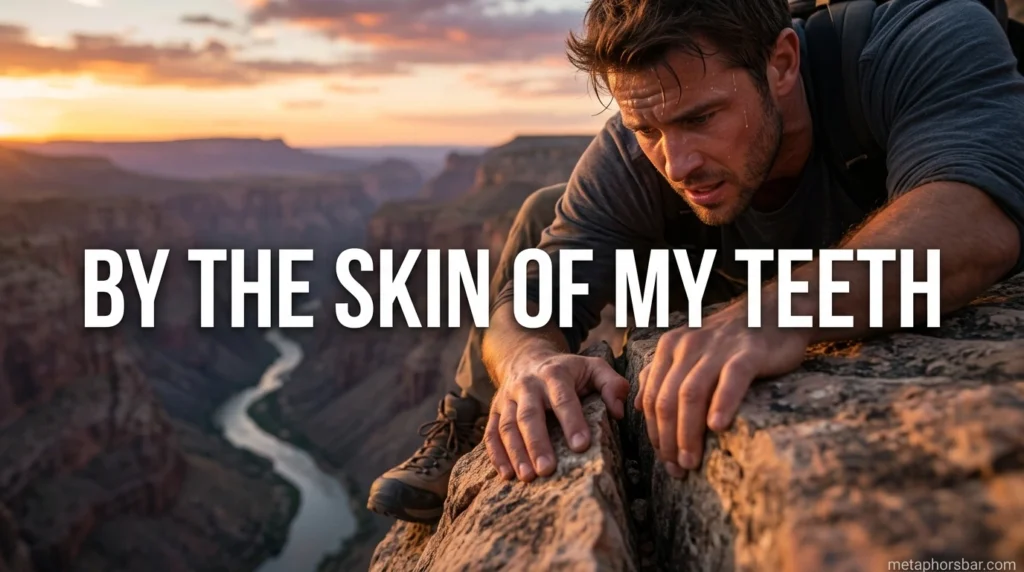
People often get confused by by the skin of my teeth because it sounds strange if you take it literally. Teeth do not really have skin, so learners naturally wonder what the phrase means and whether it is correct English. That matters in everyday writing, speaking, exams, and professional communication because idioms can make your English sound natural and expressive, but only if you use them correctly.
The good news is that this phrase is easy to understand once you know its meaning. By the skin of my teeth means barely, by a very small margin, or only just. It is used when something succeeds, happens, or is avoided with almost no room to spare. In this article, you will learn the meaning, correct usage, grammar rules, pronunciation, sentence examples, common mistakes, and memory tips so you can use it confidently.
What Does “By the Skin of My Teeth” Mean?
The idiom by the skin of my teeth means only just, barely, or narrowly. It is usually used to describe a close escape or a very small success.
Simple meaning
- barely
- only just
- narrowly
- by a very small margin
- with almost no extra room
Examples
- I passed the test by the skin of my teeth.
- The team won by the skin of their teeth.
- We caught the train by the skin of our teeth.
What the phrase suggests
It often gives a feeling of:
- relief
- danger
- luck
- close success
- near failure
Comparison table: basic meaning
| Phrase | Meaning | Tone |
| by the skin of my teeth | barely, narrowly | informal, vivid |
| barely | only just | neutral |
| narrowly | by a small margin | neutral/formal |
| just in time | at the last possible moment | common, neutral |
A simple way to think about it
If something happened by the skin of your teeth, it almost did not happen. There was very little time, space, or margin left.
Where Did the Phrase Come From?
This idiom is old and unusual. The phrase appears in the Bible in the Book of Job, where it refers to someone escaping with almost nothing left. Over time, it became a common English expression meaning a very narrow escape or success.
Why the phrase sounds strange
The words are not literal. No one is saying that teeth actually have skin in the usual way. The phrase is a figurative expression that has survived for centuries.
Origin summary table
| Element | Explanation |
| literal image | skin and teeth |
| figurative meaning | barely escaping or succeeding |
| historical source | old religious/literary language |
| modern use | near miss, narrow success |
Why this matters
Knowing the origin helps you remember that the phrase is about extreme closeness. It is not about anatomy. It is about the tiny margin between success and failure.
Correct Usage in Real Life
This phrase is used when someone:
- succeeds with almost no room to spare
- avoids failure or danger by a tiny amount
- manages to do something at the very last moment
Common situations
- passing an exam
- catching a bus or flight
- winning a game
- avoiding an accident
- meeting a deadline
Examples
- I arrived at the station by the skin of my teeth.
- She passed the driving test by the skin of her teeth.
- The plane landed safely by the skin of its teeth.
Comparison table: common uses
| Situation | Example | Meaning |
| exam result | He passed by the skin of his teeth. | barely passed |
| travel | We caught the train by the skin of our teeth. | almost missed it |
| sports | They won by the skin of their teeth. | narrow victory |
| safety | She escaped injury by the skin of her teeth. | very close call |
Tone and style
The phrase is:
- informal
- colorful
- expressive
- dramatic in a mild way
It is very common in:
- conversation
- news stories
- storytelling
- casual writing
- opinion pieces
More examples in context
- “Did you finish the project on time?”
“Yes, by the skin of my teeth.” - “Did you catch the bus?”
“Just by the skin of my teeth.”
That makes the phrase especially useful when you want to show relief or excitement.
Grammar Rules Behind the Phrase
Although by the skin of my teeth is an idiom, it still follows normal grammar patterns.
Basic structure
by + the + skin + of + possessive + teeth
The possessive changes depending on the subject:
- my
- your
- his
- her
- our
- their
Grammar comparison table
| Subject | Correct phrase | Example |
| I | by the skin of my teeth | I escaped by the skin of my teeth. |
| you | by the skin of your teeth | You made it by the skin of your teeth. |
| he/she | by the skin of his/her teeth | She won by the skin of her teeth. |
| we | by the skin of our teeth | We got there by the skin of our teeth. |
| they | by the skin of their teeth | They survived by the skin of their teeth. |
Why the possessive matters
The phrase must agree with the subject of the sentence. You do not say:
- by the skin of me teeth
- by the skin of I teeth
- by the skin of your tooth
The phrase is fixed in structure, but the possessive pronoun changes as needed.
Common sentence patterns
- Verb + by the skin of my teeth
- Made it by the skin of my teeth
- Won by the skin of our teeth
- Survived by the skin of their teeth
Important note
The phrase usually appears with past events because it often describes something that almost failed or almost did not happen.
Examples:
- I passed by the skin of my teeth.
- We caught the train by the skin of our teeth.
- She escaped by the skin of her teeth.
Sentence Examples: Correct and Incorrect Usage
Examples make the phrase much easier to understand and remember.
Correct examples
- I passed the exam by the skin of my teeth.
- They won the match by the skin of their teeth.
- We caught the bus by the skin of our teeth.
- He escaped the accident by the skin of his teeth.
- She finished the assignment by the skin of her teeth.
More real-life examples
- I made it to the interview by the skin of my teeth.
- The dog got through the gate by the skin of its teeth.
- We arrived before the deadline by the skin of our teeth.
Correct ways to use it with different subjects
First person
- I got there by the skin of my teeth.
Second person
- You passed by the skin of your teeth.
Third person singular
- He survived by the skin of his teeth.
Plural
- They escaped by the skin of their teeth.
Incorrect examples
- I passed the exam by the skin of my tooth.
- She won by the skin of her teeths.
- They made it by skin of their teeth.
- He arrived by the skin of teeth.
- We won by the skin in our teeth.
Correct vs incorrect table
| Incorrect | Correct |
| by the skin of my tooth | by the skin of my teeth |
| by skin of our teeth | by the skin of our teeth |
| by the skin of her teeths | by the skin of her teeth |
| by the skin in my teeth | by the skin of my teeth |
A useful pattern to notice
The phrase often follows verbs like:
- pass
- win
- catch
- survive
- escape
- make it
Examples:
- She passed by the skin of her teeth.
- We made it by the skin of our teeth.
That pattern helps the phrase sound natural in real English.
Common Mistakes Learners Make
Because this idiom is unusual, learners often make small but noticeable errors.
1: Changing the plural “teeth”
- Wrong: by the skin of my tooth
- Right: by the skin of my teeth
The phrase always uses teeth, even though it refers to one person.
2: Missing the article “the”
- Wrong: by skin of my teeth
- Right: by the skin of my teeth
3: Misplacing the possessive
- Wrong: by the skin of me teeth
- Right: by the skin of my teeth
4: Taking the phrase literally
Some learners imagine it means a real tooth problem. It does not. It is an idiom meaning a narrow escape or success.
5: Using it in very formal writing without purpose
The phrase is correct, but it sounds colorful and informal. In a legal report or academic paper, a simpler phrase may be better.
Comparison table: common mistakes and fixes
| Mistake | Better version |
| by skin of my teeth | by the skin of my teeth |
| by the skin of my tooth | by the skin of my teeth |
| by the skin of me teeth | by the skin of my teeth |
| by the skin of our tooth | by the skin of our teeth |
Easy memory tip
Remember the phrase as a fixed chunk:
- by the skin of my teeth
Do not try to “correct” the plural. The idiom already uses teeth.
Pronunciation, Style, and British vs American English
Pronunciation
The phrase is usually pronounced like:
- by thuh skin uhv my teeth
The final word teeth is stressed a little because it gives the phrase its memorable ending.
Pronunciation table
| Word | Approximate pronunciation | Notes |
| by | bye | simple |
| the | thuh | usually unstressed here |
| skin | skin | clear consonant sound |
| teeth | teeth | important final word |
Style
The phrase sounds:
- informal
- vivid
- slightly dramatic
- natural in conversation
It is often used in:
- storytelling
- casual conversation
- news reports
- personal writing
- friendly email responses
Comparison table: style choices
| Phrase | Tone | Best use |
| by the skin of my teeth | colorful, informal | speech, stories, casual writing |
| barely | neutral | general writing |
| narrowly | slightly formal | reports, essays |
| just in time | neutral | common conversation |
British vs American English
There is no major British vs American English difference in this idiom. Both varieties understand and use it in the same general way.
Comparison table
| Feature | British English | American English |
| phrase | by the skin of my teeth | by the skin of my teeth |
| meaning | narrow escape/success | narrow escape/success |
| spelling | same | same |
| grammar | same | same |
Practical note
You do not need separate rules for British and American English here. The phrase works the same in both.
FAQs
Is “by the skin of my teeth” correct English?
Yes. It is a correct and well-known idiom.
What does it mean in simple words?
It means:
- barely
- by a very small margin
- with almost no room to spare
Is it formal?
Not really. It is more informal and expressive than formal. It is fine in conversation and storytelling.
Can I use it in writing?
Yes. It works well in casual writing, articles, and creative writing. In formal reports, a simpler phrase may be better.
Can I use it for positive and negative situations?
Mostly it is used for close calls, near misses, or narrow successes. It can feel positive because something worked out, but it may also describe danger or risk.
What are some simpler synonyms?
- barely
- narrowly
- just
- only just
- at the last moment
Can I say “by the skin of his teeth”?
Yes, if the subject is he:
- He passed by the skin of his teeth.
Is it okay to use it in an exam?
Yes, if the question is about idioms or meaning. Just be sure you know the meaning and spelling.
What is the easiest way to remember it?
Think of a close escape:
- almost failed
- almost missed
- almost lost
- but succeeded or survived at the last second
Conclusion
The idiom by the skin of my teeth is a vivid and useful way to say barely, narrowly, or only just. It is used when something succeeds or is avoided with almost no room to spare. The phrase is fixed, so it should always be written as by the skin of my teeth, not by the skin of my tooth or by skin of my teeth.
Here is the easiest way to remember it:
- by the skin of my teeth = a very narrow escape or success
- teeth stays plural
- the is part of the phrase
- the possessive changes with the subject: my, your, his, her, our, their
So write:
- I passed by the skin of my teeth.
- We caught the train by the skin of our teeth.
- She survived by the skin of her teeth.
- They won by the skin of their teeth.
If you remember only one thing, remember this: the phrase means “barely” or “narrowly,” and the correct fixed form is by the skin of my teeth. That simple rule will help you use it naturally and confidently in speaking, writing, and everyday English.