
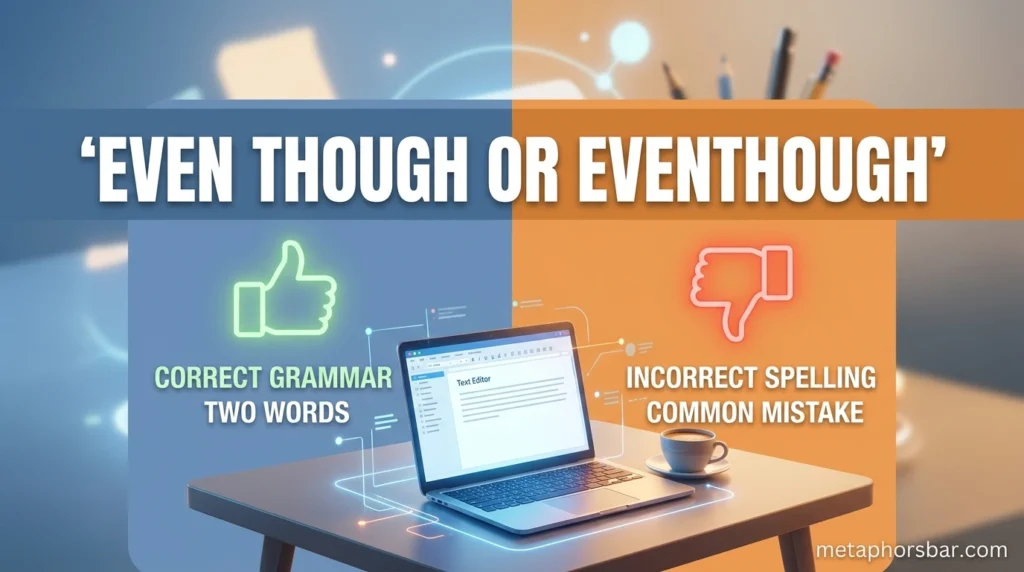
Many English learners get confused by even though and eventhough because the two forms look very similar when written quickly, and in speech they sound almost the same. That makes it easy to assume both spellings are correct. But in everyday writing, speaking, exams, and professional communication, a small spacing mistake can change the quality of your English and make your writing look less careful.
The good news is that the rule is simple. Even though is the correct form. Eventhough written as one word is not standard English. In this article, you will learn the meaning of even though, how to use it correctly, why eventhough is wrong, sentence patterns, common mistakes, pronunciation tips, examples, and simple memory tricks so you can use the phrase confidently.
What Does “Even Though” Mean?
The phrase even though is used to show a contrast or surprising fact. It means although, despite the fact that, or in spite of the fact that.
Simple meaning
- although
- despite the fact that
- in spite of the fact that
- though something is true, the opposite result still happens
Examples
- Even though it was raining, we went for a walk.
- She smiled even though she was tired.
- He finished the job even though it was difficult.
Why it is useful
This phrase helps you show two ideas that contrast with each other:
- one part of the sentence creates a problem or challenge
- the other part shows what actually happened
Comparison table: meaning of similar expressions
| Expression | Meaning | Tone |
| even though | despite the fact that | common, clear |
| although | despite the fact that | formal or neutral |
| though | despite the fact that | casual or neutral |
| despite | in spite of | formal and concise |
Simple way to remember it
If you can replace it with although, then even though is probably the right phrase.
Examples:
- Even though he was busy, he helped me.
= Although he was busy, he helped me.
The phrase shows contrast, but it does not change the basic truth of the sentence.
Is “Eventhough” Correct English?
No, eventhough written as one word is not standard English. The correct form is even though with a space between the two words.
Correct
- even though
Incorrect
- eventhough
Why people make this mistake
The mistake happens because:
- the words are often spoken quickly
- they sound like one unit
- texting and informal writing make spacing errors more common
- learners may think the phrase is a compound word
Comparison table: spelling differences
| Form | Status | Notes |
| even though | correct | standard English phrase |
| eventhough | incorrect | common misspelling |
| even-though | incorrect | not standard |
| even though, | correct with comma if needed | punctuation depends on sentence |
Why the space matters
In English, even though is a two-word conjunction-like phrase. It is not normally written as one word.
Correct vs incorrect table
| Incorrect | Correct |
| eventhough it was late, we stayed. | even though it was late, we stayed. |
| I went out eventhough I was tired. | I went out even though I was tired. |
| Eventhough she called, I missed the phone. | Even though she called, I missed the phone. |
Easy memory tip
Think of it as:
- even + though
- two separate words, not one
That small space is important.
Grammar Rules for “Even Though”
Even though is used to introduce a clause. A clause is a group of words with a subject and a verb.
Basic structure
Even though + subject + verb, main clause
Examples:
- Even though I was tired, I kept working.
- Even though she studied hard, she was nervous.
- Even though they are rich, they live simply.
Grammar comparison table
| Structure | Example | Function |
| even though + clause | Even though it was cold, we went outside. | shows contrast |
| although + clause | Although it was cold, we went outside. | same idea |
| though + clause | Though it was cold, we went outside. | shorter and common |
| despite + noun/gerund | Despite the cold weather, we went outside. | contrast with noun phrase |
Important grammar note
After even though, you need a full clause:
- subject
- verb
Correct:
- Even though she was tired, she came.
Incorrect:
- Even though tired, she came.
This sounds incomplete because it is missing the full clause structure.
Difference between “even though” and “despite”
This is a common confusion.
- even though + clause
- despite + noun or gerund
Examples:
- Even though it was raining, we went out.
- Despite the rain, we went out.
- Despite raining, we went out.
Comparison table: even though vs despite
| Phrase | What follows it? | Example |
| even though | clause | Even though it rained, we went out. |
| although | clause | Although it rained, we went out. |
| despite | noun / gerund | Despite the rain, we went out. |
| in spite of | noun / gerund | In spite of the rain, we went out. |
Key rule
Use even though when you want to connect two full ideas and show that one fact is surprising or contrasts with the other.
Sentence Examples: Correct and Incorrect Usage
Examples make this rule much easier to remember.
Correct examples
- Even though it was very hot, we enjoyed the trip.
- She passed the test even though she had little time to study.
- I like the movie even though it was a bit long.
- He kept smiling even though he was upset.
- They continued working even though the power went out.
More real-life examples
- Even though I was late, my teacher was kind.
- She stayed calm even though the situation was stressful.
- We went to the beach even though the forecast said rain.
- He finished the race even though he was injured.
- Even though the price was high, many people bought it.
Incorrect examples
- Eventhough it was late, we stayed.
- Even though late, we stayed.
- Even though raining, we went out.
- We stayed eventhough we were tired.
- He finished the race, even though he injured.
Correct vs incorrect table
| Incorrect | Correct |
| eventhough it was late, we stayed. | even though it was late, we stayed. |
| even though late, we stayed. | even though it was late, we stayed. |
| we stayed eventhough we were tired. | we stayed even though we were tired. |
| even though he injured | even though he was injured |
A useful observation
The phrase often appears at the beginning or middle of a sentence.
Examples:
- Even though it was dark, we found the house.
- We found the house even though it was dark.
Both are correct.
Style note
Starting a sentence with even though is completely fine. It is common in both speaking and writing.
Common Mistakes Learners Make
Because even though is so common, learners often make a few predictable mistakes.
1: Writing it as one word
- Wrong: eventhough
- Right: even though
2: Using “even though” without a full clause
- Wrong: Even though tired, she continued.
- Right: Even though she was tired, she continued.
3: Confusing it with “even if”
This is a very common error.
- even though = something is true
- even if = something may happen or may not happen
Examples:
- Even though it was raining, we went out.
(It really was raining.) - Even if it rains, we will go out.
(The rain may or may not happen.)
Comparison table: even though vs even if
| Phrase | Meaning | Example |
| even though | fact is true | Even though it was raining, we went out. |
| even if | possible condition | Even if it rains, we will go out. |
4: Using “despite” in the wrong structure
- Wrong: Despite it was raining, we went out.
- Right: Even though it was raining, we went out.
- Right: Despite the rain, we went out.
5: Overusing the phrase
It is useful, but too much repetition can make writing feel heavy.
Instead of repeating:
- Even though he was late, he came. Even though he was tired, he stayed. Even though he was busy, he helped.
You can vary your writing:
- Although he was late, he came.
- Despite being tired, he stayed.
- He helped, though he was busy.
Common mistakes table
| Wrong | Correct |
| eventhough he was tired | even though he was tired |
| even though tired, she came | even though she was tired, she came |
| despite he was tired | even though he was tired / despite his tiredness |
| even if it was raining | even though it was raining |
Easy memory tip
Ask yourself:
- Is the fact already true? → even though
- Is it only a possible condition? → even if
That question solves many grammar problems.
Pronunciation and British vs American English
Pronunciation
The phrase is usually pronounced like:
- EE-vuhn THOH
In natural speech, it may sound a little softer and faster.
Pronunciation table
| Phrase | Approximate pronunciation | Notes |
| even | EE-vuhn | soft second syllable |
| though | THOH | rhymes with “go” |
| even though | EE-vuhn THOH | smooth, common phrase |
British vs American English
There is no major British vs American English difference in the meaning or spelling of even though. Both varieties use the same phrase in the same way.
Comparison table
| Feature | British English | American English |
| spelling | even though | even though |
| meaning | same | same |
| grammar | same | same |
| eventhough | incorrect | incorrect |
Style note
The phrase is used commonly in both varieties, whether in conversation, essays, or professional writing.
Practical takeaway
You do not need separate rules for British and American English here. The only important rule is to keep the two words separate and use the correct clause structure.
FAQs
Is “eventhough” a real word?
No, eventhough as one word is not standard English. The correct form is even though.
Is “even though” the same as “although”?
Yes, they are very similar in meaning. Both show contrast.
Can I start a sentence with “Even though”?
Yes. That is perfectly correct.
Example:
- Even though it was late, we continued working.
Can “even though” come in the middle of a sentence?
Yes.
Example:
- We continued working even though it was late.
Is “even though” formal?
It is neutral. It works in both formal and informal writing.
What is the difference between “even though” and “even if”?
- even though = a real fact
- even if = a possible condition
Can I use “despite” instead of “even though”?
Sometimes yes, but the grammar changes.
- Even though it was cold, we stayed.
- Despite the cold, we stayed.
Which is better for exams?
Use even though when the question asks for a conjunction showing contrast. Just make sure it is written as two words.
Conclusion
The correct phrase is even though, written as two separate words. Eventhough is not standard English and should be avoided in writing, speaking tests, emails, and professional communication. The phrase even though is used to show contrast and introduce a clause, just like although.
Here is the easiest way to remember it:
- even though = correct
- eventhough = incorrect
- even though + full clause
- even if = a different meaning, used for possible conditions
So write:
- Even though it was raining, we went out.
- She kept working even though she was tired.
- Although the rule is simple, people often spell it wrong.
If you remember only one thing, remember this: “even though” is always two words and it introduces a real contrast, not a guess or a possibility. That simple rule will help you avoid a common spelling mistake and make your English clearer and more professional.