
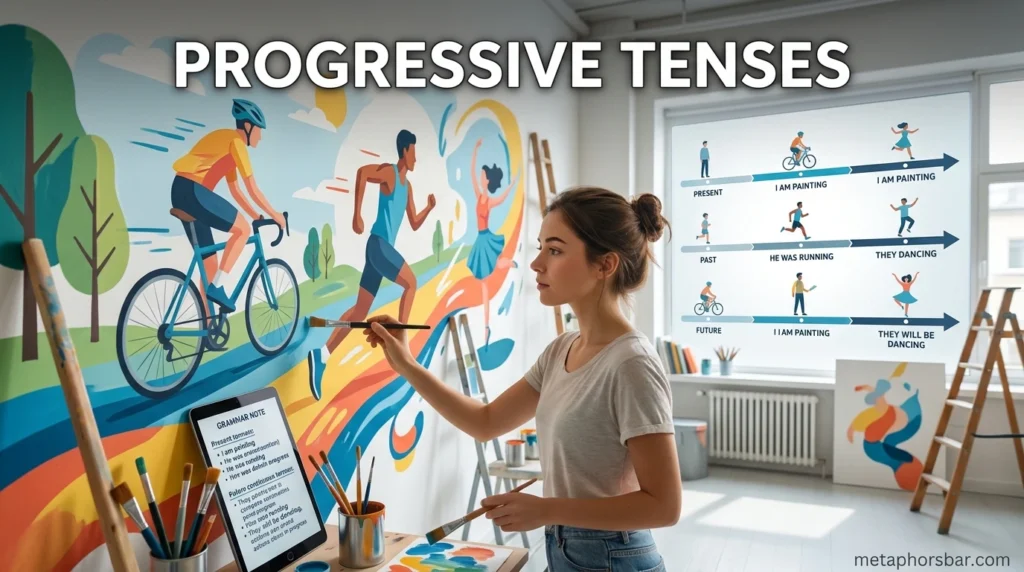
Many English learners get confused by progressive tenses because they show action in motion, and that idea can feel different from the simple tenses we use for facts and finished events. People also mix them up with the continuous form, forget which verb ending to use, or choose the wrong tense in writing and conversation. That matters in everyday English, exams, emails, interviews, and professional communication because tense choice changes meaning. A small tense mistake can make a sentence sound unnatural or unclear.
The good news is that progressive tenses are easy to understand once you see the pattern. They are used to show that an action is in progress, happening over a period of time, or temporarily true. In this guide, you will learn what progressive tenses mean, how to form them, when to use them, common mistakes to avoid, and how to recognize them confidently in real English.
What Are Progressive Tenses?
Progressive tenses, also called continuous tenses, are verb forms that show an action is ongoing or in progress.
Simple definition
A progressive tense tells us that:
- something is happening now,
- was happening in the past,
- will be happening in the future,
- or had been happening before another event.
The basic idea
Progressive tenses focus on movement, duration, and action in progress.
Examples:
- I am studying.
- She was cooking.
- They will be traveling tomorrow.
- He had been waiting for an hour.
Comparison table: progressive vs simple tense
| Type | Example | Main idea |
| simple tense | I study every day. | fact or routine |
| progressive tense | I am studying now. | action in progress |
Why learners find them confusing
The progressive form uses:
- an auxiliary verb like am/is/are/was/were
- plus the -ing form of the main verb
That is simple once you learn the pattern, but at first it can be easy to mix up with other tenses.
Key idea
If you want to show an action in progress, use a progressive tense.
Forms of Progressive Tenses
There are several progressive tenses in English. The most common are:
- present progressive
- past progressive
- future progressive
- present perfect progressive
- past perfect progressive
- future perfect progressive
Common progressive tenses table
| Tense | Form | Example |
| present progressive | am/is/are + verb-ing | I am reading. |
| past progressive | was/were + verb-ing | She was reading. |
| future progressive | will be + verb-ing | They will be reading. |
| present perfect progressive | have/has been + verb-ing | We have been reading. |
| past perfect progressive | had been + verb-ing | He had been reading. |
| future perfect progressive | will have been + verb-ing | I will have been reading. |
What they all have in common
Every progressive tense uses:
- a form of be or have been
- the -ing form of the verb
Example with the verb “work”
- I am working.
- I was working.
- I will be working.
- I have been working.
- I had been working.
- I will have been working.
Main rule
The -ing form is a big clue that a progressive tense is being used.
How to Form Progressive Tenses
The formula for progressive tenses is very regular.
Basic structure
be verb + main verb-ing
Examples:
- am studying
- is running
- are waiting
- was speaking
- were dancing
Formation table
| Subject | Present progressive | Past progressive |
| I | am working | was working |
| He / She / It | is working | was working |
| We / You / They | are working | were working |
Add the “-ing” form
Most verbs simply add -ing:
- walk → walking
- read → reading
- play → playing
Spelling changes before -ing
Some verbs change spelling when adding -ing:
| Base verb | -ing form | Rule |
| make | making | drop silent e |
| run | running | double final consonant |
| lie | lying | change ie to y |
| swim | swimming | double final consonant |
Correct examples
- She is making dinner.
- He is running fast.
- They are lying on the grass.
- We are swimming in the pool.
Incorrect examples
- She is makeing dinner.
- He is runing fast.
- They are lieing on the grass.
- We are swiming in the pool.
Important note
The spelling of the main verb matters, but the grammar pattern stays the same:
- be + verb-ing
When Do We Use Progressive Tenses?
Progressive tenses are used in several common situations.
1) Action happening now
Use the present progressive to show something is happening at the moment.
Examples:
- I am writing an email.
- She is studying for the test.
- They are playing football.
2) Temporary situations
Use progressive tenses for situations that are not permanent.
Examples:
- He is living with his aunt this month.
- I am working from home this week.
- They are staying at a hotel.
3) Actions in progress at a specific time in the past
Use past progressive for an action that was happening at a certain time.
Examples:
- I was sleeping at 10 p.m.
- She was cooking when I arrived.
- They were talking during the meeting.
4) Longer actions before now
Use present perfect progressive for actions that started in the past and continue now or recently ended.
Examples:
- I have been studying for two hours.
- She has been working here since June.
- They have been waiting all morning.
5) Future actions in progress
Use future progressive for actions that will be happening later.
Examples:
- I will be traveling next week.
- She will be working late tonight.
- They will be meeting us at the station.
Usage table
| Situation | Tense | Example |
| action happening now | present progressive | I am reading now. |
| temporary situation | present progressive | She is living in Paris. |
| action in progress in the past | past progressive | They were watching TV. |
| action continuing from past to now | present perfect progressive | He has been waiting for hours. |
| action in progress in the future | future progressive | We will be arriving soon. |
Easy rule
If the sentence focuses on ongoing action, a progressive tense is often the right choice.
Sentence Examples: Correct and Incorrect Usage
Examples are the best way to understand progressive tenses.
Present progressive examples
- I am learning English.
- She is cooking dinner.
- They are watching a movie.
- He is speaking to the manager.
Past progressive examples
- I was reading when the phone rang.
- She was walking to school.
- They were playing outside.
- We were discussing the plan.
Future progressive examples
- I will be traveling tomorrow.
- She will be working at 9 a.m.
- They will be meeting us later.
- We will be staying at my brother’s house.
Perfect progressive examples
- I have been studying for three hours.
- He had been waiting before the bus arrived.
- They will have been working for ten hours by then.
Correct vs incorrect table
| Incorrect | Correct |
| She is cook dinner. | She is cooking dinner. |
| They was playing outside. | They were playing outside. |
| I have study for two hours. | I have been studying for two hours. |
| He will be work tomorrow. | He will be working tomorrow. |
More real-life examples
- Present: I am checking my messages.
- Past: She was listening when I called.
- Future: He will be driving home later.
- Present perfect progressive: We have been waiting for the bus.
- Past perfect progressive: They had been talking for an hour before the class started.
What to notice
In progressive tenses, the action is not finished or not shown as finished. The focus is on the action being in progress.
Common Mistakes Learners Make
Progressive tenses are common, so learners make some predictable mistakes.
1: Forgetting the -ing form
- Wrong: He is play football.
- Right: He is playing football.
2: Using the wrong form of be
- Wrong: They is working.
- Right: They are working.
3: Using progressive with stative verbs
Some verbs usually do not appear in progressive form, such as:
- know
- believe
- understand
- love
- hate
- own
Examples:
- Wrong: I am knowing the answer.
- Better: I know the answer.
- Wrong: She is loving this idea.
Sometimes this can work in casual, emotional speech, but in many cases love is a stative verb and is better in simple form.
Stative verb table
| Usually not progressive | Better form |
| know | I know |
| believe | I believe |
| understand | I understand |
| own | We own a car |
| like | She likes music |
4: Confusing present progressive and simple present
- Wrong: I am work every day.
- Right: I work every day.
Use simple present for routines and facts, progressive for action in progress.
5: Forgetting time context
You need to choose tense based on the time reference.
- Wrong: She was cooking now.
- Right: She is cooking now.
Common mistake table
| Wrong | Correct |
| I am work now. | I am working now. |
| They was talking. | They were talking. |
| I am knowing him. | I know him. |
| She will be go tomorrow. | She will be going tomorrow. |
Easy memory tip
Ask:
- Is the action in progress?
- Is it temporary?
- Is there a -ing form with be?
If yes, progressive tense may be the answer.
Pronunciation, British vs American English, and Style
Pronunciation
The progressive form is usually easy to hear because of the -ing ending.
Examples:
- reading
- writing
- walking
- talking
In fast speech, -ing may sound a little like -in in casual conversation, but in writing it stays -ing.
Pronunciation table
| Word | Pronunciation clue | Example |
| reading | REE-ding | I am reading. |
| working | WER-king | She is working. |
| waiting | WAY-ting | They are waiting. |
British vs American English
There is no major difference in the grammar rules of progressive tenses between British and American English. Both use them in the same way.
Style note
However, some differences in word choice may appear in examples:
- American English: I’m working from home
- British English: I’m working from home
This sentence is the same, so no issue here.
The main difference is not in the tense itself, but in vocabulary or pronunciation details.
Style comparison table
| Feature | British English | American English |
| progressive tense rule | same | same |
| use of -ing forms | same | same |
| main difference | pronunciation, vocabulary | pronunciation, vocabulary |
Practical takeaway
You do not need separate rules for British and American English here. The progressive tense works the same in both.
FAQs
What are progressive tenses?
They are verb forms that show action in progress, using be + verb-ing or similar structures.
Are progressive tenses and continuous tenses the same?
Yes. In most grammar books, progressive and continuous mean the same thing.
How many progressive tenses are there?
There are six commonly taught:
- present progressive
- past progressive
- future progressive
- present perfect progressive
- past perfect progressive
- future perfect progressive
Do all verbs work in progressive form?
No. Some verbs, especially stative verbs like know, own, and believe, usually do not appear in progressive form.
Is “I am knowing” correct?
Usually no. Say:
- I know the answer.
Which tense do I use for an action happening now?
Use the present progressive:
- I am studying now.
Which tense do I use for something happening over a period of time?
Often the present perfect progressive:
- I have been studying for two hours.
Which tense do I use for an action in progress in the past?
Use the past progressive:
- She was reading when I arrived.
Are progressive tenses common in spoken English?
Yes, very common. They are used all the time in conversation, writing, and formal English.
Conclusion
Progressive tenses are one of the most useful parts of English grammar because they help us show action in progress, temporary situations, and ongoing events. The structure is simple: be + verb-ing. Once you know that pattern, the rest becomes much easier.
Here is the easiest way to remember them:
- Present progressive = happening now
- Past progressive = happening at a past time
- Future progressive = will be happening later
- Perfect progressive = action continuing over time
So write:
- I am studying now.
- She was cooking when I called.
- They will be working tomorrow.
- We have been waiting for an hour.
If you remember only one thing, remember this: progressive tenses show action in motion, and the -ing form is the clearest signal. That simple rule will help you choose the right tense, avoid common mistakes, and sound more natural in both speech and writing.