
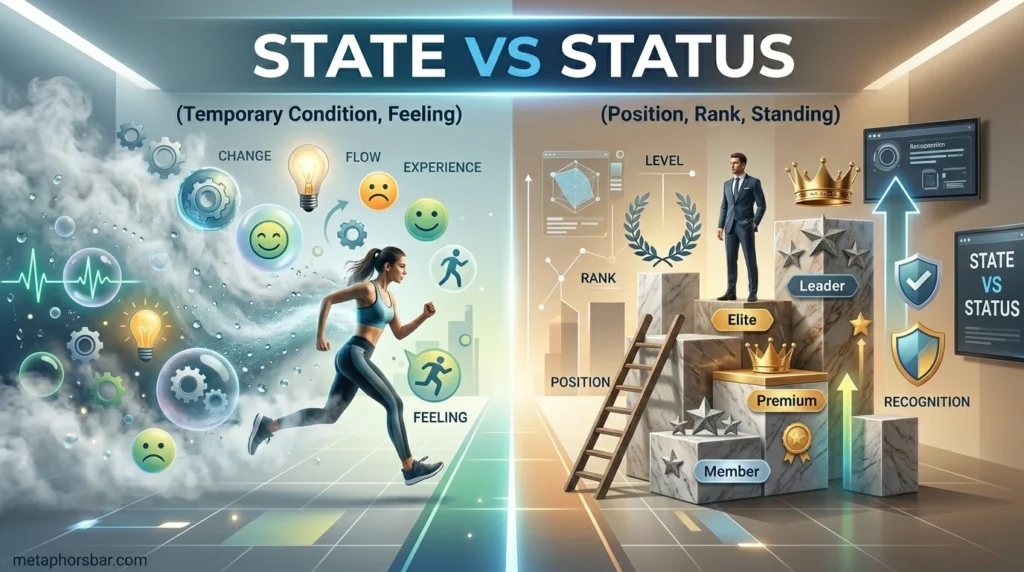
People often get confused by state vs status because the two words seem close in meaning and both appear in formal writing, everyday conversation, and professional communication. In some sentences they can overlap a little, but they are not identical. That small difference matters in emails, reports, exams, job applications, and clear spoken English because using the wrong word can make your sentence sound awkward or less precise.
The good news is that the difference is easy to understand once you see the basic idea. State usually refers to a condition, situation, or way something exists. Status usually refers to a rank, position, condition in a system, or current standing. In this article, you will learn the meaning, correct usage, grammar rules, spelling differences, sentence examples, common mistakes, pronunciation, and simple memory tips so you can use both words confidently.
What Does “State” Mean?
The word state has several common meanings, but most of them relate to condition, situation, or way of being.
Main meanings of “state”
- a condition or way something is
- a situation at a particular time
- a political unit in a country
- to express something formally
Examples of “state”
- The room is in a poor state.
- He was in a calm state of mind.
- The country is made up of several states.
- She stated her opinion clearly.
Simple meaning table
| Meaning of state | Example | Context |
| condition | The car is in bad state. | everyday description |
| situation | The country is in a state of emergency. | formal/general |
| political unit | Texas is a state in the USA. | geography/politics |
| express formally | He stated the facts. | verb use |
Key idea
When state is a noun, it often means:
- condition
- situation
- way of being
When it is a verb, it means:
- to say
- to declare
- to express clearly
That is why state is a very flexible word.
What Does “Status” Mean?
The word status usually means social position, rank, standing, condition in a system, or current position. It is often used in formal, technical, or official contexts.
Main meanings of “status”
- position or rank
- current condition or standing
- legal or social situation
- progress in a system
Examples of “status”
- What is the status of your application?
- She has high social status.
- The project is still in progress; that is its current status.
- He checked the delivery status online.
Simple meaning table
| Meaning of status | Example | Context |
| position or rank | She has high status in the company. | social/work |
| current standing | What is the status of the case? | formal/official |
| progress update | Check the order status online. | technical/business |
| legal standing | His immigration status changed. | legal |
Key idea
Status often answers the question:
- “What is the current position or condition in a system?”
That is why it is common in:
- business
- law
- medicine
- technology
- social descriptions
State vs Status: The Main Difference
The two words can sometimes overlap, but they are not the same.
State
Usually means:
- condition
- situation
- form of being
Status
Usually means:
- standing
- rank
- position
- condition within a system
Side-by-side comparison table
| Word | Main idea | Common use |
| state | condition or situation | general English, descriptions |
| status | rank or standing | formal, social, technical, legal |
Easy comparison
- The car is in a bad state.
Here, state means condition. - The status of the car order is delayed.
Here, status means current progress or standing in a system.
Another comparison
- State of mind = how someone feels mentally
- Status update = current progress or standing
Practical rule
Use state when you mean:
- how something is
- the condition of something
- a general situation
Use status when you mean:
- rank
- social position
- current standing in a formal or technical system
Grammar Rules and Word Forms
Both words are nouns, but state can also be a verb.
State as a noun
Examples:
- The house is in a bad state.
- She is in a nervous state.
State as a verb
Examples:
- He stated the reason clearly.
- Please state your name and address.
- The report states the facts.
Status as a noun
Examples:
- The status of the account is pending.
- Her social status has changed.
- The legal status of the case is unclear.
Word form table
| Word | Part of speech | Example |
| state | noun | The room is in a bad state. |
| state | verb | He stated his opinion. |
| status | noun | Check the status of your order. |
Plural forms
Both words have plural forms in certain uses:
- states = more than one state, especially political units or conditions
- statuses = more than one status, though this is less common in everyday speech
Plural table
| Singular | Plural | Example |
| state | states | The United States has 50 states. |
| status | statuses | The system shows different statuses for users. |
Important note
The plural statuses is correct, though some writers avoid it by rephrasing:
- different status levels
- different levels of status
This makes the sentence smoother if you want to sound more natural.
Sentence Examples: Correct and Incorrect Usage
Examples make the difference much easier to understand.
Correct examples with state
- The building is in a dangerous state.
- She was in a cheerful state after the news.
- The country declared a state of emergency.
- He stated the answer clearly.
- The room was in a complete state after the party.
Correct examples with status
- What is the status of my application?
- His social status improved over time.
- The delivery status is “out for delivery.”
- She checked the project status on the dashboard.
- The legal status of the child is being reviewed.
More real-life examples
- State: “The car is in a terrible state after the accident.”
- Status: “What is the status of the repair?”
- State: “He was in a state of shock.”
- Status: “Her job status is now full-time.”
Incorrect examples
- The status of the room is dirty.
- What is the state of your application?
- He stated his application online.
- The car is in a good status.
Correct vs incorrect table
| Incorrect | Correct |
| The status of the room is dirty. | The state of the room is dirty. |
| What is the state of your order? | What is the status of your order? |
| The car is in a good status. | The car is in good condition / state. |
| He stated the project is delayed. | He stated that the project is delayed. |
A useful observation
Some sentences may be possible with both words only if the meaning changes.
For example:
- The state of the project is bad.
This focuses on the project’s condition. - The status of the project is bad.
This sounds less natural unless you mean its position in a system or progress update.
So always think about the exact idea you want to express.
Common Mistakes Learners Make
Because these words overlap a little, learners often make predictable mistakes.
1: Using status when you mean condition
- Wrong: The house is in a bad status.
- Right: The house is in a bad state.
2: Using state when you mean standing or progress in a system
- Wrong: What is the state of my application?
- Right: What is the status of my application?
3: Forgetting that state is also a verb
- Wrong: He state the facts.
- Right: He stated the facts.
4: Using the wrong word in legal or technical writing
In professional contexts, precision matters.
- Wrong: The status of the patient is weak.
Better: The state of the patient is weak / poor. - Wrong: The state of the visa is pending.
Better: The status of the visa is pending.
5: Overusing status in everyday conversation
Sometimes people use status when a simple word would be better.
- Less natural: The status of my mood is bad.
- Better: I am in a bad mood.
- Better: I am not feeling well.
Common mistake table
| Wrong | Correct |
| in a bad status | in a bad state |
| the state of my order | the status of my order |
| he state the reason | he stated the reason |
| their status was old and broken | their state was old and broken |
Easy memory tip
Ask:
- Do I mean condition or situation? → state
- Do I mean standing, rank, or progress? → status
That question solves most confusion.
Pronunciation, Style, and British vs American English
Pronunciation
The words are easy to confuse when spoken quickly, but their sounds are different.
- state → /steɪt/
sounds like “stayt” - status → /ˈstætəs/ or /ˈsteɪtəs/ depending on accent
Pronunciation table
| Word | Approximate pronunciation | Notes |
| state | stayt | rhymes with late |
| status | stat-uhs / stayt-uhs | accent differences exist |
Style
- State is common in everyday English, descriptions, and formal writing.
- Status is common in formal, technical, legal, business, and online contexts.
Style comparison table
| Word | Tone | Best use |
| state | general, descriptive | condition, situation |
| status | formal, official | rank, progress, standing |
British vs American English
There is no major British vs American English difference in the basic meaning of state and status. Both varieties use the words in largely the same way.
Comparison table
| Feature | British English | American English |
| state | same use | same use |
| status | same use | same use |
| main difference | none | none |
Practical takeaway
The real issue is not regional English. It is choosing the right word for the situation.
FAQs
Is “state” the same as “status”?
No. They can overlap a little, but they are not the same.
Which word means condition?
State often means condition.
Which word means rank or standing?
Status often means rank or standing.
Can I say “state of my application”?
Usually no. Use status of my application.
Can I say “status of the room”?
Usually no. Use state of the room or condition of the room.
Is “state” a verb?
Yes. It means to say or declare clearly.
Example:
- Please state your name.
Can “status” be plural?
Yes, the plural is statuses, though it is not very common in casual speech.
Which is more formal?
Status often sounds more official or technical. State is broader and more general.
Can I use either one in a sentence about health?
Not always.
- state of health is common
- status may be used in medical or official records
Which one should I use in exams?
Use the word that fits the meaning:
- condition or situation → state
- position or standing in a system → status
Conclusion
The difference between state and status becomes easy once you focus on the meaning.
- State = condition, situation, form, or way of being
- Status = standing, rank, position, or current condition in a system
So write:
- The room is in a bad state.
- What is the status of your order?
- He is in a calm state of mind.
- Her legal status is still being reviewed.
If you remember only one thing, remember this: use “state” for general condition or situation, and use “status” for rank, standing, or official progress. That simple rule will help you choose the right word in writing, speaking, exams, and professional communication.