
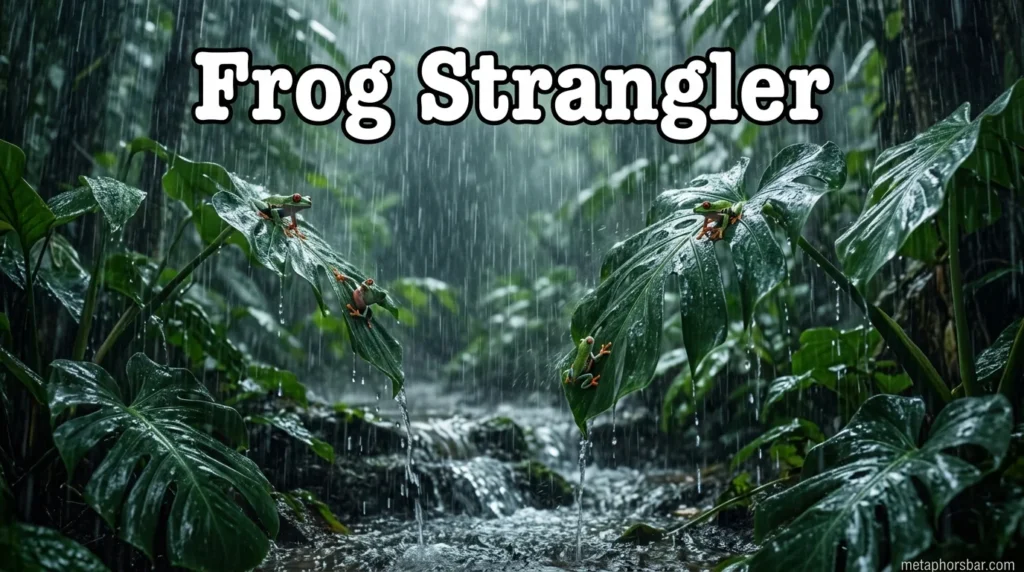
English is full of colorful expressions that sound strange at first but become memorable once you understand them. One such phrase is. If you’ve heard someone use it and wondered whether it is literal, humorous, or slang, you are not alone. Many learners misinterpret it because it sounds dramatic and unusual.
Understanding idioms like this matters because they appear in informal speech, storytelling, regional conversations, and even creative writing. Misunderstanding them can lead to confusion in meaning, especially in exams, reading comprehension, or real-life communication.
This guide breaks down everything about frog strangler—its meaning, origin, usage, grammar behavior, examples, common mistakes, and how native speakers actually use it.
What Does “Frog Strangler” Mean?
The phrase “frog strangler” is an informal, humorous expression used mainly in parts of the United States. It refers to:
A very heavy, intense rainfall or downpour.
It does NOT involve frogs literally or anything violent. Instead, it exaggerates how heavy the rain is.
Simple meaning:
- A very heavy rainstorm
- A torrential downpour
- A sudden, intense rain
Example:
- “We got caught in a frog strangler on the way home.”
This means the person experienced extremely heavy rain.
Why Is It Called “Frog Strangler”?
The phrase comes from Southern American English slang, where people often create vivid, exaggerated expressions for weather.
The idea behind it:
Heavy rain is imagined as being so intense that even frogs (which live in rain-friendly environments) would struggle to survive it.
Of course, this is humorous exaggeration, not literal meaning.
Related expressive weather phrases:
- “It’s raining cats and dogs” (very heavy rain)
- “Downpour”
- “Cloudburst”
- “Washed out storm”
Comparison table: literal vs figurative meaning
| Phrase | Literal meaning | Actual meaning |
| Frog strangler | harming frogs | extremely heavy rain |
| Raining cats and dogs | animals falling | heavy rain |
| Cloudburst | clouds bursting | sudden heavy rain |
Grammar and Structure
From a grammar point of view, frog strangler is a compound noun phrase.
Structure:
- “frog” (noun)
- “strangler” (noun)
Together, they form a figurative noun phrase describing weather.
How it behaves in sentences:
It functions as a noun, usually the subject or object.
Examples:
- “That was a real frog strangler.”
- “We drove through a frog strangler last night.”
Is it countable?
Yes, it can be used as:
- a singular countable noun: a frog strangler
- plural: frog stranglers
Plural examples:
- “We’ve had several frog stranglers this summer.”
Correct Usage in Sentences
Understanding context is important because this phrase is informal and regional.
Natural usage examples:
- “The game was delayed because of a frog strangler.”
- “We barely made it home before the frog strangler started.”
- “That storm turned into a full-on frog strangler.”
Spoken English usage:
- Mostly used in casual conversation
- Common in rural or Southern U.S. dialects
- Rare in formal writing
Comparison: Frog Strangler vs Other Weather Expressions
Let’s compare this phrase with more common English alternatives.
Table: informal vs formal usage
| Informal phrase | Formal equivalent | Meaning |
| frog strangler | heavy rain | very strong rainfall |
| rain bucketed down | heavy rainfall occurred | descriptive |
| cats and dogs raining | heavy rain | idiomatic |
| downpour | torrential rain | formal weather term |
When to use which:
- Informal speech: frog strangler, cats and dogs
- News reports: heavy rain, downpour
- Academic writing: precipitation, rainfall intensity
Common Mistakes Learners Make
Because the phrase is unusual, learners often misunderstand or misuse it.
Mistake 1: Taking it literally
❌ “The frog strangler killed frogs in the pond.”
✔ “The frog strangler is a heavy rainstorm.”
Mistake 2: Using it in formal writing
❌ “The frog strangler caused flooding in the report.”
✔ “The heavy rainfall caused flooding.”
Mistake 3: Confusing it with animals
❌ Thinking it refers to a type of frog
✔ It refers to weather, not animals
Quick correction table
| Incorrect | Correct |
| strangler frog | frog strangler |
| frog killer storm | frog strangler |
| literal frog attack | heavy rain |
British vs American English Usage
The phrase frog strangler is primarily used in:
- Southern United States English
- Rural American dialects
In British English:
It is not commonly used or recognized.
Instead, British speakers prefer:
- “torrential rain”
- “downpour”
- “pouring heavily”
Comparison table:
| Region | Common phrase | Usage level |
| Southern US | frog strangler | informal, regional |
| US general | heavy rain | standard |
| UK English | torrential rain | standard |
Key takeaway:
If you’re writing for a global or academic audience, avoid “frog strangler.” Use standard weather terms instead.
Pronunciation Guide
Even though it’s informal, pronunciation helps in spoken English understanding.
Pronunciation:
- frog → /frɒg/ or /frɑːg/
- strangler → /ˈstræŋɡlər/
Full phrase:
frog straengler → /frɒg ˈstræŋɡlər/
Spoken rhythm:
FROG STRANG-ler (stress on first syllable of “strangler”)
Cultural Context and Usage Style
This phrase reflects a broader feature of English: regional idioms with humor and exaggeration.
Why people use it:
- To sound expressive
- To add humor to storytelling
- To describe extreme weather vividly
Where you’ll hear it:
- Rural conversations
- Weather storytelling
- Casual dialogue in Southern U.S. media
Style comparison table:
| Style | Example |
| Literal | It rained heavily. |
| Standard | There was heavy rainfall. |
| Idiomatic | It was a frog strangler. |
FAQs
Is it a real English word?
It is not formal English—it is an idiom.
Can I use it in essays?
No, avoid it in academic or formal writing.
What does it literally mean?
Literally, it makes no sense—it is figurative language.
Is it common in modern English?
It is still used regionally but not widely across all English speakers.
Conclusion
The phrase “frog strangler” is a vivid, informal American idiom meaning very heavy rain. It does not describe animals or anything literal—it is simply a colorful way of expressing a strong downpour.
To remember it easily:
- It is informal and regional
- It is best used in spoken storytelling, not formal writing
While it may sound strange at first, it is part of the rich variety of English idioms that make the language expressive and fun. Once you understand it, you’ll recognize it easily in conversations and even enjoy how dramatically it describes a simple weather event.