
Imagine opening an old book found on a dusty shelf. The pages whisper softly as they turn, carrying the scent of paper and time. Within seconds, you’re no longer sitting in a quiet room. You’re crossing oceans, meeting heroes, solving mysteries, or traveling through centuries. A book can feel like a doorway, a companion, or even a treasure chest waiting to be unlocked.
That is the beauty of metaphors for books. Books are much more than bound pages filled with words. They hold ideas, emotions, adventures, and wisdom. Metaphors help us express these qualities in vivid and memorable ways, transforming a simple object into something magical and meaningful.
Whether you’re a writer, student, teacher, book lover, or social media creator, learning metaphors for books can enrich your language and make your descriptions more engaging. In this guide, we’ll explore powerful metaphors, creative examples, writing tips, and interactive exercises to help you use book metaphors effectively.
Why Use Metaphors for Books?
They Make Writing More Vivid
Instead of saying a book is interesting, a metaphor paints a picture that readers can instantly imagine.
They Capture Emotional Connections
Books often shape our memories, beliefs, and dreams. Metaphors help communicate those deeper experiences.
They Enhance Creativity
Using figurative language encourages fresh thinking and helps writers avoid repetitive descriptions.
They Make Readers Feel More Engaged
A strong metaphor can turn an ordinary sentence into one readers remember long after they finish reading.
Three Powerful Metaphors for Books
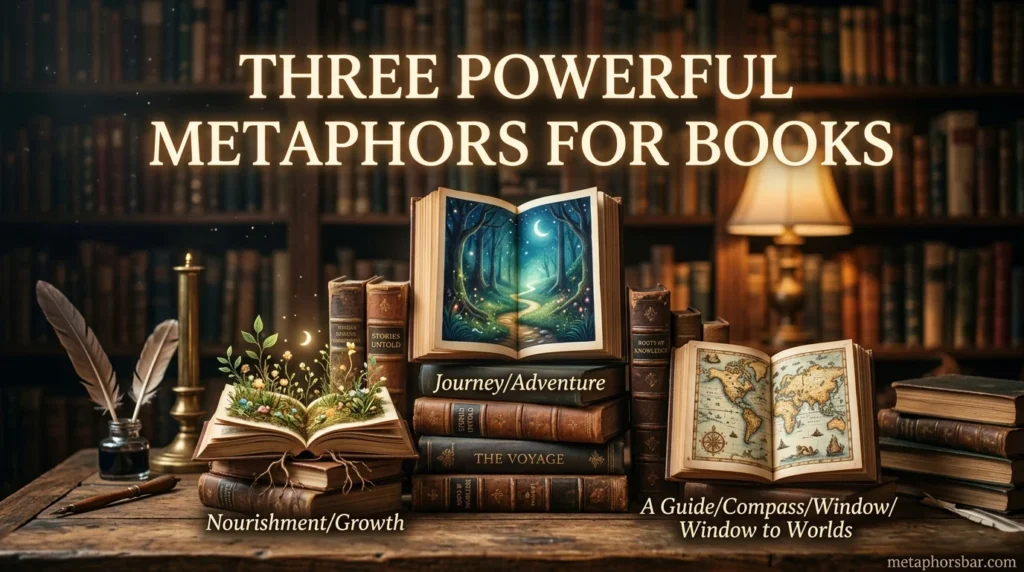
1. A Book Is a Doorway
One of the most popular metaphors for books compares them to doorways.
Meaning and Explanation
A doorway leads from one place to another. Similarly, books transport readers beyond their immediate surroundings into new worlds, ideas, and experiences.
Whether you’re reading fantasy, history, biography, or science fiction, each book opens access to something beyond your current reality.
Example Sentence or Scenario
“The novel was a doorway to a forgotten kingdom where dragons ruled the skies.”
In this example, the book becomes an entrance to adventure rather than simply a collection of pages.
Alternative Ways to Express It
- a gateway to imagination
- a portal to another world
- an entrance to new ideas
- a passage into history
- a key to hidden realms
Sensory and Emotional Details
Imagine standing before a massive wooden door. As it opens, warm light spills out, revealing landscapes, characters, and possibilities. That feeling mirrors the excitement of beginning a new book.
Mini Storytelling Example
A young reader once picked up a fantasy novel during a rainy weekend. Hours later, she emerged from the story feeling as though she had traveled across mountains and battled mythical creatures. The book became more than entertainment—it became a doorway.
Literary and Cultural Reference
Fantasy classics often rely on this concept. Magical wardrobes, secret platforms, and hidden passages symbolize how books transport readers into extraordinary worlds.
2. A Book Is a Treasure Chest
Books are often compared to treasure chests because they contain valuable discoveries waiting to be uncovered.
Meaning and Explanation
Just as treasure chests hold gold, jewels, and rare artifacts, books contain knowledge, wisdom, stories, and inspiration.
Every chapter offers something valuable for readers willing to explore.
Example Sentence or Scenario
“Her bookshelf was a collection of treasure chests, each filled with lessons gathered from different centuries.”
The metaphor highlights the hidden value stored within books.
Alternative Ways to Express It
- a chest of wisdom
- a vault of stories
- a storehouse of knowledge
- a chest of imagination
- a collection of literary gems
Sensory and Emotional Details
Picture opening an old wooden chest and discovering sparkling treasures. Reading can create a similar feeling as unexpected insights and unforgettable characters emerge from the pages.
Mini Storytelling Example
A student struggling with confidence found a biography about an inventor who overcame repeated failures. That single book became a treasure chest containing exactly the encouragement she needed.
Literary and Cultural Reference
Libraries throughout history have been viewed as repositories of priceless treasures because knowledge often proves more valuable than material wealth.
3. A Book Is a Lighthouse
Books frequently guide people through uncertainty, making the lighthouse metaphor especially powerful.
Meaning and Explanation
A lighthouse helps sailors navigate dangerous waters. Likewise, books can provide guidance, wisdom, comfort, and direction during difficult times.
Many readers turn to books when seeking answers or inspiration.
Example Sentence or Scenario
“During a challenging year, that self-help book became a lighthouse that guided him through the storm.”
The metaphor emphasizes support and illumination.
Alternative Ways to Express It
- a beacon of wisdom
- a guiding light
- a compass for life
- a lantern in darkness
- a map through uncertainty
Sensory and Emotional Details
Imagine standing on a rocky shore during a storm. Far in the distance, a bright light cuts through the darkness, showing a safe path forward. That is how a meaningful book can feel.
Mini Storytelling Example
Many people recall a specific book that changed their perspective during a difficult period. For some, it was a novel that offered hope. For others, it was a memoir that provided reassurance. In each case, the book served as a lighthouse.
Literary and Cultural Reference
Throughout history, philosophers, educators, and leaders have described books as lights that illuminate the path toward understanding.
How to Choose the Best Metaphor for Books
Consider the Purpose of the Book
Different books inspire different metaphors.
- Adventure books may feel like doorways.
- Educational books may feel like treasure chests.
- Inspirational books may feel like lighthouses.
Match the Emotion
Think about how the book makes readers feel.
- Excitement
- Curiosity
- Comfort
- Wonder
- Motivation
The metaphor should reflect that emotional experience.
Use Sensory Details
Strong metaphors become even more memorable when paired with sounds, sights, textures, or emotions.
Creative Writing Exercises for Metaphors for Books
Exercise 1: Complete the Metaphor
Finish the sentence:
“A book is a ______ because ______.”
Examples:
- A book is a bridge because it connects different minds and cultures.
- A book is a lantern because it lights the way through confusion.
Exercise 2: Create a Personal Book Metaphor
Think of your favorite book.
Ask yourself:
- How did it change you?
- What emotions did it create?
- What object does it remind you of?
Turn your answer into a metaphor.
Exercise 3: Build a Story Around a Book Metaphor
Choose one metaphor:
- doorway
- treasure chest
- lighthouse
Write a short paragraph explaining how a book became that object for someone.
Exercise 4: Social Media Caption Challenge
Create a caption using a book metaphor:
- “Books are…”
- “Today’s read feels like…”
- “Every chapter is…”
Example:
“Every great book is a passport stamped with imagination.”
Bonus Tips for Using Metaphors for Books
In Fiction Writing
Use book metaphors to describe libraries, reading experiences, and character relationships with literature.
In Essays and Speeches
Metaphors help communicate the importance of reading in a memorable way.
On Social Media
Book-related metaphors make captions more creative and engaging.
Examples:
- “Books are time machines disguised as paper.”
- “Every novel is a doorway waiting to be opened.”
In Education
Teachers can use metaphors to help students appreciate reading and understand abstract concepts.
In Personal Journaling
Reflect on books you’ve read by describing them metaphorically. This encourages deeper thinking and self-expression.
Common Mistakes When Using Book Metaphors
Using Overly Complex Comparisons
Keep metaphors understandable and relevant.
Mixing Too Many Metaphors
Avoid combining unrelated images in a single description.
Forgetting the Emotional Connection
The strongest metaphors capture both meaning and feeling.
Repeating the Same Metaphor
Try varying your imagery to keep your writing fresh and original.
FAQs
1. What is a metaphor for a book?
A metaphor for a book is a figurative comparison that describes a book as something else, such as a doorway, treasure chest, or lighthouse.
2. Why are books often compared to doorways?
Because books transport readers into new worlds, ideas, and experiences, much like a doorway leads to another place.
3. What metaphor best represents educational books?
A treasure chest is often effective because educational books contain valuable knowledge and insights.
4. Can books symbolize guidance?
Yes. Books are frequently compared to lighthouses, compasses, and lanterns because they help guide readers through challenges and uncertainty.
5. How do metaphors improve book descriptions?
They create vivid imagery, strengthen emotional impact, and make writing more memorable.
6. Are book metaphors useful in social media content?
Absolutely. Creative metaphors often make captions more engaging and shareable.
7. How can I create my own metaphor for books?
Think about what books do for you personally and compare that experience to an object, place, or natural phenomenon with similar qualities.
Conclusion
Books have always been more than paper and ink. They are journeys, discoveries, companions, and guides. Through metaphors, we can express their deeper significance in ways that resonate with readers and listeners alike.
Whether you view a book as a doorway to adventure, a treasure chest of wisdom, or a lighthouse in the darkness, each metaphor reveals a different aspect of the reading experience. These comparisons help us appreciate not only what books contain but also how they transform us.
The next time you open a book, pause for a moment and ask yourself: What metaphor best captures this experience? You may discover that every great book is its own unique world waiting to be described.