
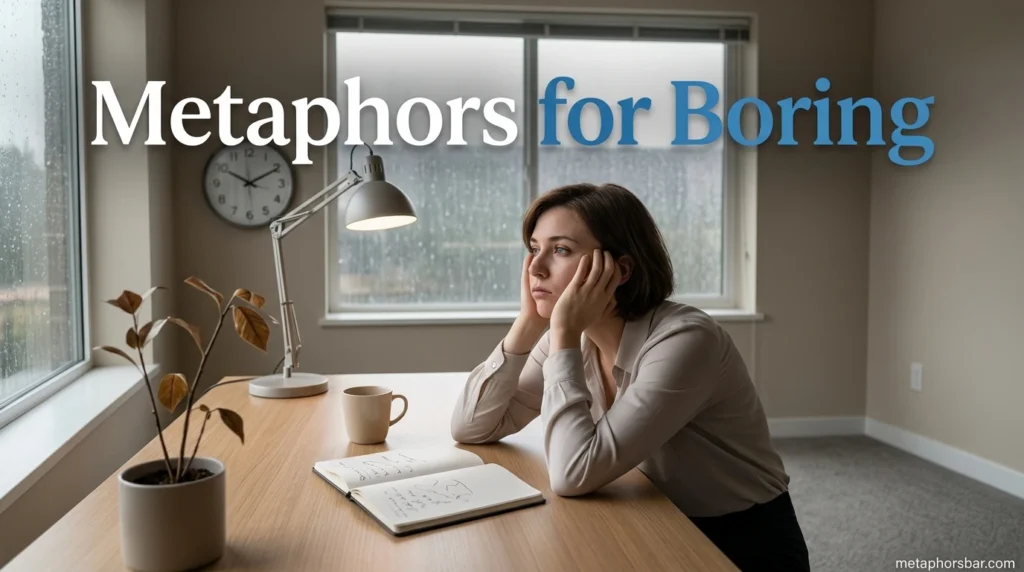
Picture yourself sitting in a classroom on a rainy afternoon. The clock ticks loudly. The fluorescent lights hum overhead. Outside, the world seems alive with movement, but inside, time drags like a heavy cart through mud. You glance at the clock again, convinced an hour has passed, only to discover it has been three minutes.
We’ve all experienced moments like that. Whether it’s a tedious meeting, an uninspiring book, a repetitive task, or a conversation that never seems to end, boredom is a universal human experience. Yet simply saying something is “boring” often fails to capture the feeling. That’s where metaphors for boring become valuable.
Metaphors transform ordinary descriptions into vivid images that readers can see and feel. They help writers, speakers, students, and content creators express dullness, monotony, and lack of excitement in memorable ways. In this article, we’ll explore powerful metaphors for boring, learn how to use them effectively, and practice creating our own imaginative comparisons.
Why Use Metaphors for Boring in Writing?
They Make Descriptions More Engaging
Ironically, describing boredom creatively can make your writing far more interesting.
They Help Readers Relate
Most people understand the feeling of boredom, but metaphors allow them to experience it more vividly.
They Improve Storytelling
Instead of telling readers that something was dull, you can show them through imagery and comparison.
They Add Personality to Language
Metaphors bring originality and emotion to otherwise ordinary descriptions.
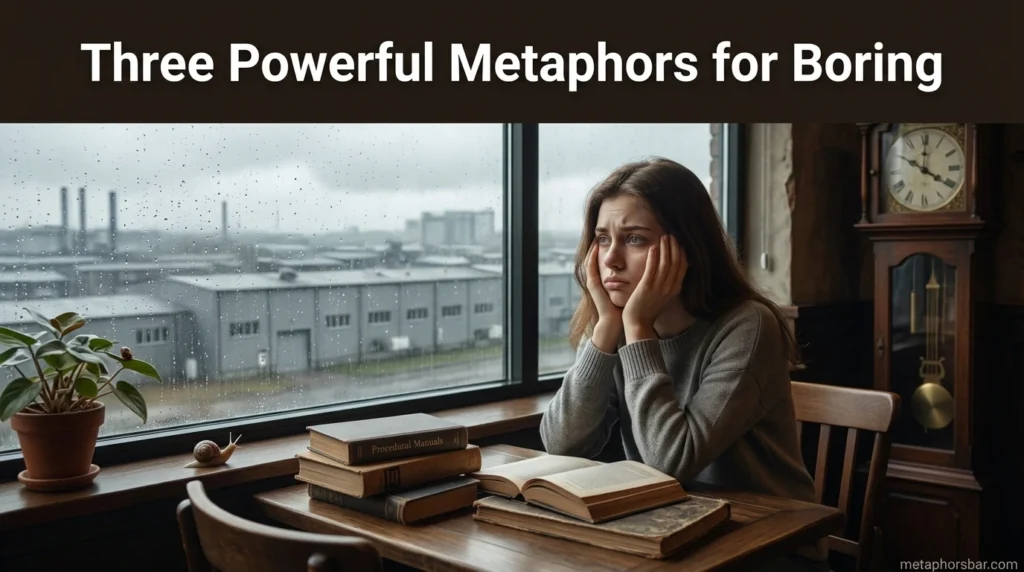
Three Powerful Metaphors for Boring
1. Boring Is a Desert Without End
One of the strongest metaphors for boredom compares it to an endless desert.
Meaning and Explanation
A desert can seem vast, repetitive, and unchanging. When something feels boring, it often appears to stretch endlessly before us with little variety or excitement.
This metaphor emphasizes monotony and the feeling that time is moving painfully slowly.
Example Sentence or Scenario
“The lecture felt like an endless desert, with no oasis of excitement in sight.”
The comparison highlights both the length and emptiness of the experience.
Alternative Ways to Express It
- a wasteland of monotony
- a sea of sameness
- an endless plain
- a dry landscape of repetition
- a journey through empty sands
Sensory and Emotional Details
Imagine hot air shimmering above endless dunes. Nothing changes. Nothing surprises you. Every direction looks the same. Emotionally, the feeling is draining and repetitive.
Mini Storytelling Example
A student preparing for an exam spent hours reading the same technical manual. By page fifty, every paragraph felt identical. The book became an endless desert where interesting ideas were rare oases.
Literary and Cultural Reference
Deserts frequently symbolize isolation, hardship, and emotional emptiness in literature, making them perfect metaphors for dull experiences.
2. Boring Is Watching Paint Dry
This classic metaphor remains popular because it instantly communicates extreme dullness.
Meaning and Explanation
Paint drying is a slow process with very little visible action. Comparing something to watching paint dry suggests that it lacks movement, excitement, or meaningful change.
Example Sentence or Scenario
“The meeting was like watching paint dry on a wall nobody cared about.”
The image immediately conveys frustration and impatience.
Alternative Ways to Express It
- slower than drying paint
- as exciting as drying cement
- motionless as a blank wall
- dull as a silent hallway
- lifeless as an empty room
Sensory and Emotional Details
Imagine sitting in silence, staring at a wall while waiting for paint to dry. The room feels still. Time seems frozen. The boredom becomes almost tangible.
Mini Storytelling Example
An employee attended a three-hour presentation filled with endless charts and statistics. By the second hour, even the sound of the air conditioner seemed more interesting than the slideshow.
Real-Life Connection
Many people use this metaphor in everyday conversation because it humorously exaggerates how slow and uneventful something feels.
3. Boring Is a Broken Record
This metaphor focuses on repetition and predictability.
Meaning and Explanation
A broken record repeats the same section over and over again. Similarly, boring situations often feel repetitive and lacking in novelty.
This metaphor works especially well when describing repetitive conversations, routines, or stories.
Example Sentence or Scenario
“His speech was a broken record, repeating the same points again and again.”
The comparison highlights the frustrating nature of repetition.
Alternative Ways to Express It
- a loop that never ends
- a song stuck on repeat
- an echo trapped in a room
- a wheel spinning in place
- a repetitive drumbeat
Sensory and Emotional Details
Imagine hearing the same few seconds of music replay endlessly. What was once enjoyable becomes irritating and exhausting.
Mini Storytelling Example
Every family gathering included one relative telling the exact same story. Everyone smiled politely, but internally they knew every sentence before it arrived.
Cultural Reference
The broken-record metaphor comes from vinyl records that would repeat when damaged. Even in the digital age, the image remains widely understood.
How to Use Metaphors for Boring Effectively
Match the Situation
Choose metaphors that fit the context.
For example:
- Desert = long and empty
- Paint drying = painfully slow
- Broken record = repetitive
Avoid Overusing Clichés
Classic metaphors work well, but creating your own can make writing more memorable.
Combine Metaphors with Details
Add sensory descriptions to strengthen the image.
Example:
“The conference room felt like an endless desert, where every slide was another dune of information.”
Use Them Sparingly
Too many metaphors can overwhelm readers. A few strong comparisons often have the greatest impact.
Creative Writing Exercises for Metaphors for Boring
Exercise 1: Complete the Metaphor
Finish this sentence:
“The experience was as boring as ______.”
Examples:
- a train station with no trains
- a movie paused forever
- a road with no destination
Try creating five original answers.
Exercise 2: Turn Ordinary Into Creative
Rewrite these sentences using metaphors:
- The class was boring.
- The speech was boring.
- The book was boring.
Example:
“The class was an endless hallway with no doors.”
Exercise 3: Create a New Boredom Metaphor
Think about:
- an object
- a place
- a sound
How could it symbolize boredom?
Example:
“Boredom was a candle that refused to burn faster.”
Exercise 4: Social Media Caption Challenge
Create a funny caption using a boredom metaphor.
Examples:
- “This meeting is a snail taking a nap.”
- “Today’s workload feels like a treadmill going nowhere.”
Bonus Tips for Using Metaphors for Boring
In Fiction Writing
Use metaphors to reveal character emotions rather than simply stating them.
In Humor Writing
Exaggerated boredom metaphors often create comedic effects.
On Social Media
Funny comparisons can make relatable content more engaging.
Example:
“My internet connection today is a sleepy turtle crossing a glacier.”
In Everyday Conversation
Creative metaphors make ordinary stories more entertaining.
In Poetry
Boredom can become surprisingly beautiful when described through imaginative imagery.
Common Mistakes When Creating Metaphors for Boring
Making Comparisons Too Complicated
Simple metaphors are usually more effective.
Using Unclear Images
Readers should immediately understand the comparison.
Repeating the Same Metaphor
Mix different images to keep your writing fresh.
Ignoring Context
Choose a metaphor that matches the specific type of boredom being described.
Why Metaphors for Boring Improve Creative Writing
They Show Rather Than Tell
Readers experience the feeling instead of simply being informed about it.
They Create Memorable Imagery
Unique metaphors stay in readers’ minds longer.
They Add Emotional Impact
Strong comparisons help readers connect with the experience.
They Encourage Creativity
Creating metaphors develops stronger writing and storytelling skills.
FAQs
1. What is a metaphor for boring?
A metaphor for boring is a figurative comparison that represents dullness or monotony through vivid imagery, such as an endless desert or a broken record.
2. Why use metaphors instead of simply saying “boring”?
Metaphors create stronger imagery, emotional impact, and reader engagement.
3. What is the most common metaphor for boring?
“Watching paint dry” is one of the most widely recognized metaphors for boredom.
4. Can boring metaphors be humorous?
Yes. Many boredom metaphors use exaggeration to create humor and relatability.
5. Are metaphors for boring useful in fiction?
Absolutely. They help show a character’s emotional experience without directly stating it.
6. How can I create my own metaphor for boring?
Think about something slow, repetitive, empty, or unchanging and compare it to the boring experience.
7. Can metaphors for boring be used in social media content?
Yes. Creative and funny metaphors often make posts more engaging and shareable.
Conclusion
Boredom may seem like an uninteresting topic, but creative metaphors can transform it into something vivid and memorable. Whether you describe boredom as an endless desert, watching paint dry, or a broken record, metaphors help readers experience the feeling rather than merely understand it.
The best metaphors for boring do more than describe monotony—they reveal the emotions hidden within it. They capture the slow crawl of time, the frustration of repetition, and the emptiness of uninspiring moments. At the same time, they make writing richer, more colorful, and far more engaging.
The next time you encounter something dull, don’t just call it boring. Look for the image, object, or experience that perfectly captures the feeling. You may discover that even boredom can inspire surprisingly creative language.